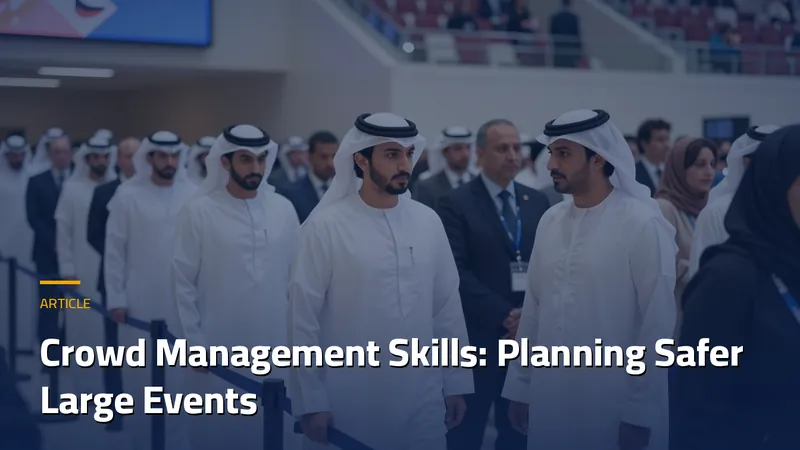
Crowds rarely turn dangerous without warning. Pressure builds at a gate, a queue spills into a walkway, weather shifts, or a small disturbance spreads faster than staff can react. What usually separates a smooth gathering from a serious incident is the quality of planning done long before the doors open, not the number of people standing at the entrance on the day.
What does crowd management actually involve?
Crowd management is often treated as a staffing problem: put enough people at the entrances and issues get handled. In practice, crowd safety depends on how space is designed, how information reaches people, how behaviour is monitored, and how quickly a team can decide what to do next. A barrier in the wrong place, an unclear exit route, or a slow read of a changing crowd mood can create risk that no number of stewards fixes on the day itself.
Treating crowds as a system rather than a headcount is what turns event safety from guesswork into a repeatable practice, one that gives organisers a way to anticipate problems instead of only reacting to them.
What skills does safe crowd management require?
Across event types, the same core skills recur:
- Event safety planning – building safety into a gathering's design from the start, instead of adding it once the layout is fixed.
- Space and barrier design – placing barricades and general admission areas so movement is guided, not blocked or bottlenecked.
- Crowd behaviour monitoring – keeping situational awareness so early warning signs are noticed and acted on before they escalate.
- Risk assessment – identifying where density, flow or specific event conditions could create danger, and building controls around them.
- Emergency and disturbance response – preparing for severe weather, civil disturbances and other incidents with a clear, rehearsed plan.
- Cross-agency coordination – aligning security, operations, venue staff and public authorities so everyone works from the same plan when conditions change quickly.
None of these skills works well in isolation. A perfect barrier plan does little if nobody is monitoring behaviour, and a strong monitoring routine is wasted if the emergency response behind it is unclear.
These skills also scale differently depending on venue and format. A ticketed indoor venue with fixed capacity limits relies heavily on barrier design and queue management, while an open-air festival depends more on monitoring, weather response and coordination across multiple entry points spread over a wide area. Recognising which combination of skills matters most for a specific venue is itself part of the discipline, rather than applying one fixed template to every gathering.
Who needs these skills, and who doesn't?
These skills matter most for event planners responsible for layout and flow, security managers leading teams on the ground, venue and site managers hosting gatherings of different sizes, and public safety officials who oversee or approve large events. They also matter to public relations and communications staff, since clear messaging to a crowd is a safety tool as much as a branding one. Even organisations that rarely host large gatherings benefit from a working knowledge of these principles once an unusually large event is on the calendar.
They are less relevant for roles with no involvement in gatherings or public spaces at all. If your work never puts you near queue design, entry flow or crowd behaviour, a general workplace safety course is likely to be a better starting point than specialist crowd training.
How does this play out during a real event?
Picture a venue expecting a much larger crowd than usual for a one-off event. Without a structured approach, teams often respond to problems as they appear: a queue backs up, a gate gets congested, and stewards improvise. With crowd management skills applied properly, the same situation looks different. The site plan is reviewed in advance for pinch points and weak exit routes. Barriers and general admission areas are designed to guide movement, not just contain it. Monitoring is set up so a shift in crowd mood is noticed early, and a response plan for disturbances or sudden weather changes already exists rather than being improvised on the spot.
That shift, from reacting to planning, is exactly what Managing Crowds During Events: Training to Secure Crowds Using DIME-ICE Model is built around, giving event and security professionals a structured model for planning safe spaces, monitoring behaviour and managing emergencies as one connected process.
How do you choose the right training path?
Crowd safety has more than one angle, and the right starting point depends on your role. For teams whose main concern is risk assessment, control measures and compliance with legal standards, Managing crowds safely : An Ultimate Crowd Safety Course goes deeper into structured risk assessment and emergency response planning, useful for event organisers, facility managers and safety officers who need to demonstrate that safety was planned systematically.
For teams running recurring high-density operations at stadiums, arenas or outdoor grounds, Crowd Management for Sport, Concerts, Festivals & Special Events covers an operational framework spanning crowd dynamics, access control, queue design, perimeter control and cross-agency coordination for live sporting and entertainment settings. A practical path for many teams is to build the broad, model-based foundation first, then add the deeper risk-assessment or operational layer that matches the type of events they run most often.
Bottom line
Crowd management is not a single skill but a set of them working together: planning, design, monitoring, and response, backed by coordination across every team involved. Building that full set, rather than relying on experience alone, is what turns a gathering that could go wrong into one that runs the way it was planned to. Check the course pages linked above for the full syllabus, upcoming dates and fees.
Frequently asked questions
Is crowd management only relevant to security teams?
No. Event planners, venue managers, public safety officials and even communications staff all play a role, since crowd safety depends on layout, monitoring and messaging as much as physical security.
What is the difference between crowd management and crowd control?
Crowd management is the proactive planning that keeps a gathering safe before problems start, while crowd control refers to the direct, tactical response used once a crowd is already agitated or disordered.
Do small or one-off events need formal crowd management planning?
Scale changes what is needed, but the same logic applies: reviewing the site for pinch points, planning barriers and exits, and having a basic response plan reduces risk even at a smaller gathering.
How does weather factor into crowd management planning?
Sudden weather changes can shift crowd movement and behaviour quickly, which is why severe weather response is treated as a specific planning area alongside general emergency management.
Can these skills apply outside entertainment and sports events?
Yes. The same principles of space design, monitoring and emergency response apply to corporate gatherings, exhibitions, hospitality venues and any setting where people gather in large numbers.