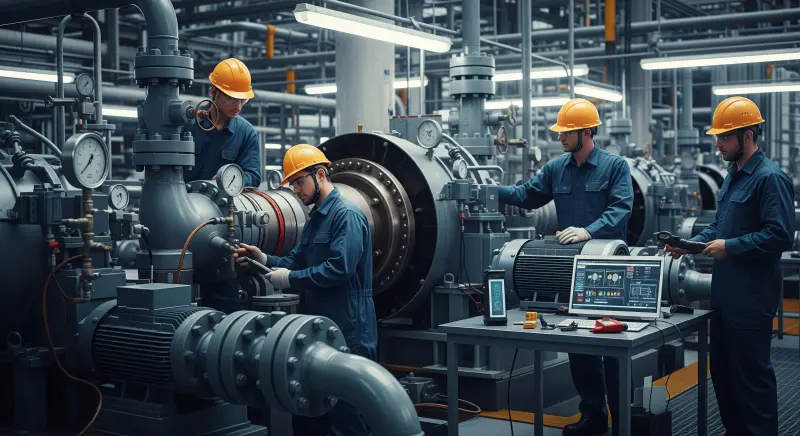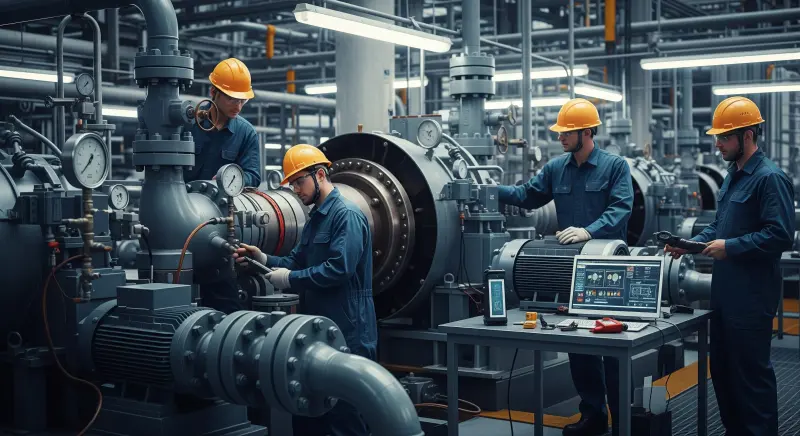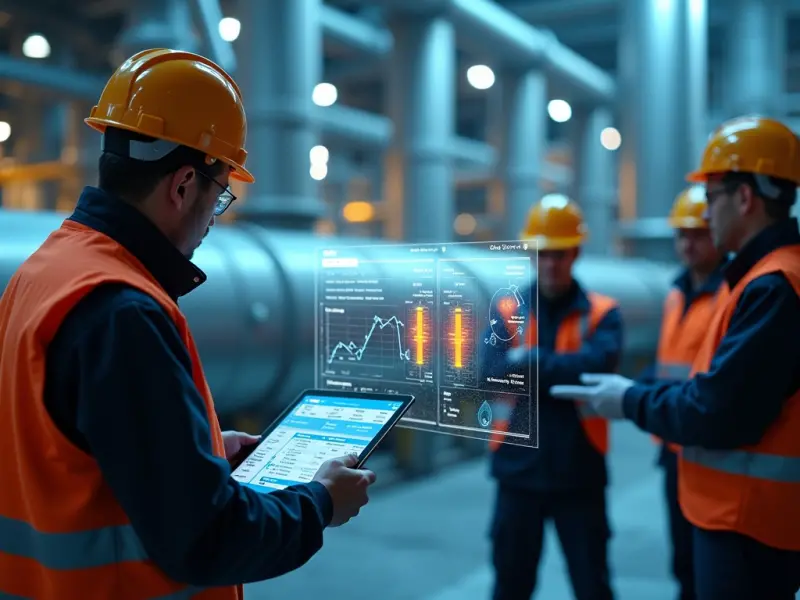
Short answer: yes, if you work with rotating equipment or flow metering on an oil and gas site. Hands-on training in this area pays off fastest for maintenance engineers, reliability technicians, and instrumentation specialists who are already responsible for keeping compressors, pumps, and flow meters running day to day. It pays off far more slowly for someone with no exposure to the equipment floor, since the real value of the training is in connecting theory to the failures and readings they already see at work.
The people who benefit most are teams who are tired of being surprised: an unplanned compressor trip, a pump seal that fails without warning, or a metering number that will not reconcile when the shift log is reviewed. The rest of this article breaks down exactly what these skills let you do on the job, who should build them, and how they show up in a normal working week.
What will you be able to do afterwards?
Training built around rotating equipment and flow measurement is deliberately practical. It is less about naming parts and more about building judgment: what a reading or a sound actually means, and what to do next. Once the training is complete, a participant can typically:
- Recognize early warning signs of compressor and pump trouble, such as abnormal vibration, unusual noise, or a drop in output, before they become a shutdown.
- Apply predictive maintenance routines instead of waiting for a breakdown, including basic vibration monitoring and condition checks on rotating machinery.
- Explain the operating principles and common failure modes of reciprocating, centrifugal, and other compressor and pump types used across oil, gas, and petrochemical sites.
- Read and sanity-check flow meter outputs, including differential pressure, ultrasonic, Coriolis, and turbine devices, and spot a reading that is drifting rather than accurate.
- Support calibration, verification, and troubleshooting of measurement systems without needing to escalate every irregularity to a specialist.
- Put together a clearer, evidence-based case for maintenance budget or equipment replacement, built on diagnostic data rather than a hunch.
None of this depends on becoming a vibration analysis expert or a metrology specialist overnight. It depends on building enough structured knowledge that the signals equipment already gives off stop being noise and start being information.
Who is it for, and who is it not for?
This kind of training fits people who already stand near the equipment or the data it produces: maintenance and reliability engineers, rotating equipment technicians, instrumentation and measurement specialists, process engineers who need to interpret flow and pressure data, and supervisors who sign off on maintenance or metering decisions. It also suits anyone moving into a technical role that now includes compressors, pumps, or flow measurement as part of the job description.
It is a weaker fit for people who have no current or planned exposure to the equipment floor, such as purely administrative or commercial staff. It is also not the right starting point for someone who wants a one-hour introduction rather than structured, hands-on practice; the value here comes from working through real operating problems, not from a quick overview. If your team mostly needs awareness rather than hands-on skill, a shorter internal briefing will serve them better than a full course.
How do these skills play out on a typical shift?
Picture a reliability technician who notices a slight increase in vibration on a reciprocating compressor during a routine round. Without training, the instinct is often to either ignore it until something fails, or to raise an alarm that turns out to be unnecessary. With the right background, the technician instead checks the vibration pattern against known failure signatures, looks at recent maintenance history, and decides whether this is a lubrication issue, a loose mounting, or an early bearing problem, then plans an intervention before the next scheduled outage.
The same logic applies to flow measurement. A process engineer reviewing daily production figures notices that a meter's readings have shifted slightly compared to a parallel line, with no obvious operational reason. Someone trained in flow measurement principles knows to check for drift, fouling, or a calibration issue before assuming the production number itself is wrong, protecting both the operation and the fiscal accuracy of the data that gets reported upward. In both cases, the skill is the same: turning a small anomaly into a specific, testable explanation instead of a guess.
Which skills fit a rotating equipment role, and which fit a measurement role?
Not every team needs the same depth in the same areas, which is why it helps to separate the two skill tracks rather than treat "technical training" as one block. For teams focused on keeping compressors and pumps running, Compressor and Pump Technology for Oil and Gas Operations builds the practical troubleshooting and maintenance foundation: operating principles, selection criteria, failure modes, and common problems like cavitation, surge, vibration, and seal failure. Engineers and technicians who already have that foundation and need to go deeper into diagnostics, condition monitoring, and reliability improvement are better matched to Advanced Compressor and Pump Technology for Oil & Gas, which adds rotating equipment diagnostics, vibration analysis, and predictive maintenance strategy on top of the basics.
For teams whose main exposure is to measurement systems rather than the machinery itself, Flow Measurement Essentials for Oil and Gas Operations covers the instruments, calibration, verification, and troubleshooting skills needed to trust the numbers a meter produces. Where the role involves fiscal allocation, custody transfer, or multiphase metering, Advanced Flow Measurement: Next-Level Oil and Gas Industry Training Courses goes further into uncertainty budgets, meter station design, and diagnostic field logging. Many reliability and process teams end up sending different people to different tracks, which keeps each course focused rather than trying to cover everything at once.
Bottom line
Rotating equipment and flow measurement skills are worth building for anyone whose daily work already touches compressors, pumps, or metering systems, because the return shows up directly in fewer surprises and more trustworthy data. They are a poor use of training budget for people without that exposure, who are better served by a general orientation first. Check the course page for the full syllabus, upcoming dates and fees.
Frequently asked questions
Do I need an engineering degree to benefit from this training?
No. The material is built for working technicians and engineers alike; what matters more is day-to-day exposure to the equipment or the data, not the qualification on paper.
Can a technician with no formal measurement background follow the flow measurement material?
Yes, as long as they already work around metering or production data in some form. The course builds from operating principles up, rather than assuming prior instrumentation theory.
Will this still help if my site already runs a reliability program?
Usually yes. A site-level program defines the process; the individual still needs the diagnostic judgment to act on what the equipment is showing, which is what this training builds.
How is this different from general mechanical maintenance training?
General maintenance training tends to stay broad. This track goes deep specifically on compressors, pumps, and flow measurement, including the failure modes and reliability practices particular to oil and gas operations.
Is this useful for someone moving from operations into maintenance?
Yes. It gives operations staff who are shifting into a maintenance or reliability role the technical vocabulary and diagnostic habits they will need, rather than leaving them to pick it up informally on the job.
Should a supervisor who does not do hands-on work still take this training?
It helps if the supervisor signs off on maintenance decisions or budget requests, since understanding the diagnostic reasoning makes it easier to judge when a technician's recommendation is sound.