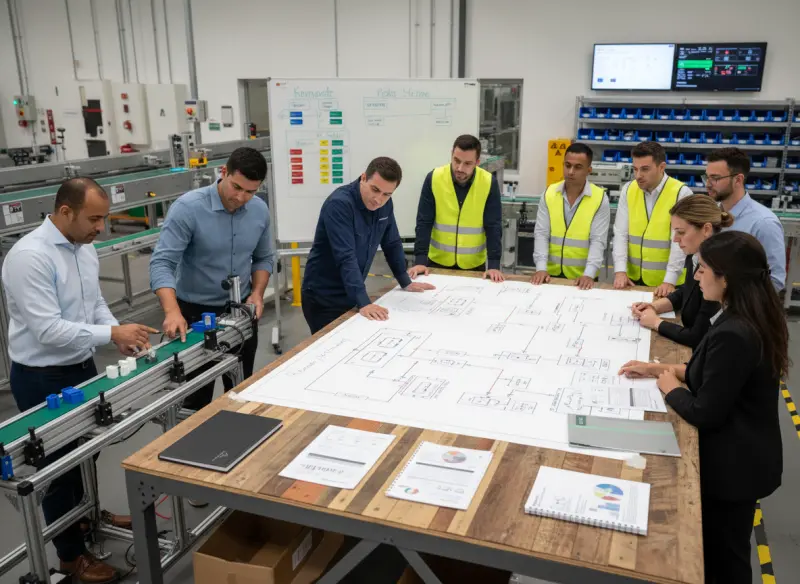
Procurement and contract teams are under pressure to do more with the same headcount, and artificial intelligence is being pitched as the answer to almost every bottleneck: spend analysis, supplier risk, contract review, even logistics exceptions. The honest answer is more specific than the pitch. AI is genuinely good at scanning large volumes of spend, supplier, contract and shipment data, surfacing patterns a human would take hours to find, and drafting a first-pass analysis that someone then checks. It is not good at making the final call on which supplier to award, which clause to accept, or which operational risk is worth taking. Those decisions still belong to the people who own the outcome, not to the model that flagged the pattern.
Procurement managers, sourcing specialists, contract administrators, supply chain planners and legal operations teams benefit most from learning to work this way, because they are the ones sitting on the data AI is best at processing: purchase orders, supplier scorecards, contract clauses and exception logs that pile up faster than any team can review line by line.
What will you be able to do afterwards?
Training built around AI in procurement and contracting is not about learning to prompt a chatbot. It is about building the judgment to use AI output safely inside a workflow that still has a human sign-off at the end. After this kind of training, a procurement or contract professional can typically:
- Validate an AI-generated signal against the underlying spend, supplier or contract data before acting on it.
- Manage exceptions: decide which flagged anomaly needs attention now and which can wait.
- Compare scenarios side by side, such as alternative suppliers, lanes or clause positions, instead of reviewing them one at a time.
- Extract clauses and obligations from long contracts and trace each finding back to the exact source text.
- Spot red flags in supplier, contract or counterparty data and prioritise which ones go to a human reviewer first.
- Keep confidential and commercially sensitive material out of the wrong hands while still using AI tools day to day.
- Assign accountable actions once an AI-assisted review is done, so nothing stays flagged without an owner.
Who is it for, and who is it not for?
This kind of training suits people who already own a procurement, sourcing, logistics, contract or compliance process and want to apply AI tools to it responsibly. That includes procurement managers and buyers responsible for sourcing events and supplier selection, category managers who own category strategy and supplier continuity, logistics and supply chain planners dealing with demand, inventory and transport exceptions, contract managers and administrators responsible for clauses, notices and obligations, and legal operations, compliance and internal audit staff who need AI-assisted review to hold up under scrutiny.
It is a poor fit for two groups. The first is anyone looking for a general introduction to artificial intelligence with no connection to procurement or contract work; that is a different course entirely. The second is anyone hoping AI training will let them skip the judgment calls altogether. Every course built around AI-assisted review keeps a human sign-off in the loop by design, because that is what makes the output defensible when a supplier disputes a decision or a contract obligation is challenged.
Where does AI actually help, and where does it not?
AI earns its place in procurement and contracting wherever the task is high-volume, pattern-based and repetitive: scanning hundreds of invoices for anomalies, classifying spend into categories, checking a contract against a standard clause library, or watching inventory and lead-time data for early signs of a supplier problem. The AI for Procurement: Spend Analytics, Sourcing and Supplier Risk course is built around exactly this layer of work, applying machine learning and generative AI to each stage of the source-to-pay cycle, from spend classification through to supplier risk monitoring, with governance built into every step rather than bolted on afterwards.
AI is weaker, and arguably should stay out of the room entirely, wherever the task is a judgment call that carries real consequences: deciding which supplier gets the award when the data is ambiguous, deciding whether a shipment delay justifies invoking a penalty clause, or deciding how to handle a logistics exception that has no precedent in the training data. The AI Procurement and Logistics Operations Course is explicit about this boundary: it trains participants to connect demand, supplier, inventory and transport signals, compare scenarios and validate AI-assisted findings, but the accountable action is always assigned to a named person, never left to the system.
How does a procurement team start applying this at work?
Picture a mid-sized organisation whose procurement team has started using an AI tool to flag unusual spend patterns and a separate tool to pre-screen incoming supplier contracts. Within a few weeks, the flags pile up faster than anyone can review them, and the team is quietly ignoring half of them just to keep up. That is the exact failure mode this kind of training is built to prevent: it is not enough to turn a tool on, people need a structured way to triage what it produces.
The practical fix usually starts on the contract side, where the volume problem is often worst. A course such as the AI-Assisted Contract Management Foundation Training Course builds a toolkit for exactly this: preparing contract data so an AI tool can read it reliably, extracting clauses and obligations, flagging contract risk, and monitoring obligations on an ongoing basis with source verification and human approval at each step, so a flagged clause always comes with the exact passage it was flagged from. For teams running due diligence on new suppliers, counterparties or transactions, the same discipline applies at a deeper level: the AI-Assisted Contract Due Diligence Review Course covers scoping a review, inventorying documents, tracing every AI-flagged finding back to its source, assessing counterparty risk, protecting confidential material, and requiring legal sign-off before anything is acted on.
Once that triage discipline is in place for contracts, the same approach extends naturally to spend data, supplier scorecards and logistics exceptions: flag, validate against the source, compare the realistic options, and assign the decision to a named owner. Teams that skip the validation step are the ones who end up explaining to a supplier, an auditor or a board why an AI tool made a call nobody actually checked.
Bottom line: AI is a genuine productivity gain for the high-volume, pattern-based parts of procurement, sourcing, logistics and contract work, and a liability wherever it is left to make the judgment call alone. The teams that benefit are the ones who build a structured, human-checked process around the tool rather than simply switching it on. Check the course page for the full syllabus, upcoming dates and fees.
Frequently asked questions
Does AI replace procurement or contract judgment?
No. AI is good at scanning data and flagging patterns, but deciding which supplier to award, which clause to accept or which risk to take still has to be made by a person who owns the outcome.
What kind of data does AI need to be useful in procurement?
It needs structured, accessible spend, supplier, contract or logistics data. The more consistent the underlying records, the more reliable the patterns AI can surface for a human to check.
How is AI-assisted contract review different from a chatbot summarising a document?
A proper review traces every flagged clause or obligation back to the exact source text, so a reviewer can verify it, rather than trusting a summary with no citation.
Can AI monitor supplier risk without human involvement?
It can watch for signals continuously, but confirming whether a flagged supplier issue is real and deciding what to do about it stays a human responsibility.
What happens when an AI tool flags something with no clear owner?
That is the gap this kind of training closes: every flagged item needs an accountable person assigned to it, or it sits unresolved while the backlog grows.