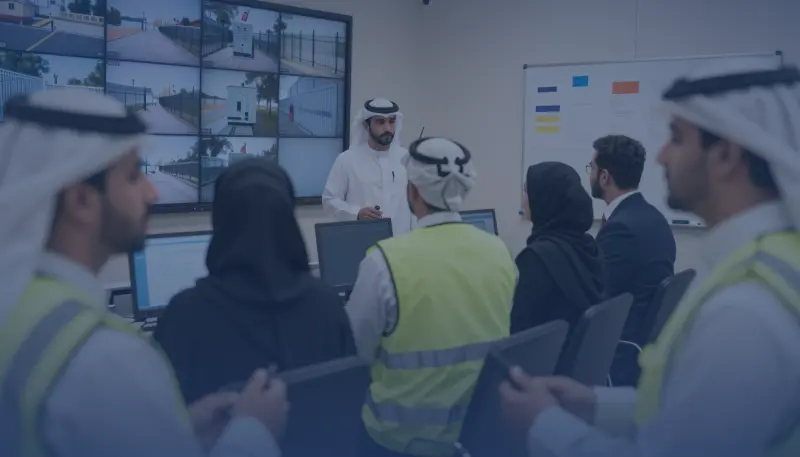
Critical infrastructure protection breaks down when teams secure one layer — the perimeter, the network, or a single asset — without mapping how essential services actually depend on each other. The fix is treating protection as one connected discipline: criticality, threats, layered controls, incident response and recovery planned together, not patched on after the fact.
The organizations that get this right are not necessarily the ones with the biggest security budget. They are the ones that stopped treating protection as a collection of separate projects — a fence here, a firewall there, a crisis plan in a drawer — and started treating it as one sequence: know what matters, know what threatens it, control it in layers, respond fast when something slips through, and recover the most essential services first.
This is not a problem unique to large national utilities. A mid-sized logistics hub, a regional data center, a port terminal and a hospital network face the same structural gap, just at a different scale: whoever owns the overall picture usually finds out it never existed the moment something goes wrong across more than one function at once.
What Will You Be Able to Do Afterwards?
Training in this area is only useful if it changes what you can actually do back at work. Done properly, it leaves a team able to:
- Map which services, assets and dependencies actually count as "critical" to the organization, instead of relying on whoever shouts loudest in a planning meeting.
- Run a threat and hazard assessment that covers physical, digital, supply-chain and operational exposure together, rather than three separate assessments that never talk to each other.
- Design layered protective controls — perimeter, access, monitoring, digital — that match each asset's real exposure, instead of applying the same checklist everywhere.
- Coordinate an incident response across security, IT, operations and facilities teams, so the first hour of a real incident is not spent working out who is in charge.
- Set continuity and recovery priorities so the most essential services come back online first, with a documented order rather than a guess under pressure.
- Build an assurance routine that keeps checking whether protective controls still work, instead of assuming a control installed once is a control that still functions.
Participants who want a structured way to build all of this in one sequence usually look at something like the Critical Infrastructure Protection and Resilience Course, which links asset criticality, dependency mapping, protective controls, incident coordination, continuity and recovery into a single improvement plan rather than separate exercises.
Who Is It For, and Who Is It Not For?
This work suits people who sit across more than one part of the problem: security leads who also have to think about continuity, facility managers who also have to think about crisis command, operations managers who have just been handed responsibility for an "essential service" and are not sure what that actually means day to day.
It is a good fit for:
- Security, continuity, risk and operations professionals responsible for protecting essential services and critical assets.
- Functions coordinating operational resilience, continuity and emergency planning.
- Facility, intelligence, HSE and government-coordination teams who need practical facility-level controls alongside crisis command, which is exactly the ground covered by the Critical Infrastructure Protection, Facility Security & Crisis Management course.
- Engineers and asset-integrity professionals who protect physical assets rather than data or buildings — a corroded structural asset is just as disruptive to an essential service as a breached network, which is why the Port Infrastructure Cathodic Protection Management Training Course belongs in the same conversation, not a separate one.
It is a weaker fit for someone who needs one narrow technical skill in isolation — a single tool, a single certification topic — and has no responsibility for how that piece connects to the wider service. This is cross-functional work by design: it is for people who have to make the parts fit together, not just operate one of them.
How Do You Put This Into Practice at Work?
Picture a mid-sized operator that has never had a serious incident. Security owns the cameras and the access control. IT owns the network. Facilities owns the building. Each function can tell you, in detail, how its own piece is protected. None of them can tell you, in one sentence, which three failures would actually stop the essential service from running.
That is the gap this kind of training closes first. The practical starting point is not a new control; it is a criticality and dependency exercise, done with people from every function in the room at once, that answers one question: if this failed, what else fails with it? Once that map exists, the threat assessment, the control design and the incident plan all have something real to attach to, instead of being written against a generic checklist.
From there, the habit that actually sticks is the assurance step — going back on a regular rhythm and asking whether the controls agreed on paper are still the controls running in reality. Teams that skip this step tend to discover their gaps during an incident. Teams that build it in discover them during a routine check, which is a much better place to find them.
Bottom Line
Critical infrastructure protection fails when it is built as a set of disconnected projects instead of one discipline that runs from criticality mapping through to recovery. It works when a cross-functional team shares one map of what matters, one set of layered controls, one incident plan and one recovery order. Check the course page for the full syllabus, upcoming dates and fees.
Frequently asked questions
Is critical infrastructure protection only about cybersecurity?
No. It covers physical security, digital security, supply-chain exposure and operational resilience together. Treating it as purely a cyber problem is one of the most common mistakes teams make.
Do we need a dedicated team for this, or can existing roles cover it?
Most organizations build on existing security, continuity, risk and facilities roles rather than creating a new function. What usually changes is how those roles coordinate, not who is hired.
What is the single most common mistake in critical infrastructure protection?
Protecting assets in isolation without mapping how services depend on each other, so nobody can say which failures would actually disrupt the essential service.
How is physical asset integrity, like corrosion management, part of this picture?
A structural or asset failure can take an essential service offline just as effectively as a security breach. Programs that only plan for deliberate attacks and ignore gradual physical degradation leave a real gap.
Can a smaller organization realistically do all of this?
Yes, scaled to its own size. The sequence — know what matters, know the threats, control it in layers, respond, recover, check again — applies whether the asset base is small or large.
Where should a team start if nothing like this exists yet?
With the criticality and dependency mapping exercise. Every other step is easier, and more accurate, once that exists.