Applied AI for Data Analysis, Automation and Decision-Making
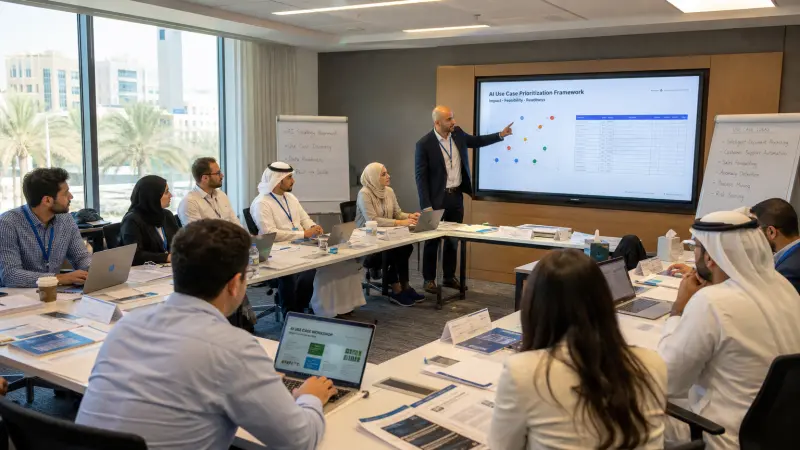
At a glance
- Duration
- 5 days
- Format
- Classroom
- Cities
- Casablanca, Amsterdam, Geneva, Milan, Nice, Abu Dhabi and more
- Next session
- 12 – 16 October 2026, Casablanca
- Average fee
- 5,800 €
Course Overview
The Applied AI for Data Analysis, Automation and Decision-Making course is a practical corporate Artificial Intelligence Training Course designed to strengthen analytical, automation, systems-analysis, and decision-support capabilities. It is particularly relevant as AI for Computer Analysts, Artificial Intelligence for Computer Analysts, and an Applied AI Course for Computer Analysis Professionals, while remaining suitable for broader technical, data, and operational roles.
The course introduces machine-learning workflows, AI-powered data analysis, predictive analytics, generative AI, intelligent automation, human-centered systems, and responsible AI governance. Participants examine how data moves from collection and preparation through model development, evaluation, deployment, and continuous improvement. The programme also connects AI initiatives to measurable organizational outcomes through business requirements, KPIs, process improvement, and technology-driven decision-making.
The content reflects the AI and data analytics lifecycle described in the AIDA Guidebook, including machine-learning methodology, data management, KPIs, human-machine interaction, organizational change, privacy, security, and governance. It also incorporates the NIST AI Risk Management Framework approach to governing, mapping, measuring, and managing AI risks throughout the system lifecycle.
Through applied exercises and business cases, participants learn to identify viable AI opportunities, assess data readiness, redesign processes for automation, evaluate AI outputs, and recommend intelligent solutions that improve accuracy, efficiency, service quality, and managerial decision-making.
Target Audience
- Computer Analysts and Systems Analysts
- Data Analysts and Business Intelligence Analysts
- Business Systems Analysts
- Application and Software Analysts
- Process Improvement Analysts
- Automation and Digital Transformation Specialists
- Information Systems Specialists
- Technology Project Coordinators
- Database and Reporting Specialists
- Technical Business Analysts
- Operations Analysts
- Professionals seeking Computer Analyst AI Training
Targeted Organizational Departments
- Information Technology and Information Systems
- Data Analytics and Business Intelligence
- Digital Transformation and Innovation
- Business Process Management
- Strategy and Corporate Planning
- Operations and Service Delivery
- Enterprise Architecture
- Software Development and Applications
- Risk, Compliance and Information Governance
Targeted Industries
- Banking, Financial Services and Insurance
- Government and Public Administration
- Telecommunications and Technology
- Healthcare and Life Sciences
- Manufacturing and Industrial Operations
- Energy, Utilities and Oil and Gas
- Transportation and Logistics
- Retail and E-Commerce
- Education and Research
Course Offerings
By the end of this course, participants will be able to:
- Explain the practical roles of artificial intelligence, machine learning, generative AI, predictive analytics, and intelligent automation.
- Translate business and systems requirements into viable AI and analytics use cases.
- Apply Data Analysis with Artificial Intelligence to identify trends, patterns, anomalies, and operational insights.
- Assess data availability, quality, relevance, privacy, and readiness for AI applications.
- Distinguish between supervised, unsupervised, predictive, and generative AI approaches.
- Design conceptual machine-learning pipelines covering data preparation, model training, validation, deployment, and monitoring.
- Use AI-Powered Data Analysis to improve reporting, forecasting, classification, and decision support.
- Identify processes suitable for Business Process Automation with AI.
- Prioritize automation opportunities using business value, feasibility, risk, and performance criteria.
- Design AI-Driven Decision Support Systems that augment rather than replace informed human judgment.
- Apply human-in-the-loop principles when designing Human-Centered AI Systems.
Training Methodology
The course uses a practical, workplace-oriented learning methodology combining instructor-led explanation, guided analysis, case studies, group work, scenario exercises, system-design discussions, and feedback sessions. Each major concept is connected to realistic organizational challenges such as inefficient reporting, repetitive workflows, inconsistent data quality, delayed decisions, unstructured documents, prediction requirements, and the need for responsible AI controls.
Participants work through an end-to-end AI use-case methodology. They begin by defining a business problem, identifying users and stakeholders, establishing measurable goals, assessing data requirements, selecting an appropriate AI approach, and evaluating possible operational risks. The human-centered machine-learning material emphasizes stakeholder involvement, measurable success criteria, responsible data collection, iterative testing, and human review throughout the system lifecycle.
For intelligent automation exercises, participants distinguish processes, procedures, and tasks before selecting automation candidates. This reflects business-process automation guidance that recommends treating automation as a business-analysis and change-management initiative rather than only a technology implementation.
Group activities include process mapping, data-readiness reviews, use-case prioritization, prompt design, model-evaluation discussions, risk identification, KPI definition, and implementation planning. Participants receive structured instructor feedback on the feasibility, value, governance, and human impact of their proposed solutions. Demonstrations may reference relevant AI tools, but the course remains platform-neutral and focuses on transferable analytical and implementation skills.
Course Toolbox
- AI use-case identification framework
- AI opportunity prioritization matrix
- Business problem definition template
- Data-readiness assessment checklist
- Data quality and suitability review guide
- Machine-learning lifecycle reference model
- Predictive analytics use-case canvas
- Generative AI use-case assessment template
- Prompt design and output-validation guide
- Process, procedure and task mapping template
The course may provide insights, demonstrations, examples, and comparisons of relevant AI tools. Software licenses, commercial platforms, automation tools, generative AI subscriptions, and technical products are not provided as part of the course.
Course Agenda
Day 1: Applied AI Foundations and Business Use Cases
- Topic 1: Artificial Intelligence, Machine Learning, Analytics and Automation
- Topic 2: Practical AI Applications for Computer Analysts
- Topic 3: Translating Business Problems into AI Use Cases
- Topic 4: AI for Systems Analysis and Requirements Definition
- Topic 5: Evaluating AI Value, Feasibility and Organizational Readiness
- Topic 6: Building an AI Use-Case Prioritization Matrix
- Reflection & Review: Participants review the distinctions between AI, machine learning, analytics, generative AI and automation, then present one workplace problem suitable for further AI analysis.
Day 2: AI Data Analytics and Predictive Modeling
- Topic 1: Data Collection, Preparation and Quality for AI
- Topic 2: Data Analysis with Artificial Intelligence
- Topic 3: Exploratory Analysis, Patterns, Trends and Anomalies
- Topic 4: Supervised and Unsupervised Machine Learning
- Topic 5: Predictive Analytics for Forecasting and Classification
- Topic 6: Evaluating Models and Analytical Outputs
- Reflection & Review: Participants assess a sample dataset, identify data-quality risks and select an appropriate analytical or machine-learning approach for the stated business objective.
Day 3: Generative AI and Intelligent Decision Support
- Topic 1: Generative AI Capabilities, Limitations and Use Cases
- Topic 2: Prompt Design for Analytical and Systems Tasks
- Topic 3: AI Tools for Computer Analysts
- Topic 4: Designing AI-Driven Decision Support Systems
- Topic 5: Human-Centered AI Systems and Human-in-the-Loop Controls
- Topic 6: Validating AI Outputs, Recommendations and Explanations
- Reflection & Review: Participants compare AI-generated outputs, identify unsupported conclusions or risks, and define where human review must remain within the decision process.
Day 4: AI Automation and Process Transformation
- Topic 1: Business Process Automation with AI
- Topic 2: Distinguishing Processes, Procedures and Repetitive Tasks
- Topic 3: RPA, OCR, NLP, Machine Learning and Workflow Automation
- Topic 4: Selecting Processes for Intelligent Automation
- Topic 5: Designing Human–Automation Handoffs and Exception Paths
- Topic 6: Measuring Automation Benefits, Costs and Performance
- Reflection & Review: Participants map an existing business process, identify eligible automation steps and define measurable performance improvements such as cycle time, accuracy, exception rates and service quality.
Day 5: Responsible AI, Risk Management and Implementation
- Topic 1: Responsible AI and Data Governance
- Topic 2: Privacy, Security, Fairness and Algorithmic Transparency
- Topic 3: AI Risk Management using Govern, Map, Measure and Manage
- Topic 4: AI System Evaluation and Continuous Monitoring
- Topic 5: Building an Applied AI Implementation Roadmap
- Topic 6: Presenting the AI Business Case and Final Recommendations
- Reflection & Review: Participants present a complete AI or automation proposal covering the business problem, data requirements, proposed solution, expected value, human oversight, risks, KPIs and phased implementation plan.
FAQ
What specific qualifications or prerequisites are needed for participants before enrolling in the course?
No advanced qualification in artificial intelligence, machine learning or programming is required. Participants should have a general understanding of business processes, information systems, data analysis, reporting, technology projects or operational decision-making. Familiarity with spreadsheets, databases, dashboards or process documentation is helpful but not mandatory. The course is suitable both for professionals beginning their AI learning journey and for experienced analysts seeking a structured Artificial Intelligence Training Course for Computer Analysts.
How long is each day's session, and is there a total number of hours required for the entire course?
Each day's session is generally structured to last around 4–5 hours, with breaks and interactive activities included. The total course duration spans five days, approximately 20–25 hours of instruction.
Does the course teach participants to build AI models, or to evaluate and apply them?
The course focuses primarily on applied analysis, use-case definition, data readiness, intelligent automation, model evaluation, decision support, risk management and implementation planning. Participants learn how machine-learning models and generative AI systems work at a practical level, but the programme is not designed as an advanced coding or data-science course.
This distinction is important because successful AI deployment requires more than technical model construction. It also requires clear objectives, suitable data, measurable success criteria, user involvement, privacy controls, governance, organizational readiness and continuous monitoring. The course therefore prepares participants to contribute effectively to multidisciplinary AI projects and to evaluate whether proposed solutions are useful, trustworthy and aligned with operational requirements.
How This Course is Different from Other Applied AI for Data Analysis, Automation and Decision-Making Courses
This course differs from many introductory AI programmes because it does not focus only on tool demonstrations, general AI terminology or isolated prompt-writing exercises. It combines four connected capabilities: AI-powered data analysis, intelligent automation, decision-support design and responsible system implementation.
The programme is structured around the actual responsibilities of analysts and systems professionals. Participants learn how to define requirements, assess data, analyze workflows, identify automation candidates, interpret model outputs, evaluate risks and communicate recommendations. This makes it a Professional AI Training for Computer and Systems Analysts rather than a generic awareness programme.
Its human-centered approach also distinguishes it from purely technical Machine Learning and Automation for Computer Analysts courses. Participants examine how people provide data, feedback, validation and operational judgment across the AI lifecycle. The human-centered machine-learning reference emphasizes that users and stakeholders should be involved during conceptualization, implementation, evaluation and deployment.
credits: 5 credit per day
Course Mode: full-time
Provider: Agile Leaders Training Center
-
Events for this Course
-
Casablanca 12 – 16 October 2026
-
Amsterdam 19 – 23 October 2026
-
Geneva 25 – 29 October 2026
-
Milan 26 – 30 October 2026
-
Nice 26 – 30 October 2026
-
Abu Dhabi 2 – 6 November 2026
-
Johannesburg 8 – 12 November 2026
-
Cairo 9 – 13 November 2026
-
Athens 16 – 20 November 2026
-
Dubai 23 – 27 November 2026
-
London 23 – 27 November 2026
-
Istanbul 30 November – 4 December 2026
-
Manama 6 – 10 December 2026
-
Sharm El-Sheikh 14 – 18 December 2026
-
Bali 20 – 24 December 2026
-
Barcelona 21 – 25 December 2026
-
Singapore 21 – 25 December 2026
-
Tashkent 27 – 31 December 2026
-
Tokyo 25 – 29 January 2027
-
Marbella 31 January – 4 February 2027
-
Amsterdam 8 – 12 February 2027
-
Abu Dhabi 8 – 12 February 2027
-
Cape town 14 – 18 February 2027
-
Nairobi 14 – 18 February 2027
-
Muscat 21 – 25 February 2027
-
Kuala Lumpur 1 – 5 March 2027
-
Frankfurt 1 – 5 March 2027
-
London 15 – 19 March 2027
-
Bangkok 21 – 25 March 2027
-
Rome 22 – 26 March 2027
-
Dubai 29 March – 2 April 2027
-
Cairo 5 – 9 April 2027
-
Accra 11 – 15 April 2027
-
Seoul 12 – 16 April 2027
-
Lisbon 12 – 16 April 2027
-
Vienna 19 – 23 April 2027
-
Madrid 26 – 30 April 2027
-
Doha 2 – 6 May 2027
-
London 10 – 14 May 2027
-
Paris 17 – 21 May 2027
-
New York 17 – 21 May 2027
-
Abu Dhabi 24 – 28 May 2027
-
Trabzon 30 May – 3 June 2027
-
Amsterdam 31 May – 4 June 2027
-
Porto 31 May – 4 June 2027
-
Kuwait 6 – 10 June 2027
-
Dubai 14 – 18 June 2027
-
Berlin 14 – 18 June 2027
-
Kuala Lumpur 21 – 25 June 2027
-
Toronto 27 June – 1 July 2027
-
Madrid 28 June – 2 July 2027
-
Rome 5 – 9 July 2027
-
Phuket 11 – 15 July 2027
-
Milan 12 – 16 July 2027
-
Vienna 19 – 23 July 2027
-
Amman 25 – 29 July 2027
-
Langkawi 25 – 29 July 2027
-
Chicago 1 – 5 August 2027
-
Abu Dhabi 2 – 6 August 2027
-
Tbilisi 9 – 13 August 2027
-
Dubai 16 – 20 August 2027
-
Paris 16 – 20 August 2027
-
Jakarta 23 – 27 August 2027
-
San Diego 23 – 27 August 2027
-
Baku 30 August – 3 September 2027
-
Zanzibar 5 – 9 September 2027
-
Barcelona 6 – 10 September 2027
-
Zoom 13 – 17 September 2027
-
Manama 26 – 30 September 2027
-
London 27 September – 1 October 2027
-
Istanbul 4 – 8 October 2027
-
Prague 11 – 15 October 2027
-
Munich 11 – 15 October 2027
-
Montreux 11 – 15 October 2027
| Image | Location | Dates | Duration | Mode | Price | Actions |
|---|---|---|---|---|---|---|

|
Casablanca |
Week 42, 2026 12 – 16 October 2026 |
5 Days | Onsite | €4,100 | |

|
Amsterdam |
Week 43, 2026 19 – 23 October 2026 |
5 Days | Onsite | €5,700 | |

|
Geneva |
Week 43, 2026 25 – 29 October 2026 |
5 Days | Onsite | €6,200 | |

|
Milan |
Week 44, 2026 26 – 30 October 2026 |
5 Days | Onsite | €5,700 | |

|
Nice |
Week 44, 2026 26 – 30 October 2026 |
5 Days | Onsite | €5,700 | |

|
Abu Dhabi |
Week 45, 2026 2 – 6 November 2026 |
5 Days | Onsite | €4,700 | |

|
Johannesburg |
Week 45, 2026 8 – 12 November 2026 |
5 Days | Onsite | €4,500 | |

|
Cairo |
Week 46, 2026 9 – 13 November 2026 |
5 Days | Onsite | €4,100 | |

|
Athens |
Week 47, 2026 16 – 20 November 2026 |
5 Days | Onsite | €6,700 | |

|
Dubai |
Week 48, 2026 23 – 27 November 2026 |
5 Days | Onsite | €4,500 | |

|
London |
Week 48, 2026 23 – 27 November 2026 |
5 Days | Onsite | €5,700 | |

|
Istanbul |
Week 49, 2026 30 November – 4 December 2026 |
5 Days | Onsite | €4,500 | |

|
Manama |
Week 49, 2026 6 – 10 December 2026 |
5 Days | Onsite | €4,700 | |

|
Sharm El-Sheikh |
Week 51, 2026 14 – 18 December 2026 |
5 Days | Onsite | €4,100 | |

|
Bali |
Week 51, 2026 20 – 24 December 2026 |
5 Days | Onsite | €5,700 | |

|
Barcelona |
Week 52, 2026 21 – 25 December 2026 |
5 Days | Onsite | €5,700 | |

|
Singapore |
Week 52, 2026 21 – 25 December 2026 |
5 Days | Onsite | €5,700 | |

|
Tashkent |
Week 52, 2026 27 – 31 December 2026 |
5 Days | Onsite | €4,500 | |

|
Tokyo |
Week 04, 2027 25 – 29 January 2027 |
5 Days | Onsite | €10,000 | |

|
Marbella |
Week 04, 2027 31 January – 4 February 2027 |
5 Days | Onsite | €5,700 |
Frequently asked questions
Are training dates available?
Yes. Available dates and destinations are listed in the course dates section on this page.
How can I register?
Choose an available date on this page and complete the registration form, or send a programme enquiry.
Can I download the course brochure?
Yes. Use the brochure download link provided on this page.
This course by city
- Data Analytics Training and Data Science Courses in Abu Dhabi
- Data Analytics Training and Data Science Courses in Accra
- Data Analytics Training and Data Science Courses in Amman
- Data Analytics Training and Data Science Courses in Amsterdam
- Data Analytics Training and Data Science Courses in Athens
- Data Analytics Training and Data Science Courses in Baku
- Data Analytics Training and Data Science Courses in Bali
- Data Analytics Training and Data Science Courses in Bangkok
- Data Analytics Training and Data Science Courses in Barcelona
- Data Analytics Training and Data Science Courses in Berlin
- Data Analytics Training and Data Science Courses in Cairo
- Data Analytics Training and Data Science Courses in Cape town
- Data Analytics Training and Data Science Courses in Casablanca
- Data Analytics Training and Data Science Courses in Chicago
- Data Analytics Training and Data Science Courses in Doha
- Data Analytics Training and Data Science Courses in Dubai
- Data Analytics Training and Data Science Courses in Frankfurt
- Data Analytics Training and Data Science Courses in Geneva
- Data Analytics Training and Data Science Courses in Istanbul
- Data Analytics Training and Data Science Courses in Jakarta
- Data Analytics Training and Data Science Courses in Johannesburg
- Data Analytics Training and Data Science Courses in Kuala Lumpur
- Data Analytics Training and Data Science Courses in Kuwait
- Data Analytics Training and Data Science Courses in Langkawi
- Data Analytics Training and Data Science Courses in Lisbon
- Data Analytics Training and Data Science Courses in London
- Data Analytics Training and Data Science Courses in Madrid
- Data Analytics Training and Data Science Courses in Manama
- Data Analytics Training and Data Science Courses in Marbella
- Data Analytics Training and Data Science Courses in Milan
- Data Analytics Training and Data Science Courses in Montreux
- Data Analytics Training and Data Science Courses in Munich
- Data Analytics Training and Data Science Courses in Muscat
- Data Analytics Training and Data Science Courses in Nairobi
- Data Analytics Training and Data Science Courses in New York
- Data Analytics Training and Data Science Courses in Nice
- Data Analytics Training and Data Science Courses in Paris
- Data Analytics Training and Data Science Courses in Phuket
- Data Analytics Training and Data Science Courses in Porto
- Data Analytics Training and Data Science Courses in Prague
- Data Analytics Training and Data Science Courses in Rome
- Data Analytics Training and Data Science Courses in San Diego
- Data Analytics Training and Data Science Courses in Seoul
- Data Analytics Training and Data Science Courses in Sharm El-Sheikh
- Data Analytics Training and Data Science Courses in Singapore
- Data Analytics Training and Data Science Courses in Tashkent
- Data Analytics Training and Data Science Courses in Tbilisi
- Data Analytics Training and Data Science Courses in Tokyo
- Data Analytics Training and Data Science Courses in Toronto
- Data Analytics Training and Data Science Courses in Trabzon
- Data Analytics Training and Data Science Courses in Vienna
- Data Analytics Training and Data Science Courses in Zanzibar
- Data Analytics Training and Data Science Courses in Zoom