Cooling Tower Performance and Maintenance Course
This 1-week course has 58 dates from December 2026 to November 2027 in 54 cities and live online. The next date runs 7 – 11 December 2026 in Kuala Lumpur. Fees per participant run from €5,200 (Sharm El-Sheikh) to €16,000 (Chicago) in a classroom, and from €3,000 live online.
- Duration
- 1 Week5 days
- Scheduled dates
- 58
- Classroom cities
- 54Kuala Lumpur, Jakarta, Nairobi, Paris and more
- Format
- Classroom and live online
- Fee per participant
- €3,000–€16,000Average €7,500
What does this course cover?
Overview
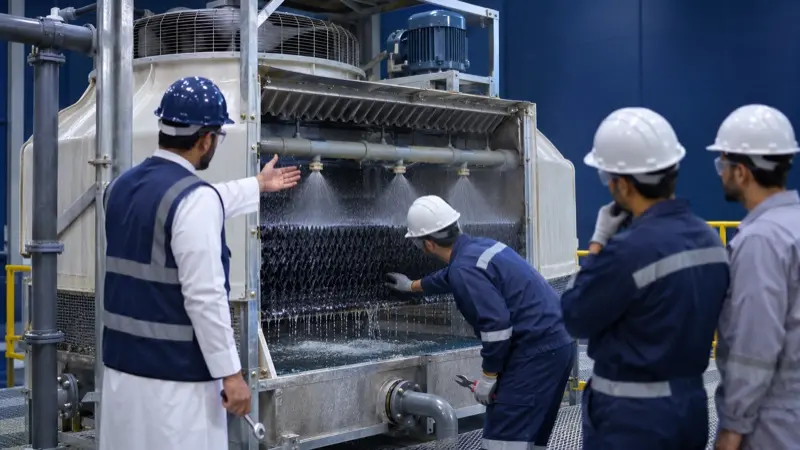
Cooling Tower Performance, Maintenance and Troubleshooting Training Course is a one-week advanced course for cooling-tower engineers, maintenance teams, utility operators, reliability professionals, water-treatment specialists, and facilities engineers who leave with a Cooling Tower Reliability Decision Pack. The course connects cooling tower thermal performance, airflow and water distribution, mechanical condition monitoring, cooling tower water treatment, fault diagnosis, seasonal operation, and lifecycle maintenance. Agile Leaders Training Center delivers this course on cooling tower performance and reliability.
Who Should Attend
- Teams responsible for cooling-tower operation, heat rejection, and performance records
- Functions responsible for fans, gearboxes, motors, pumps, basins, and mechanical reliability
- Teams responsible for circulating-water chemistry, blowdown, makeup, and biological control
- Functions responsible for inspection, vibration evidence, fault diagnosis, and work planning
- Teams responsible for seasonal readiness, contractor control, safety interfaces, and lifecycle decisions
The course assumes participants already work with cooling-water systems, operating trends, inspection records, or maintenance plans and leaves out introductory refrigeration cycles, chiller selection, chemical-handling authorization, and live intrusive work.
Departments and Industries
The course supports cooling-tower decisions across process plants, utilities, and large water-cooled facilities.
- Mechanical maintenance, reliability, utilities, and condition monitoring
- Water treatment, chemistry, environmental operations, and industrial hygiene
- Power generation, petrochemical, refining, manufacturing, and district cooling
- Commercial property, healthcare, hospitality, data centers, and institutional facilities
- Engineering services, specialist contractors, technical assurance, and asset management
Learning Objectives
By the end of this course, participants will be able to:
- Analyze cooling-tower heat and mass transfer performance.
- Diagnose airflow, water-distribution, and thermal faults.
- Evaluate fan, drive, pump, fill, basin, and structural condition.
- Apply water-management controls for scale, corrosion, and biofouling.
- Build a risk-based maintenance and troubleshooting plan.
- Prioritize restoration, replacement, and lifecycle actions.
Course Agenda
Day 1: Establish Tower Performance
- Open-Circuit, Closed-Circuit, Crossflow, Counterflow, and Draft Configuration Map
- Heat Load, Water Flow, Airflow, Wet-Bulb, Range, and Approach Data Sheet
- Thermal Performance Baseline, Measurement Quality, and Operating Context Register
- Evaporation, Drift, Blowdown, Makeup, and Water-Balance Calculation Method
- Performance Deviation, Capacity Loss, Energy Effect, and Escalation Matrix
Day 2: Inspect Mechanical and Structural Systems
- Fan Blade, Hub, Pitch, Gearbox, Coupling, Motor, and Drive Inspection Checklist
- Vibration, Temperature, Lubrication, Current, Noise, and Alignment Trend Sheet
- Pump, Strainer, Valve, Piping, Basin, Level Control, and Leak Condition Record
- Fill, Louver, Drift Eliminator, Nozzle, Header, and Distribution Inspection Grid
- FRP, Timber, Concrete, Steel, Fastener, Access, and Support Condition Matrix
Day 3: Control Water and Fouling
- Makeup Quality, Conductivity, Cycles of Concentration, and Blowdown Control Chart
- Scale, Corrosion, Deposition, Sediment, and Material Compatibility Risk Map
- Biofouling, Algae, Slime, Aerosol, Cleaning, and Biological-Control Plan
- Chemical Feed, Side-Stream Filtration, Sampling, Monitoring, and Response Log
- Water-System Hazard, Control Measure, Verification, and Contingency Register
Day 4: Diagnose Faults and Plan Maintenance
- High Approach, Low Range, Capacity Loss, and Unstable Temperature Fault Tree
- Uneven Distribution, Clogged Nozzle, Damaged Fill, Recirculation, and Drift Diagnosis
- Fan Imbalance, Gearbox Distress, Motor Overload, Pump Cavitation, and Vibration Matrix
- Preventive Task, Condition Trigger, Work Scope, Spare, Resource, and Outage Plan
- Clean, Repair, Restore, Replace, Lay Up, or Return-to-Service Decision Gate
Day 5: Practice Cooling Tower Decisions
- Exercise: Build the Tower Configuration, Water Balance, and Performance Baseline
- Exercise: Assess Fan, Drive, Pump, Fill, Distribution, and Structural Evidence
- Exercise: Diagnose Scale, Corrosion, Biofouling, Drift, and Water-Control Symptoms
- Exercise: Prioritize Faults, Maintenance Scope, Seasonal Readiness, and Acceptance Checks
- Capstone Exercise: Build the Cooling Tower Reliability Decision Pack
Practical Exercises
The course uses suggested activities to connect operating evidence with controlled maintenance decisions.
- Suggested activity: calculate range, approach, water balance, cycles of concentration, and performance deviation.
- Suggested activity: review vibration, temperature, current, lubrication, water-quality, and inspection trends.
- Suggested activity: trace thermal, mechanical, distribution, scaling, corrosion, and biological fault paths.
- Suggested activity: develop a seasonal maintenance scope with controls, resources, spares, contingencies, and acceptance evidence.
FAQs
Who should attend cooling tower performance, maintenance and troubleshooting training?
Cooling tower training suits experienced operations, mechanical, reliability, water-treatment, utilities, and facilities teams and assumes familiarity with cooling-water systems, operating readings, inspection evidence, or maintenance plans.
How does cooling tower training differ from general HVAC maintenance training?
Cooling tower training focuses on evaporative heat rejection, range and approach, airflow, water distribution, fans, drives, fill, drift, water chemistry, biofouling, and tower-specific lifecycle decisions, while general HVAC maintenance addresses wider building systems.
How is cooling tower thermal performance evaluated?
Cooling tower thermal performance is evaluated by confirming measurement quality and operating context, then comparing heat load, water flow, wet-bulb temperature, range, approach, airflow, water distribution, and baseline behavior.
What causes a cooling tower to lose capacity?
Cooling tower capacity loss can result from reduced airflow, recirculation, uneven water distribution, clogged nozzles, fouled or damaged fill, fan or drive problems, incorrect flow, scaling, biofouling, or changed ambient and load conditions.
How does cooling tower water treatment affect maintenance?
Cooling tower water treatment affects maintenance by controlling concentration, scale, corrosion, deposits, and biological growth while supporting clean heat-transfer surfaces, reliable distribution, planned cleaning, and traceable operating limits.
Conclusion
Participants take back a Cooling Tower Reliability Decision Pack. The pack connects configuration, thermal performance, water balance, mechanical and structural condition, chemistry, fouling, fault paths, seasonal readiness, maintenance scope, and acceptance evidence. It changes separate tower readings and inspection findings into a traceable basis for troubleshooting and lifecycle action.
credits: 5 credit per day
Course Mode: full-time
Provider: Agile Leaders Training Center
-
Events for this Course
-
Kuala Lumpur 7 – 11 December 2026
-
Jakarta 7 – 11 December 2026
-
Nairobi 13 – 17 December 2026
-
Paris 14 – 18 December 2026
-
Dubai 21 – 25 December 2026
-
Athens 21 – 25 December 2026
-
Johannesburg 3 – 7 January 2027
-
Madrid 11 – 15 January 2027
-
Frankfurt 11 – 15 January 2027
-
Barcelona 18 – 22 January 2027
-
Abu Dhabi 18 – 22 January 2027
-
Accra 1 – 5 February 2027
-
Kuwait 7 – 11 February 2027
-
Bangkok 14 – 18 February 2027
-
Manama 21 – 25 February 2027
-
Lisbon 1 – 5 March 2027
-
Zoom 8 – 12 March 2027
-
Nice 8 – 12 March 2027
-
Langkawi 21 – 25 March 2027
-
Tashkent 28 March – 1 April 2027
-
Singapore 5 – 9 April 2027
-
Muscat 11 – 15 April 2027
-
Montreux 19 – 23 April 2027
-
Tokyo 26 – 30 April 2027
-
Trabzon 2 – 6 May 2027
-
Vienna 3 – 7 May 2027
-
Dubai 10 – 14 May 2027
-
Munich 10 – 14 May 2027
-
Bali 16 – 20 May 2027
-
Baku 17 – 21 May 2027
-
Chicago 23 – 27 May 2027
-
Rome 24 – 28 May 2027
-
Toronto 30 May – 3 June 2027
-
Doha 6 – 10 June 2027
-
Amsterdam 21 – 25 June 2027
-
Marbella 27 June – 1 July 2027
-
Cape town 4 – 8 July 2027
-
Casablanca 5 – 9 July 2027
-
Berlin 12 – 16 July 2027
-
Geneva 25 – 29 July 2027
-
London 2 – 6 August 2027
-
New York 2 – 6 August 2027
-
San Diego 16 – 20 August 2027
-
Tbilisi 23 – 27 August 2027
-
Seoul 6 – 10 September 2027
-
Sharm El-Sheikh 13 – 17 September 2027
-
Abu Dhabi 13 – 17 September 2027
-
Istanbul 20 – 24 September 2027
-
Porto 27 September – 1 October 2027
-
Prague 4 – 8 October 2027
-
Zanzibar 17 – 21 October 2027
-
Milan 18 – 22 October 2027
-
London 25 – 29 October 2027
-
Amman 31 October – 4 November 2027
-
Addis Ababa 8 – 12 November 2027
-
Phuket 14 – 18 November 2027
-
Cairo 15 – 19 November 2027
-
Lagos 28 November – 2 December 2027
When and where does this course run?
| Image | Location | Dates | Duration | Mode | Price | Actions |
|---|---|---|---|---|---|---|
|
Kuala Lumpur |
Week 50, 2026 7 – 11 December 2026 |
1 Week | Onsite | €6,500 | |
|
Jakarta |
Week 50, 2026 7 – 11 December 2026 |
1 Week | Onsite | €8,000 | |
|
Nairobi |
Week 50, 2026 13 – 17 December 2026 |
1 Week | Onsite | €6,000 | |

|
Paris |
Week 51, 2026 14 – 18 December 2026 |
1 Week | Onsite | €6,500 | |
|
Dubai |
Week 52, 2026 21 – 25 December 2026 |
1 Week | Onsite | €6,500 | |
|
Athens |
Week 52, 2026 21 – 25 December 2026 |
1 Week | Onsite | €7,500 | |
|
Johannesburg |
Week 53, 2027 3 – 7 January 2027 |
1 Week | Onsite | €6,000 | |

|
Madrid |
Week 02, 2027 11 – 15 January 2027 |
1 Week | Onsite | €6,500 | |
|
Frankfurt |
Week 02, 2027 11 – 15 January 2027 |
1 Week | Onsite | €6,500 | |

|
Barcelona |
Week 03, 2027 18 – 22 January 2027 |
1 Week | Onsite | €6,500 | |
|
Abu Dhabi |
Week 03, 2027 18 – 22 January 2027 |
1 Week | Onsite | €6,500 | |
|
Accra |
Week 05, 2027 1 – 5 February 2027 |
1 Week | Onsite | €6,330 | |
|
Kuwait |
Week 05, 2027 7 – 11 February 2027 |
1 Week | Onsite | €7,000 | |

|
Bangkok |
Week 06, 2027 14 – 18 February 2027 |
1 Week | Onsite | €8,000 | |
|
Manama |
Week 07, 2027 21 – 25 February 2027 |
1 Week | Onsite | €6,500 | |

|
Lisbon |
Week 09, 2027 1 – 5 March 2027 |
1 Week | Onsite | €6,500 | |

|
Zoom |
Week 10, 2027 8 – 12 March 2027 |
1 Week | Online | €3,000 | |
|
Nice |
Week 10, 2027 8 – 12 March 2027 |
1 Week | Onsite | €8,000 | |
|
Langkawi |
Week 11, 2027 21 – 25 March 2027 |
1 Week | Onsite | €8,000 | |
|
Tashkent |
Week 12, 2027 28 March – 1 April 2027 |
1 Week | Onsite | €8,000 |
Frequently asked questions
When does this course next run?
The next date runs 7 – 11 December 2026 in Kuala Lumpur. It is one of 58 dates scheduled up to November 2027.
Where is this course held?
In a classroom in 54 cities: Kuala Lumpur, Jakarta, Nairobi, Paris, Dubai, Athens, Johannesburg, Madrid, and more. It is also scheduled as live online sessions.
Can I attend this course online?
Yes. One date is scheduled as a live online session: 8 – 12 March 2027, from €3,000 per participant.
How long is the course?
1 Week. Each date shows its start and end dates.
How much does the course cost?
Fees per participant run from €5,200 (Sharm El-Sheikh) to €16,000 (Chicago) in a classroom, and from €3,000 live online. Each date shows its own fee.
What does this course cover?
OverviewCooling Tower Performance, Maintenance and Troubleshooting Training Course is a one-week advanced course for cooling-tower engineers, maintenance teams, utility operators, reliability professionals, water-treatment specialists, and facilities engineers who leave with a Cooling Tower Reliability Decision Pack. The course connects cooling tower ther…
Are training dates available?
Yes. Available dates and destinations are listed in the course dates section on this page.
How can I register?
Choose an available date on this page and complete the registration form, or send a programme enquiry.
Can I download the course brochure?
Yes. Use the brochure download link provided on this page.
Can this course be run for our team?
Yes. Tell us the number of participants and your preferred dates and city through our training request form.
This course by city
- Maintenance Training and Engineering Training Courses in Abu Dhabi
- Maintenance Training and Engineering Training Courses in Accra
- Maintenance Training and Engineering Training Courses in Addis Ababa
- Maintenance Training and Engineering Training Courses in Amman
- Maintenance Training and Engineering Training Courses in Amsterdam
- Maintenance Training and Engineering Training Courses in Athens
- Maintenance Training and Engineering Training Courses in Baku
- Maintenance Training and Engineering Training Courses in Bali
- Maintenance Training and Engineering Training Courses in Bangkok
- Maintenance Training and Engineering Training Courses in Barcelona
- Maintenance Training and Engineering Training Courses in Berlin
- Maintenance Training and Engineering Training Courses in Cairo
- Maintenance Training and Engineering Training Courses in Cape town
- Maintenance Training and Engineering Training Courses in Casablanca
- Maintenance Training and Engineering Training Courses in Chicago
- Maintenance Training and Engineering Training Courses in Doha
- Maintenance Training and Engineering Training Courses in Dubai
- Maintenance Training and Engineering Training Courses in Frankfurt
- Maintenance Training and Engineering Training Courses in Geneva
- Maintenance Training and Engineering Training Courses in Istanbul
- Maintenance Training and Engineering Training Courses in Jakarta
- Maintenance Training and Engineering Training Courses in Johannesburg
- Maintenance Training and Engineering Training Courses in Kuala Lumpur
- Maintenance Training and Engineering Training Courses in Kuwait
- Maintenance Training and Engineering Training Courses in Lagos
- Maintenance Training and Engineering Training Courses in Langkawi
- Maintenance Training and Engineering Training Courses in Lisbon
- Maintenance Training and Engineering Training Courses in London
- Maintenance Training and Engineering Training Courses in Madrid
- Maintenance Training and Engineering Training Courses in Manama
- Maintenance Training and Engineering Training Courses in Marbella
- Maintenance Training and Engineering Training Courses in Milan
- Maintenance Training and Engineering Training Courses in Montreux
- Maintenance Training and Engineering Training Courses in Munich
- Maintenance Training and Engineering Training Courses in Muscat
- Maintenance Training and Engineering Training Courses in Nairobi
- Maintenance Training and Engineering Training Courses in New York
- Maintenance Training and Engineering Training Courses in Nice
- Maintenance Training and Engineering Training Courses in Paris
- Maintenance Training and Engineering Training Courses in Phuket
- Maintenance Training and Engineering Training Courses in Porto
- Maintenance Training and Engineering Training Courses in Prague
- Maintenance Training and Engineering Training Courses in Rome
- Maintenance Training and Engineering Training Courses in San Diego
- Maintenance Training and Engineering Training Courses in Seoul
- Maintenance Training and Engineering Training Courses in Sharm El-Sheikh
- Maintenance Training and Engineering Training Courses in Singapore
- Maintenance Training and Engineering Training Courses in Tashkent
- Maintenance Training and Engineering Training Courses in Tbilisi
- Maintenance Training and Engineering Training Courses in Tokyo
- Maintenance Training and Engineering Training Courses in Toronto
- Maintenance Training and Engineering Training Courses in Trabzon
- Maintenance Training and Engineering Training Courses in Vienna
- Maintenance Training and Engineering Training Courses in Zanzibar
- Maintenance Training and Engineering Training Courses in Zoom
More ways to train
- Every date of this courseAll cities and months, with fees
- Maintenance Training and Engineering Training CoursesEvery course in this subject
- Live online coursesTrain from wherever you are
- Training citiesCourses in each city
- All upcoming datesThe course calendar by month
- Training for your teamTell us the course, the number of participants and your dates
- Contact usAsk us about this course