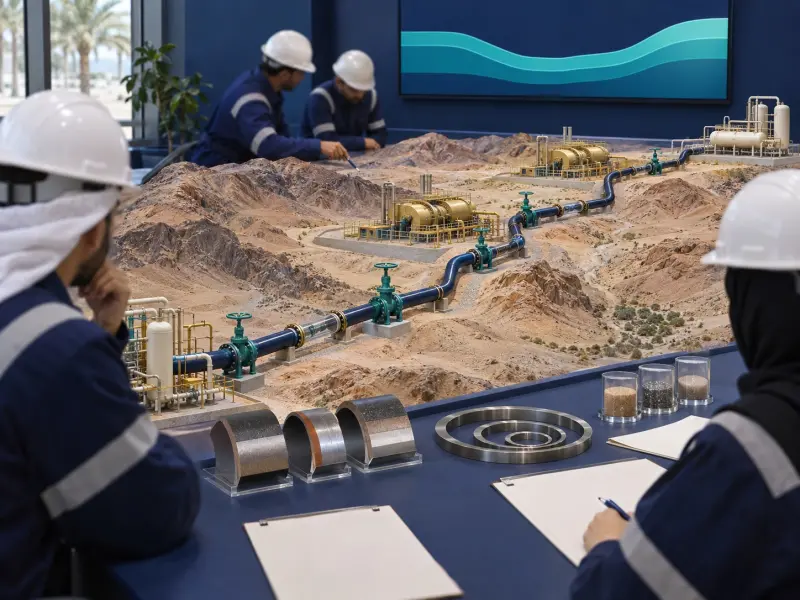
Hydraulic and Pneumatic Bulk Solids Conveying Course

At a glance
- Duration
- 1 Week
- Format
- Classroom
- Cities
- Prague, Amman, Singapore, Geneva, Porto, London and more
- Next session
- 9 – 13 November 2026, Prague
- Average fee
- 7,500 €
Overview
Hydraulic and Pneumatic Conveying of Bulk Solids Training Course is a one-week intermediate course for process, mechanical, plant operations, maintenance, and project professionals who leave with a Bulk Solids Conveying Design and Reliability Basis. Participants examine bulk solids characterization, slurry pipeline design, pneumatic conveying system selection, pressure-loss analysis, conveying system troubleshooting, and combustible-dust controls. The course connects material behavior, transport regime, equipment interfaces, safety, energy, and reliability. Agile Leaders Training Center presents hydraulic and pneumatic conveying of bulk solids.
Who Should Attend
- Functions responsible for process-system selection, sizing, and design review
- Teams responsible for bulk-material handling, plant operations, and production continuity
- Functions responsible for pipelines, pumps, blowers, feeders, separators, and dust collectors
- Teams responsible for mechanical reliability, inspection, maintenance, and troubleshooting
- Functions responsible for projects, commissioning, safety review, and performance acceptance
The course assumes participants interpret basic process-flow and equipment data at work, and it leaves out detailed equipment manufacturing and computational model development.
Departments and Industries
The course supports departments and industries that transport powders, granules, minerals, ash, catalysts, food ingredients, or process slurries.
- Process engineering, mechanical engineering, and project delivery
- Mining, mineral processing, cement, and metals operations
- Chemical, petrochemical, plastics, and fertilizer production
- Power generation, ash handling, and environmental systems
- Food, grain, pharmaceutical, and bulk-storage operations
Learning Objectives
By the end of this course, participants will be able to:
- Analyze particle, bulk, liquid, and gas properties for conveying decisions
- Compare hydraulic and pneumatic transport regimes and system configurations
- Build slurry-pipeline and pneumatic-conveying sizing calculations
- Evaluate feeders, pipelines, bends, separators, filters, pumps, and blowers
- Diagnose settling, plugging, erosion, attrition, leakage, and unstable flow
- Prioritize safety, energy, maintenance, and reliability improvements
Course Agenda
Day 1: Characterize Materials and Select Transport Modes
- Bulk Solids Particle Size, Shape, Density, and Hardness Data Sheet
- Flowability, Cohesion, Moisture, and Abrasiveness Test Matrix
- Slurry Concentration, Rheology, and Settling Behavior Profile
- Hydraulic versus Pneumatic Conveying Selection Framework
- Conveying Duty, Route, Throughput, and Constraint Design Basis
Day 2: Size Hydraulic Solids Transport Systems
- Homogeneous, Heterogeneous, Sliding-Bed, and Stationary-Bed Flow Map
- Critical and Deposition Velocity Calculation Method
- Slurry Pipeline Diameter and Pressure-Loss Calculation Sheet
- Pump Duty, System Curve, and Solids Throughput Balance
- ASME B31.4 Slurry Pipeline Design and Integrity Review
Day 3: Design Pneumatic Conveying Systems
- Dilute, Dense, and Transitional Phase Selection Matrix
- Pressure versus Vacuum Conveying Configuration Review
- Pickup, Saltation, and Minimum Conveying Velocity Method
- Airflow, Solids Loading, Pressure Drop, and Blower Sizing Sheet
- Feeder, Pipeline, Bend, Receiver, and Filter Interface Map
Day 4: Control Safety, Wear, and Reliability
- NFPA 660 Combustible-Dust Hazard Control Review
- NFPA 91 Air-Conveying Exhaust System Safety Check
- Erosion, Attrition, Bend Wear, and Material Degradation Map
- Settling, Plugging, Surging, Leakage, and Instability Diagnostic Tree
- Instrumentation, Alarm, Inspection, and Maintenance Strategy
Day 5: Practice Conveying Design and Troubleshooting
- Suggested Exercise: Characterize a Bulk Solid and Select the Transport Mode
- Suggested Exercise: Size a Slurry Pipeline above Deposition Velocity
- Suggested Exercise: Configure a Dilute- or Dense-Phase Pneumatic Line
- Suggested Exercise: Diagnose Pressure, Wear, and Plugging Evidence
- Capstone Exercise: Complete the Bulk Solids Conveying Design and Reliability Basis
Practical Exercises
The course uses suggested activities to convert material and operating data into conveying decisions.
- Suggested activity: characterize mineral slurry and dry-powder cases using particle, carrier-fluid, route, and throughput evidence.
- Suggested activity: calculate hydraulic velocity, pipeline loss, pump duty, pneumatic airflow, solids loading, and blower pressure.
- Suggested activity: evaluate feeder, bend, separator, filter, and instrumentation interfaces for capacity and reliability.
- Suggested activity: turn settling, plugging, erosion, attrition, and dust-hazard evidence into corrective and verification actions.
FAQs
Who suits hydraulic and pneumatic conveying of bulk solids training, and what does it assume?
Hydraulic and pneumatic conveying training suits process, mechanical, operations, maintenance, reliability, safety, and project functions. It assumes participants interpret basic process-flow and equipment data and excludes detailed equipment manufacturing.
How does bulk solids conveying training differ from a general fluid-flow course?
Bulk solids conveying training addresses particle behavior, solids concentration, transport regimes, deposition or saltation, equipment interfaces, wear, plugging, and dust hazards. A general fluid-flow course mainly treats single-phase liquids or gases.
What determines slurry pipeline deposition velocity?
Slurry pipeline deposition velocity depends on particle size and density, size distribution, solids concentration, carrier-liquid properties, pipe diameter, flow regime, and pipeline orientation.
How are dilute- and dense-phase pneumatic conveying selected?
Dilute- and dense-phase conveying are selected by evaluating particle fragility, abrasiveness, cohesion, bulk density, required throughput, route, pressure capability, product quality, energy, and acceptable conveying velocity.
What evidence supports bulk solids conveying troubleshooting?
Bulk solids conveying troubleshooting combines pressure profiles, flow and throughput trends, pump or blower load, feeder behavior, vibration, dust-collector differential pressure, wear inspection, product degradation, and blockage location.
Conclusion
Participants take back a Bulk Solids Conveying Design and Reliability Basis linking material properties, transport regimes, calculations, equipment interfaces, safety controls, and troubleshooting evidence. It changes separate process and mechanical assumptions into a traceable system decision path. The basis supports design review, commissioning, operations, maintenance, and performance verification.
credits: 5 credit per day
Course Mode: full-time
Provider: Agile Leaders Training Center
-
Events for this Course
-
Prague 9 – 13 November 2026
-
Amman 15 – 19 November 2026
-
Singapore 16 – 20 November 2026
-
Geneva 22 – 26 November 2026
-
Porto 30 November – 4 December 2026
-
London 7 – 11 December 2026
-
Zanzibar 13 – 17 December 2026
-
Amsterdam 14 – 18 December 2026
-
Jakarta 21 – 25 December 2026
-
Dubai 28 December 2026 – 1 January 2027
-
Marbella 3 – 7 January 2027
-
Vienna 18 – 22 January 2027
-
Phuket 31 January – 4 February 2027
-
Athens 1 – 5 February 2027
-
Manama 14 – 18 February 2027
-
Kuwait 28 February – 4 March 2027
-
Paris 1 – 5 March 2027
-
Cairo 15 – 19 March 2027
-
Nairobi 21 – 25 March 2027
-
Tbilisi 22 – 26 March 2027
-
Montreux 5 – 9 April 2027
-
Doha 11 – 15 April 2027
-
Munich 12 – 16 April 2027
-
Cape town 18 – 22 April 2027
-
Bali 25 – 29 April 2027
-
Tashkent 2 – 6 May 2027
-
Zoom 3 – 7 May 2027
-
Madrid 10 – 14 May 2027
-
Johannesburg 16 – 20 May 2027
-
Langkawi 23 – 27 May 2027
-
Chicago 23 – 27 May 2027
-
Lisbon 31 May – 4 June 2027
-
Toronto 6 – 10 June 2027
-
Casablanca 7 – 11 June 2027
-
Baku 14 – 18 June 2027
-
Accra 20 – 24 June 2027
-
Seoul 21 – 25 June 2027
-
London 28 June – 2 July 2027
-
Lagos 4 – 8 July 2027
-
Sharm El-Sheikh 12 – 16 July 2027
-
Addis Ababa 12 – 16 July 2027
-
New York 19 – 23 July 2027
-
Dubai 26 – 30 July 2027
-
Abu Dhabi 26 – 30 July 2027
-
Bangkok 8 – 12 August 2027
-
Trabzon 8 – 12 August 2027
-
Tokyo 16 – 20 August 2027
-
Barcelona 23 – 27 August 2027
-
Milan 6 – 10 September 2027
-
Nice 6 – 10 September 2027
-
Istanbul 13 – 17 September 2027
-
Rome 20 – 24 September 2027
-
Abu Dhabi 20 – 24 September 2027
-
Kuala Lumpur 4 – 8 October 2027
-
San Diego 4 – 8 October 2027
-
Muscat 10 – 14 October 2027
-
Berlin 1 – 5 November 2027
-
Frankfurt 8 – 12 November 2027
| Image | Location | Dates | Duration | Mode | Price | Actions |
|---|---|---|---|---|---|---|

|
Addis Ababa |
Week 28, 2027 12 – 16 July 2027 |
1 Week | Onsite | €6,000 | |

|
New York |
Week 29, 2027 19 – 23 July 2027 |
1 Week | Onsite | €16,000 | |

|
Dubai |
Week 30, 2027 26 – 30 July 2027 |
1 Week | Onsite | €6,500 | |

|
Abu Dhabi |
Week 30, 2027 26 – 30 July 2027 |
1 Week | Onsite | €6,500 | |

|
Bangkok |
Week 31, 2027 8 – 12 August 2027 |
1 Week | Onsite | €8,000 | |

|
Trabzon |
Week 31, 2027 8 – 12 August 2027 |
1 Week | Onsite | €8,000 | |

|
Tokyo |
Week 33, 2027 16 – 20 August 2027 |
1 Week | Onsite | €12,000 | |

|
Barcelona |
Week 34, 2027 23 – 27 August 2027 |
1 Week | Onsite | €6,500 | |

|
Milan |
Week 36, 2027 6 – 10 September 2027 |
1 Week | Onsite | €7,000 | |

|
Nice |
Week 36, 2027 6 – 10 September 2027 |
1 Week | Onsite | €8,000 | |

|
Istanbul |
Week 37, 2027 13 – 17 September 2027 |
1 Week | Onsite | €6,000 | |

|
Rome |
Week 38, 2027 20 – 24 September 2027 |
1 Week | Onsite | €6,500 | |
|
|
Abu Dhabi |
Week 38, 2027 20 – 24 September 2027 |
1 Week | Onsite | €6,500 | |

|
Kuala Lumpur |
Week 40, 2027 4 – 8 October 2027 |
1 Week | Onsite | €6,500 | |

|
San Diego |
Week 40, 2027 4 – 8 October 2027 |
1 Week | Onsite | €16,000 | |

|
Muscat |
Week 40, 2027 10 – 14 October 2027 |
1 Week | Onsite | €6,500 | |

|
Berlin |
Week 44, 2027 1 – 5 November 2027 |
1 Week | Onsite | €6,500 | |

|
Frankfurt |
Week 45, 2027 8 – 12 November 2027 |
1 Week | Onsite | €6,500 |
Frequently asked questions
What does this course cover?
OverviewHydraulic and Pneumatic Conveying of Bulk Solids Training Course is a one-week intermediate course for process, mechanical, plant operations, maintenance, and project professionals who leave with a Bulk Solids Conveying Design and Reliability Basis. Participants examine bulk solids characterization, slurry pipeline design, pneumatic conveying syst…
Are training dates available?
Yes. Available dates and destinations are listed in the course dates section on this page.
How can I register?
Choose an available date on this page and complete the registration form, or send a programme enquiry.
Can I download the course brochure?
Yes. Use the brochure download link provided on this page.
This course by city
- Maintenance Training and Engineering Training Courses in Abu Dhabi
- Maintenance Training and Engineering Training Courses in Accra
- Maintenance Training and Engineering Training Courses in Addis Ababa
- Maintenance Training and Engineering Training Courses in Amman
- Maintenance Training and Engineering Training Courses in Amsterdam
- Maintenance Training and Engineering Training Courses in Athens
- Maintenance Training and Engineering Training Courses in Baku
- Maintenance Training and Engineering Training Courses in Bali
- Maintenance Training and Engineering Training Courses in Bangkok
- Maintenance Training and Engineering Training Courses in Barcelona
- Maintenance Training and Engineering Training Courses in Berlin
- Maintenance Training and Engineering Training Courses in Cairo
- Maintenance Training and Engineering Training Courses in Cape town
- Maintenance Training and Engineering Training Courses in Casablanca
- Maintenance Training and Engineering Training Courses in Chicago
- Maintenance Training and Engineering Training Courses in Doha
- Maintenance Training and Engineering Training Courses in Dubai
- Maintenance Training and Engineering Training Courses in Frankfurt
- Maintenance Training and Engineering Training Courses in Geneva
- Maintenance Training and Engineering Training Courses in Istanbul
- Maintenance Training and Engineering Training Courses in Jakarta
- Maintenance Training and Engineering Training Courses in Johannesburg
- Maintenance Training and Engineering Training Courses in Kuala Lumpur
- Maintenance Training and Engineering Training Courses in Kuwait
- Maintenance Training and Engineering Training Courses in Lagos
- Maintenance Training and Engineering Training Courses in Langkawi
- Maintenance Training and Engineering Training Courses in Lisbon
- Maintenance Training and Engineering Training Courses in London
- Maintenance Training and Engineering Training Courses in Madrid
- Maintenance Training and Engineering Training Courses in Manama
- Maintenance Training and Engineering Training Courses in Marbella
- Maintenance Training and Engineering Training Courses in Milan
- Maintenance Training and Engineering Training Courses in Montreux
- Maintenance Training and Engineering Training Courses in Munich
- Maintenance Training and Engineering Training Courses in Muscat
- Maintenance Training and Engineering Training Courses in Nairobi
- Maintenance Training and Engineering Training Courses in New York
- Maintenance Training and Engineering Training Courses in Nice
- Maintenance Training and Engineering Training Courses in Paris
- Maintenance Training and Engineering Training Courses in Phuket
- Maintenance Training and Engineering Training Courses in Porto
- Maintenance Training and Engineering Training Courses in Prague
- Maintenance Training and Engineering Training Courses in Rome
- Maintenance Training and Engineering Training Courses in San Diego
- Maintenance Training and Engineering Training Courses in Seoul
- Maintenance Training and Engineering Training Courses in Sharm El-Sheikh
- Maintenance Training and Engineering Training Courses in Singapore
- Maintenance Training and Engineering Training Courses in Tashkent
- Maintenance Training and Engineering Training Courses in Tbilisi
- Maintenance Training and Engineering Training Courses in Tokyo
- Maintenance Training and Engineering Training Courses in Toronto
- Maintenance Training and Engineering Training Courses in Trabzon
- Maintenance Training and Engineering Training Courses in Vienna
- Maintenance Training and Engineering Training Courses in Zanzibar
- Maintenance Training and Engineering Training Courses in Zoom