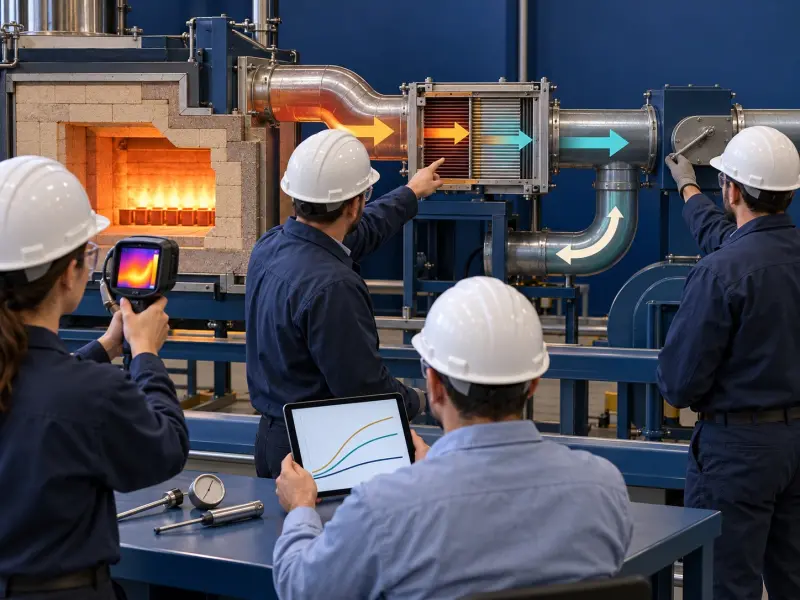
Industrial Fluid Flow and Heat Transfer Course

At a glance
- Duration
- 1 Week
- Format
- Classroom
- Cities
- Tashkent, Milan, London, Abu Dhabi, Casablanca, Istanbul and more
- Next session
- 8 – 12 November 2026, Tashkent
- Average fee
- 7,500 €
Overview
Industrial Fluid Flow and Heat Transfer Training Course is a one-week intermediate course for process, mechanical, plant, operations, and maintenance engineering teams who leave with a Thermal-Hydraulic Performance Workbook. The course connects fluid properties, conservation equations, pressure-loss analysis, pump-system curves, thermal resistance networks, heat-exchanger balances, measurement uncertainty, and coupled thermal-hydraulic diagnostics. Participants use calculations and operating evidence to investigate industrial performance. Agile Leaders Training Center delivers this course on industrial fluid flow and heat transfer.
Who Should Attend
- Functions responsible for process flow, pressure, temperature, and energy balances
- Teams responsible for piping, pumping, utility, and thermal-system performance
- Functions responsible for plant operations and deviation investigation
- Teams responsible for maintenance diagnostics and equipment condition evidence
- Technical project groups responsible for system calculations and option reviews
The course assumes participants use engineering units, algebra, process data, or equipment records and leaves out exam preparation, detailed equipment fabrication, advanced computational fluid dynamics, and narrow technology certification.
Departments and Industries
The course supports thermal-hydraulic analysis across industrial operations and engineered facilities.
- Process, mechanical, energy, and plant engineering
- Operations, maintenance, reliability, and technical services
- Chemicals, petrochemicals, refining, and food processing
- Power generation, water, utilities, and district energy
- Manufacturing, mining, pharmaceuticals, and building services
Learning Objectives
By the end of this course, participants will be able to:
- Apply conservation equations to industrial flow systems.
- Analyze regimes, friction, fittings, and pressure losses.
- Evaluate pump curves, cavitation, and flow measurements.
- Build conduction, convection, and radiation resistance models.
- Analyze exchanger balances and transient thermal behavior.
- Diagnose coupled thermal-hydraulic performance from measured evidence.
Course Agenda
Day 1: Establish Fluid Flow Fundamentals
- Fluid Property, State, and Unit Consistency Worksheet
- Control-Volume Mass, Momentum, and Energy Balance Method
- Bernoulli Equation Assumption and Loss-Term Map
- Reynolds Number and Laminar-Turbulent Regime Classification
- Dimensional Analysis and Similarity Variable Checklist
Day 2: Analyze Piping and Pump Performance
- Darcy-Weisbach Pipe Friction Calculation Sheet
- Fitting Loss Coefficient and Network Pressure Profile
- Pump Curve, System Curve, and Operating-Point Diagram
- Net Positive Suction Head and Cavitation Risk Assessment
- Flow-Meter Selection, Installation, and Uncertainty Register
Day 3: Model Heat Transfer Mechanisms
- Steady and Transient Conduction Resistance Network
- Internal Forced-Convection Correlation Selection Map
- External and Natural-Convection Boundary Assessment
- Surface Radiation Exchange and Emissivity Calculation Sheet
- Insulation Thickness and Thermal-Loss Comparison Model
Day 4: Integrate Thermal-Hydraulic Evidence
- Heat-Exchanger Energy Balance and Effectiveness Worksheet
- Thermal Capacitance and Transient Response Plot
- Coupled Flow, Pressure, and Temperature Diagnostic Map
- Sensor Calibration, Data Quality, and Uncertainty Budget
- Industrial Deviation Cause-and-Evidence Troubleshooting Matrix
Day 5: Practice Industrial Analysis
- Exercise: Build a Control-Volume Flow Balance
- Exercise: Calculate a Pipe Network and Pump Operating Point
- Exercise: Model a Thermal Resistance and Heat Loss
- Exercise: Diagnose a Coupled Flow and Temperature Deviation
- Capstone Exercise: Build the Thermal-Hydraulic Performance Workbook
Practical Exercises
The course uses suggested activities to connect calculations with operating evidence and industrial decisions.
- Suggested activity: calculate pressure losses and a pump operating point for a water utility network.
- Suggested activity: compare conduction, convection, radiation, and insulation effects for a process-heating surface.
- Suggested activity: reconcile exchanger duty with measured flow and temperature data in a manufacturing case.
- Suggested activity: diagnose a coupled thermal-hydraulic deviation and document uncertainty and verification actions.
FAQs
Who suits industrial fluid flow and heat transfer training and what does it assume?
Industrial fluid flow and heat transfer training suits technical teams that already use engineering units, process measurements, equipment records, or basic balance calculations.
How does industrial fluid flow and heat transfer training differ from general thermodynamics?
Industrial fluid flow and heat transfer training applies conservation, pressure-loss, pumping, convection, radiation, and exchanger methods to operating systems, while general thermodynamics emphasizes states, properties, cycles, and energy principles.
How are pipe pressure losses calculated in industrial fluid flow?
Pipe pressure losses are calculated from flow regime, friction, diameter, length, roughness, fittings, elevation, and fluid properties, then reconciled with the system pressure profile.
How do pump and system curves support industrial flow analysis?
Pump and system curves locate the expected operating point and show how resistance, speed, control position, or equipment condition can shift flow and pressure.
How is measurement uncertainty used in heat transfer analysis?
Measurement uncertainty qualifies the confidence placed in flow, pressure, and temperature evidence before heat duty, coefficients, losses, or diagnostic conclusions are accepted.
Conclusion
Participants take back a Thermal-Hydraulic Performance Workbook. The workbook connects fluid properties, balances, flow regimes, pipe losses, pump behavior, heat-transfer mechanisms, exchanger duty, transients, measurements, and uncertainty. It changes disconnected calculations into a traceable method for analyzing and troubleshooting industrial flow and thermal performance.
credits: 5 credit per day
Course Mode: full-time
Provider: Agile Leaders Training Center
-
Events for this Course
-
Tashkent 8 – 12 November 2026
-
Milan 16 – 20 November 2026
-
London 23 – 27 November 2026
-
Zoom 23 – 27 November 2026
-
Abu Dhabi 30 November – 4 December 2026
-
Casablanca 7 – 11 December 2026
-
Istanbul 7 – 11 December 2026
-
Jakarta 14 – 18 December 2026
-
Johannesburg 20 – 24 December 2026
-
Marbella 27 – 31 December 2026
-
Manama 3 – 7 January 2027
-
Zanzibar 10 – 14 January 2027
-
Prague 18 – 22 January 2027
-
Nice 25 – 29 January 2027
-
San Diego 1 – 5 February 2027
-
Nairobi 7 – 11 February 2027
-
London 15 – 19 February 2027
-
Porto 22 – 26 February 2027
-
Tokyo 1 – 5 March 2027
-
Lisbon 8 – 12 March 2027
-
Doha 14 – 18 March 2027
-
Toronto 21 – 25 March 2027
-
Sharm El-Sheikh 29 March – 2 April 2027
-
New York 5 – 9 April 2027
-
Paris 12 – 16 April 2027
-
Muscat 18 – 22 April 2027
-
Rome 26 – 30 April 2027
-
Frankfurt 3 – 7 May 2027
-
Baku 10 – 14 May 2027
-
Kuwait 16 – 20 May 2027
-
Cape town 23 – 27 May 2027
-
Abu Dhabi 31 May – 4 June 2027
-
Geneva 6 – 10 June 2027
-
Seoul 14 – 18 June 2027
-
Bangkok 20 – 24 June 2027
-
Accra 27 June – 1 July 2027
-
Berlin 5 – 9 July 2027
-
Barcelona 12 – 16 July 2027
-
Langkawi 18 – 22 July 2027
-
Munich 26 – 30 July 2027
-
Montreux 2 – 6 August 2027
-
Addis Ababa 9 – 13 August 2027
-
Phuket 15 – 19 August 2027
-
Cairo 23 – 27 August 2027
-
Amsterdam 23 – 27 August 2027
-
Dubai 30 August – 3 September 2027
-
Vienna 30 August – 3 September 2027
-
Trabzon 5 – 9 September 2027
-
Singapore 13 – 17 September 2027
-
Bali 19 – 23 September 2027
-
Athens 27 September – 1 October 2027
-
Kuala Lumpur 4 – 8 October 2027
-
Madrid 11 – 15 October 2027
-
Chicago 17 – 21 October 2027
-
Amman 24 – 28 October 2027
-
Dubai 1 – 5 November 2027
-
Tbilisi 1 – 5 November 2027
-
Lagos 7 – 11 November 2027
| Image | Location | Dates | Duration | Mode | Price | Actions |
|---|---|---|---|---|---|---|

|
Doha |
Week 10, 2027 14 – 18 March 2027 |
1 Week | Onsite | €7,000 | |

|
Toronto |
Week 11, 2027 21 – 25 March 2027 |
1 Week | Onsite | €16,000 | |

|
Sharm El-Sheikh |
Week 13, 2027 29 March – 2 April 2027 |
1 Week | Onsite | €5,200 | |

|
New York |
Week 14, 2027 5 – 9 April 2027 |
1 Week | Onsite | €16,000 | |

|
Paris |
Week 15, 2027 12 – 16 April 2027 |
1 Week | Onsite | €6,500 | |

|
Muscat |
Week 15, 2027 18 – 22 April 2027 |
1 Week | Onsite | €6,500 | |

|
Rome |
Week 17, 2027 26 – 30 April 2027 |
1 Week | Onsite | €6,500 | |

|
Frankfurt |
Week 18, 2027 3 – 7 May 2027 |
1 Week | Onsite | €6,500 | |

|
Baku |
Week 19, 2027 10 – 14 May 2027 |
1 Week | Onsite | €8,000 | |

|
Kuwait |
Week 19, 2027 16 – 20 May 2027 |
1 Week | Onsite | €7,000 | |

|
Cape town |
Week 20, 2027 23 – 27 May 2027 |
1 Week | Onsite | €6,000 | |

|
Abu Dhabi |
Week 22, 2027 31 May – 4 June 2027 |
1 Week | Onsite | €6,500 | |

|
Geneva |
Week 22, 2027 6 – 10 June 2027 |
1 Week | Onsite | €8,000 | |

|
Seoul |
Week 24, 2027 14 – 18 June 2027 |
1 Week | Onsite | €12,000 | |

|
Bangkok |
Week 24, 2027 20 – 24 June 2027 |
1 Week | Onsite | €8,000 | |

|
Accra |
Week 25, 2027 27 June – 1 July 2027 |
1 Week | Onsite | €6,000 | |

|
Berlin |
Week 27, 2027 5 – 9 July 2027 |
1 Week | Onsite | €6,500 | |

|
Barcelona |
Week 28, 2027 12 – 16 July 2027 |
1 Week | Onsite | €6,500 | |

|
Langkawi |
Week 28, 2027 18 – 22 July 2027 |
1 Week | Onsite | €8,000 | |

|
Munich |
Week 30, 2027 26 – 30 July 2027 |
1 Week | Onsite | €6,500 |
Frequently asked questions
What does this course cover?
OverviewIndustrial Fluid Flow and Heat Transfer Training Course is a one-week intermediate course for process, mechanical, plant, operations, and maintenance engineering teams who leave with a Thermal-Hydraulic Performance Workbook. The course connects fluid properties, conservation equations, pressure-loss analysis, pump-system curves, thermal resistance…
Are training dates available?
Yes. Available dates and destinations are listed in the course dates section on this page.
How can I register?
Choose an available date on this page and complete the registration form, or send a programme enquiry.
Can I download the course brochure?
Yes. Use the brochure download link provided on this page.
This course by city
- Maintenance Training and Engineering Training Courses in Abu Dhabi
- Maintenance Training and Engineering Training Courses in Accra
- Maintenance Training and Engineering Training Courses in Addis Ababa
- Maintenance Training and Engineering Training Courses in Amman
- Maintenance Training and Engineering Training Courses in Amsterdam
- Maintenance Training and Engineering Training Courses in Athens
- Maintenance Training and Engineering Training Courses in Baku
- Maintenance Training and Engineering Training Courses in Bali
- Maintenance Training and Engineering Training Courses in Bangkok
- Maintenance Training and Engineering Training Courses in Barcelona
- Maintenance Training and Engineering Training Courses in Berlin
- Maintenance Training and Engineering Training Courses in Cairo
- Maintenance Training and Engineering Training Courses in Cape town
- Maintenance Training and Engineering Training Courses in Casablanca
- Maintenance Training and Engineering Training Courses in Chicago
- Maintenance Training and Engineering Training Courses in Doha
- Maintenance Training and Engineering Training Courses in Dubai
- Maintenance Training and Engineering Training Courses in Frankfurt
- Maintenance Training and Engineering Training Courses in Geneva
- Maintenance Training and Engineering Training Courses in Istanbul
- Maintenance Training and Engineering Training Courses in Jakarta
- Maintenance Training and Engineering Training Courses in Johannesburg
- Maintenance Training and Engineering Training Courses in Kuala Lumpur
- Maintenance Training and Engineering Training Courses in Kuwait
- Maintenance Training and Engineering Training Courses in Lagos
- Maintenance Training and Engineering Training Courses in Langkawi
- Maintenance Training and Engineering Training Courses in Lisbon
- Maintenance Training and Engineering Training Courses in London
- Maintenance Training and Engineering Training Courses in Madrid
- Maintenance Training and Engineering Training Courses in Manama
- Maintenance Training and Engineering Training Courses in Marbella
- Maintenance Training and Engineering Training Courses in Milan
- Maintenance Training and Engineering Training Courses in Montreux
- Maintenance Training and Engineering Training Courses in Munich
- Maintenance Training and Engineering Training Courses in Muscat
- Maintenance Training and Engineering Training Courses in Nairobi
- Maintenance Training and Engineering Training Courses in New York
- Maintenance Training and Engineering Training Courses in Nice
- Maintenance Training and Engineering Training Courses in Paris
- Maintenance Training and Engineering Training Courses in Phuket
- Maintenance Training and Engineering Training Courses in Porto
- Maintenance Training and Engineering Training Courses in Prague
- Maintenance Training and Engineering Training Courses in Rome
- Maintenance Training and Engineering Training Courses in San Diego
- Maintenance Training and Engineering Training Courses in Seoul
- Maintenance Training and Engineering Training Courses in Sharm El-Sheikh
- Maintenance Training and Engineering Training Courses in Singapore
- Maintenance Training and Engineering Training Courses in Tashkent
- Maintenance Training and Engineering Training Courses in Tbilisi
- Maintenance Training and Engineering Training Courses in Tokyo
- Maintenance Training and Engineering Training Courses in Toronto
- Maintenance Training and Engineering Training Courses in Trabzon
- Maintenance Training and Engineering Training Courses in Vienna
- Maintenance Training and Engineering Training Courses in Zanzibar
- Maintenance Training and Engineering Training Courses in Zoom