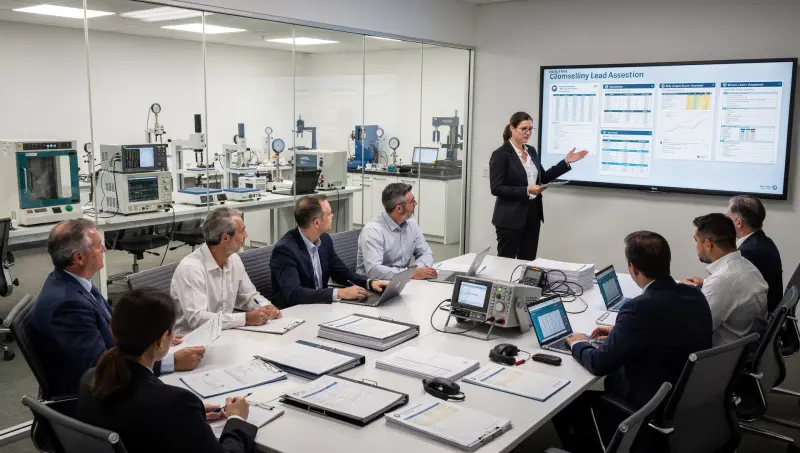
ISO/IEC 17025 Lead Implementer Certificate Training Course

At a glance
- Duration
- 5 days
- Format
- Classroom
- Cities
- London, Tbilisi, Al Jubail, Kuala Lumpur, Amsterdam, Istanbul and more
- Next session
- 12 – 16 October 2026, London
- Average fee
- 7,450 €
Course Overview
The ISO/IEC 17025 Lead Implementer Certificate Training Course equips professionals with the expertise required to design, deploy, maintain, and enhance a robust Laboratory Management System across testing and calibration laboratories. Participants examine the core requirements of ISO/IEC 17025:2017, focusing on laboratory technical competence, impartiality, metrological traceability, and consistent operational quality. The syllabus translates international standard requirements into practical implementation steps, guiding candidates through gap analysis, documentation design, risk management, and internal assessment routines. This course is delivered by Agile Leaders Training Center.
Through real-world laboratory scenarios, attendees develop competencies in establishing quality policies, managing technical records, determining measurement uncertainty, validating test methods, and organizing interlaboratory comparisons. The training links implementation practices directly with accreditation preparation workflows, ensuring participants are equipped to coordinate cross-functional teams and establish disciplined compliance routines.
Target Audience
- Laboratory directors and managers responsible for laboratory management system implementation
- Quality managers and quality assurance specialists overseeing compliance and documentation
- Technical managers, laboratory supervisors, and calibration engineers
- Internal auditors and compliance officers preparing for accreditation assessments
- Consultants guiding testing and calibration laboratories through management system adoption
Targeted Organizational Departments
- Quality Assurance and Quality Control
- Testing and Analytical Operations
- Calibration and Metrology Services
- Technical Governance and Regulatory Compliance
- Research, Development, and Method Validation
Targeted Industries
- Testing and calibration laboratories
- Pharmaceutical, clinical, and diagnostic testing facilities
- Food safety, environmental, and agricultural laboratories
- Petrochemical, energy, and materials testing facilities
- Industrial manufacturing, automotive, and aerospace testing centers
Course Objectives
By the end of this course, participants will be able to:
- Interpret standard requirements and apply them to testing and calibration laboratories.
- Organize and execute a laboratory management system implementation roadmap.
- Perform baseline gap evaluations to detect operational deficiencies and compliance risks.
- Formulate structured documentation packages, including policies, standard procedures, and technical records.
- Establish controls for equipment calibration, environmental monitoring, and metrological traceability.
- Calculate measurement uncertainty budgets and execute sound method validation protocols.
- Execute internal audits and management reviews aligned with accreditation criteria.
- Align laboratory processes with Lead Implementer exam domains and accreditation audit expectations.
Training Methodology
The curriculum utilizes an application-driven instructional model that combines interactive lectures, clause-by-clause analysis, and practical laboratory exercises. Participants review real-world testing workflows, analyze nonconformity case studies, evaluate equipment registers, and build quality documentation. Daily reflection exercises reinforce key implementation concepts, clarify documentation boundaries, and strengthen readiness for professional certification evaluations.
Course Toolbox
- Laboratory implementation roadmap and milestone planning templates
- ISO/IEC 17025 baseline gap evaluation checklist
- Laboratory risk register template addressing impartiality and operational risks
- Competence evaluation matrix and analyst training log
- Equipment calibration and metrological traceability register
- Method validation summary worksheet and measurement uncertainty calculation guide
- Internal audit checklist and corrective action tracking register
Course Agenda
Day 1: Introduction to ISO/IEC 17025 and Initiation of a LMS
- Course structure, professional certification pathways, and core learning goals
- Scope, objectives, and normative foundations of ISO/IEC 17025:2017
- Core principles: technical competence, impartiality, confidentiality, and data integrity
- Regulatory structures and accreditation context for commercial and industrial laboratories
- Project initiation steps, resource allocation, and governance frameworks
- Conducting baseline gap assessments and identifying operational priorities
- Review session: synthesis of fundamental concepts and Day 1 core themes
Day 2: Planning the Implementation of a Laboratory Management System
- Securing leadership commitment and organizing implementation project teams
- Defining the Laboratory Management System boundary and scope of testing operations
- Drafting laboratory quality policies, impartiality declarations, and ethics statements
- Establishing roles, responsibilities, technical authorities, and organizational charts
- Designing document control, technical record retention, and data security frameworks
- Resource planning, competence requirements, and risk mitigation schedules
- Review session: evaluation of implementation plans and governance documentation
Day 3: Implementation of a Laboratory Management System
- Drafting and deploying standard operating procedures and technical work instructions
- Managing personnel qualification records, technical supervision, and competence monitoring
- Facilities management, environmental condition monitoring, and contamination control
- Equipment maintenance routines, calibration schedules, and metrological traceability
- Method verification, method validation protocols, and sampling control plans
- Evaluating measurement uncertainty, proficiency testing programs, and quality controls
- Review session: operational implementation controls and technical competence criteria
Day 4: LMS Monitoring, Measurement, Continual Improvement and Accreditation Preparation
- Monitoring laboratory performance, quality control trends, and process metrics
- Planning and conducting internal audits against ISO/IEC 17025 criteria
- Structuring formal management reviews, executive inputs, and strategic decisions
- Managing nonconforming work, complaints, root cause analysis, and corrective actions
- Driving continual improvement through risk reviews and operational key indicators
- Accreditation assessment readiness, pre-audit planning, and auditor liaison
- Review session: auditing mechanisms, corrective action routines, and audit readiness
Day 5: Certification Exam Preparation and Final Review
- Domain 1 review: principles, terminology, and laboratory quality concepts
- Domain 2 review: interpretation of management and technical requirements
- Domain 3 review: planning techniques and governance structuring for a LMS
- Domain 4 review: executing technical controls, traceability, and method validation
- Domains 5 and 6 review: internal auditing, evaluation, and continual improvement
- Domain 7 review: accreditation audit mechanics and implementer role expectations
- Review session: practice question analysis, core concept synthesis, and final review
Frequently Asked Questions
What specific qualifications or prerequisites are needed for participants before enrolling in the course?
Participants should have a foundational understanding of laboratory operations, quality management concepts, or regulatory testing environments. Prior exposure to quality assurance, testing, calibration, or auditing is beneficial for those preparing for professional Lead Implementer evaluations, though professionals joining an implementation initiative for the first time will find the systematic structure accessible.
How long is each day's session, and is there a total number of hours required for the entire course?
Each day consists of structured instructional sessions lasting approximately four to five hours, including interactive discussions, practical exercises, and review intervals. Over the five days, the course encompasses approximately 20 to 25 instructional hours.
What is the difference between ISO/IEC 17025 accreditation and ISO 17025 Lead Implementer certification?
ISO/IEC 17025 accreditation is granted by an authoritative accreditation body to an organization, confirming that a specific testing or calibration laboratory operates competently and produces valid results. Lead Implementer certification is awarded to an individual professional, confirming their personal capability to design, establish, manage, and audit a Laboratory Management System in conformance with the standard.
How This Course Compares
While many standard training offerings focus strictly on theoretical clause interpretation, this programme bridges regulatory theory and operational practice. Participants gain hands-on experience in drafting traceability registers, setting up uncertainty calculation frameworks, structuring risk evaluations, and preparing laboratory teams for formal accreditation assessments.
credits: 5 credit per day
Course Mode: full-time
Provider: Agile Leaders Training Center
-
Events for this Course
-
London 12 – 16 October 2026
-
Tbilisi 12 – 16 October 2026
-
Al Jubail 18 – 22 October 2026
-
Kuala Lumpur 26 – 30 October 2026
-
Amsterdam 26 – 30 October 2026
-
Istanbul 2 – 6 November 2026
-
Munich 2 – 6 November 2026
-
Kuwait 8 – 12 November 2026
-
Barcelona 9 – 13 November 2026
-
Amman 15 – 19 November 2026
-
Tokyo 23 – 27 November 2026
-
Baku 23 – 27 November 2026
-
Lisbon 23 – 27 November 2026
-
Rome 30 November – 4 December 2026
-
San Diego 30 November – 4 December 2026
-
Nice 7 – 11 December 2026
-
Berlin 7 – 11 December 2026
-
Paris 14 – 18 December 2026
-
London 14 – 18 December 2026
-
Prague 14 – 18 December 2026
-
Dubai 21 – 25 December 2026
-
Abu Dhabi 21 – 25 December 2026
-
Istanbul 8 – 12 February 2027
-
Bali 28 February – 4 March 2027
-
Manama 21 – 25 March 2027
-
Riyadh 21 – 25 March 2027
-
Nairobi 28 March – 1 April 2027
-
Toronto 28 March – 1 April 2027
-
Trabzon 4 – 8 April 2027
-
Frankfurt 5 – 9 April 2027
-
Madrid 12 – 16 April 2027
-
Johannesburg 18 – 22 April 2027
-
Tashkent 18 – 22 April 2027
-
Milan 3 – 7 May 2027
-
Porto 3 – 7 May 2027
-
Zanzibar 16 – 20 May 2027
-
Cape town 23 – 27 May 2027
-
Phuket 6 – 10 June 2027
-
Singapore 7 – 11 June 2027
-
Chicago 13 – 17 June 2027
-
New York 14 – 18 June 2027
-
London 21 – 25 June 2027
-
Athens 21 – 25 June 2027
-
Montreux 12 – 16 July 2027
-
Geneva 18 – 22 July 2027
-
Marbella 18 – 22 July 2027
-
Cairo 19 – 23 July 2027
-
Langkawi 25 – 29 July 2027
-
Abu Dhabi 2 – 6 August 2027
-
Kuala Lumpur 2 – 6 August 2027
-
Muscat 8 – 12 August 2027
-
Seoul 16 – 20 August 2027
-
Bangkok 22 – 26 August 2027
-
Vienna 30 August – 3 September 2027
-
Dubai 6 – 10 September 2027
-
Amsterdam 6 – 10 September 2027
-
Zoom 13 – 17 September 2027
-
Accra 19 – 23 September 2027
-
Paris 27 September – 1 October 2027
-
Casablanca 4 – 8 October 2027
-
Jakarta 4 – 8 October 2027
-
Doha 10 – 14 October 2027
-
Sharm El-Sheikh 11 – 15 October 2027
| Image | Location | Dates | Duration | Mode | Price | Actions |
|---|---|---|---|---|---|---|

|
Dubai |
Week 52, 2026 21 – 25 December 2026 |
5 Days | Onsite | €6,500 | |

|
Abu Dhabi |
Week 52, 2026 21 – 25 December 2026 |
5 Days | Onsite | €6,500 | |

|
Istanbul |
Week 06, 2027 8 – 12 February 2027 |
5 Days | Onsite | €6,000 | |

|
Bali |
Week 08, 2027 28 February – 4 March 2027 |
5 Days | Onsite | €6,500 | |

|
Manama |
Week 11, 2027 21 – 25 March 2027 |
5 Days | Onsite | €6,500 | |

|
Riyadh |
Week 11, 2027 21 – 25 March 2027 |
5 Days | Onsite | €7,500 | |

|
Nairobi |
Week 12, 2027 28 March – 1 April 2027 |
5 Days | Onsite | €6,000 | |

|
Toronto |
Week 12, 2027 28 March – 1 April 2027 |
5 Days | Onsite | €16,000 | |

|
Trabzon |
Week 13, 2027 4 – 8 April 2027 |
5 Days | Onsite | €8,000 | |

|
Frankfurt |
Week 14, 2027 5 – 9 April 2027 |
5 Days | Onsite | €6,500 | |

|
Madrid |
Week 15, 2027 12 – 16 April 2027 |
5 Days | Onsite | €6,500 | |

|
Johannesburg |
Week 15, 2027 18 – 22 April 2027 |
5 Days | Onsite | €6,000 | |

|
Tashkent |
Week 15, 2027 18 – 22 April 2027 |
5 Days | Onsite | €8,000 | |

|
Milan |
Week 18, 2027 3 – 7 May 2027 |
5 Days | Onsite | €7,000 | |

|
Porto |
Week 18, 2027 3 – 7 May 2027 |
5 Days | Onsite | €6,500 | |

|
Zanzibar |
Week 19, 2027 16 – 20 May 2027 |
5 Days | Onsite | €6,000 | |

|
Cape town |
Week 20, 2027 23 – 27 May 2027 |
5 Days | Onsite | €6,000 | |

|
Phuket |
Week 22, 2027 6 – 10 June 2027 |
5 Days | Onsite | €8,000 | |

|
Singapore |
Week 23, 2027 7 – 11 June 2027 |
5 Days | Onsite | €6,500 | |

|
Chicago |
Week 23, 2027 13 – 17 June 2027 |
5 Days | Onsite | €16,000 |
Frequently asked questions
What does this course cover?
Course OverviewThe ISO/IEC 17025 Lead Implementer Certificate Training Course equips professionals with the expertise required to design, deploy, maintain, and enhance a robust Laboratory Management System across testing and calibration laboratories. Participants examine the core requirements of ISO/IEC 17025:2017, focusing on laboratory technical compete…
Are training dates available?
Yes. Available dates and destinations are listed in the course dates section on this page.
How can I register?
Choose an available date on this page and complete the registration form, or send a programme enquiry.
Can I download the course brochure?
Yes. Use the brochure download link provided on this page.
This course by city
- Certified Courses By International Bodies in Abu Dhabi
- Certified Courses By International Bodies in Accra
- Certified Courses By International Bodies in Al Jubail
- Certified Courses By International Bodies in Amman
- Certified Courses By International Bodies in Amsterdam
- Certified Courses By International Bodies in Athens
- Certified Courses By International Bodies in Baku
- Certified Courses By International Bodies in Bali
- Certified Courses By International Bodies in Bangkok
- Certified Courses By International Bodies in Barcelona
- Certified Courses By International Bodies in Berlin
- Certified Courses By International Bodies in Cairo
- Certified Courses By International Bodies in Cape town
- Certified Courses By International Bodies in Casablanca
- Certified Courses By International Bodies in Chicago
- Certified Courses By International Bodies in Doha
- Certified Courses By International Bodies in Dubai
- Certified Courses By International Bodies in Frankfurt
- Certified Courses By International Bodies in Geneva
- Certified Courses By International Bodies in Istanbul
- Certified Courses By International Bodies in Jakarta
- Certified Courses By International Bodies in Johannesburg
- Certified Courses By International Bodies in Kuala Lumpur
- Certified Courses By International Bodies in Kuwait
- Certified Courses By International Bodies in Langkawi
- Certified Courses By International Bodies in Lisbon
- Certified Courses By International Bodies in London
- Certified Courses By International Bodies in Madrid
- Certified Courses By International Bodies in Manama
- Certified Courses By International Bodies in Marbella
- Certified Courses By International Bodies in Milan
- Certified Courses By International Bodies in Montreux
- Certified Courses By International Bodies in Munich
- Certified Courses By International Bodies in Muscat
- Certified Courses By International Bodies in Nairobi
- Certified Courses By International Bodies in New York
- Certified Courses By International Bodies in Nice
- Certified Courses By International Bodies in Paris
- Certified Courses By International Bodies in Phuket
- Certified Courses By International Bodies in Porto
- Certified Courses By International Bodies in Prague
- Certified Courses By International Bodies in Riyadh
- Certified Courses By International Bodies in Rome
- Certified Courses By International Bodies in San Diego
- Certified Courses By International Bodies in Seoul
- Certified Courses By International Bodies in Sharm El-Sheikh
- Certified Courses By International Bodies in Singapore
- Certified Courses By International Bodies in Tashkent
- Certified Courses By International Bodies in Tbilisi
- Certified Courses By International Bodies in Tokyo
- Certified Courses By International Bodies in Toronto
- Certified Courses By International Bodies in Trabzon
- Certified Courses By International Bodies in Vienna
- Certified Courses By International Bodies in Zanzibar
- Certified Courses By International Bodies in Zoom