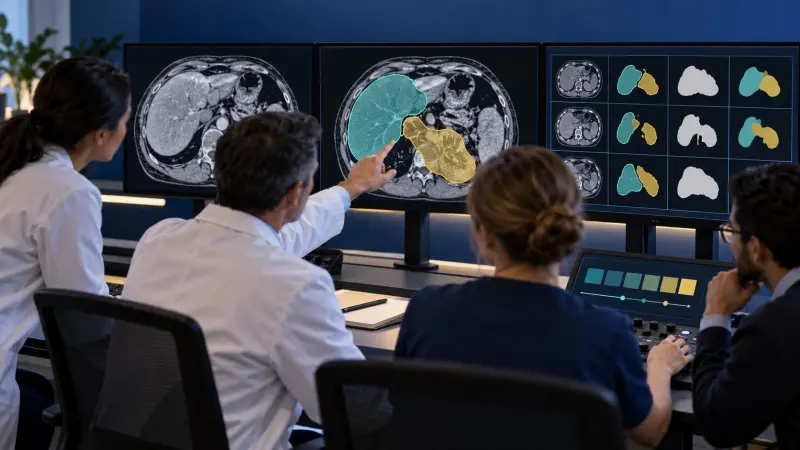
Medical Imaging AI Governance Training Course
- Duration
- 1 Week5 days
- Next start
- London
- Scheduled dates
- 76
- Classroom cities
- 54London, Seoul, Abu Dhabi, Montreux and more
- Format
- Classroom and live online
- Fee per participant
- €1,500–€14,000Average €5,750
What does this course cover?
Overview
Medical Imaging AI Governance and Deployment Course is a one-week course for imaging service managers, radiology operations coordinators, quality teams, clinical technology personnel, data stewards, and digital health transformation teams, who leave with an Imaging AI Governance and Deployment Plan. Participants define use cases, map workflows, assess image datasets and annotations, review validation evidence, set human oversight, control deployment, monitor performance, and escalate incidents. Agile Leaders Training Center provides training in medical imaging AI governance and deployment.
Who Should Attend
- Imaging service personnel responsible for operational quality and capacity
- Radiology operations personnel responsible for workflow and service integration
- Quality personnel responsible for validation evidence and performance review
- Clinical technology personnel responsible for deployment and system controls
- Data stewards responsible for image datasets, labels, access, and traceability
- Digital health personnel responsible for governed AI adoption
The course assumes participants contribute to imaging operations or technology governance and leaves out diagnostic interpretation, algorithm development, coding, and specialist data science.
Departments and Industries
The course supports governed imaging AI deployment across healthcare service and technology environments.
- Radiology and medical imaging operations
- Clinical quality and patient safety functions
- Health technology and biomedical engineering
- Healthcare data governance and informatics
- Hospitals, diagnostic centers, and outpatient networks
- Digital health and medical technology organizations
Learning Objectives
By the end of this course, participants will be able to:
- Analyze imaging use cases and workflow fit
- Evaluate dataset, annotation, and validation readiness
- Apply bias, performance-limit, and human-review controls
- Build deployment, change, and rollback controls
- Use monitoring thresholds and incident escalation
- Build an Imaging AI Governance and Deployment Plan
Course Agenda
Day 1: Use Cases and Workflow Fit
- Imaging AI Use-Case Definition Canvas
- Clinical and Operational Need Statement
- Imaging Workflow Integration Map
- Human-AI Task Allocation Matrix
- Governance Ownership and RACI Chart
Day 2: Data and Validation Readiness
- Image Dataset Provenance Register
- Annotation Quality Review Checklist
- Population Representation Assessment
- Local Validation Evidence Matrix
- Performance Limit and Uncertainty Card
Day 3: Oversight and Deployment Controls
- Human Review and Override Protocol
- Predeployment Acceptance Test Plan
- Workflow Safety and Failure-Mode Review
- Version and Change Control Register
- Rollback and Service Continuity Procedure
Day 4: Monitoring and Incident Response
- Input and Output Stability Baseline
- Performance Drift Monitoring Dashboard
- Threshold Alert and Review Rules
- Imaging AI Incident Classification Scheme
- Root-Cause and Corrective Action Record
Day 5: Imaging AI Governance Practice
- Suggested Exercise: Define Use Case and Workflow Fit
- Suggested Exercise: Review Data and Validation Evidence
- Suggested Exercise: Set Oversight and Deployment Controls
- Suggested Exercise: Design Monitoring and Escalation
- Capstone Exercise: Imaging AI Governance and Deployment Plan
Practical Exercises
The course uses suggested activities that convert imaging AI proposals into governed deployment decisions.
- Suggested activity: define the need, map workflow tasks, and assign governance ownership
- Suggested activity: review provenance, annotation quality, representation, validation, and performance limits
- Suggested activity: design human review, acceptance tests, failure controls, versioning, and rollback
- Suggested activity: establish baselines, thresholds, incident classes, escalation, and corrective action
FAQs
Who suits medical imaging AI governance training, and what does it assume?
Medical imaging AI governance training suits personnel responsible for imaging operations, quality, clinical technology, data stewardship, or digital health transformation. It assumes familiarity with healthcare workflows and requires no coding.
How does medical imaging AI governance differ from image interpretation training?
Medical imaging AI governance focuses on evidence, data readiness, workflow integration, oversight, deployment, monitoring, and incidents, while image interpretation training develops clinical reading and diagnostic skills.
What evidence should teams review before deploying imaging AI?
Teams should review intended use, dataset provenance, annotation quality, population representation, validation design, performance measures, uncertainty, workflow tests, failure modes, and local acceptance evidence.
How should teams monitor medical imaging AI after deployment?
Teams should monitor input and output stability, workflow exceptions, overrides, performance indicators, alert thresholds, incidents, changes, and corrective actions against an approved baseline.
What belongs in an Imaging AI Governance and Deployment Plan?
The plan should include use cases, owners, workflow maps, data and validation evidence, performance limits, human oversight, acceptance tests, version control, rollback, monitoring thresholds, incident escalation, and review dates.
Conclusion
Participants take back an Imaging AI Governance and Deployment Plan connecting need, workflow, data, validation, oversight, deployment, monitoring, and incidents. It changes how teams evaluate and control imaging AI across its operating lifecycle. The plan provides a basis for traceable evidence, accountable review, controlled change, visible performance limits, and timely corrective action.
credits: 5 credit per day
Course Mode: full-time
Provider: Agile Leaders Training Center
-
Events for this Course
-
London 23 – 27 November 2026
-
Seoul 23 – 27 November 2026
-
Abu Dhabi 30 November – 4 December 2026
-
Montreux 7 – 11 December 2026
-
Phuket 13 – 17 December 2026
-
Rome 14 – 18 December 2026
-
Madrid 21 – 25 December 2026
-
Muscat 27 – 31 December 2026
-
Barcelona 28 December 2026 – 1 January 2027
-
Manama 3 – 7 January 2027
-
London 4 – 8 January 2027
-
Sharm El-Sheikh 11 – 15 January 2027
-
Athens 11 – 15 January 2027
-
Marbella 17 – 21 January 2027
-
Dubai 18 – 22 January 2027
-
Kuwait 24 – 28 January 2027
-
Addis Ababa 25 – 29 January 2027
-
Berlin 1 – 5 February 2027
-
Singapore 8 – 12 February 2027
-
San Diego 15 – 19 February 2027
-
Amsterdam 22 – 26 February 2027
-
Abu Dhabi 22 – 26 February 2027
-
Madrid 1 – 5 March 2027
-
Baku 8 – 12 March 2027
-
Bangkok 14 – 18 March 2027
-
Istanbul 29 March – 2 April 2027
-
Jakarta 29 March – 2 April 2027
-
Paris 5 – 9 April 2027
-
Langkawi 11 – 15 April 2027
-
Kuala Lumpur 12 – 16 April 2027
-
London 19 – 23 April 2027
-
Abu Dhabi 26 – 30 April 2027
-
Nairobi 2 – 6 May 2027
-
Cairo 3 – 7 May 2027
-
Dubai 10 – 14 May 2027
-
Vienna 10 – 14 May 2027
-
Amsterdam 17 – 21 May 2027
-
Chicago 23 – 27 May 2027
-
Amman 30 May – 3 June 2027
-
Barcelona 7 – 11 June 2027
-
Nice 7 – 11 June 2027
-
Johannesburg 20 – 24 June 2027
-
Cape town 27 June – 1 July 2027
-
London 5 – 9 July 2027
-
Prague 5 – 9 July 2027
-
Milan 12 – 16 July 2027
-
Tokyo 19 – 23 July 2027
-
New York 19 – 23 July 2027
-
Trabzon 25 – 29 July 2027
-
Dubai 2 – 6 August 2027
-
Munich 2 – 6 August 2027
-
Porto 9 – 13 August 2027
-
Toronto 15 – 19 August 2027
-
Casablanca 16 – 20 August 2027
-
Abu Dhabi 23 – 27 August 2027
-
Rome 30 August – 3 September 2027
-
Accra 30 August – 3 September 2027
-
Paris 6 – 10 September 2027
-
Tbilisi 6 – 10 September 2027
-
Manama 12 – 16 September 2027
-
Kuala Lumpur 13 – 17 September 2027
-
Doha 19 – 23 September 2027
-
Cairo 27 September – 1 October 2027
-
Lisbon 27 September – 1 October 2027
-
Frankfurt 4 – 8 October 2027
-
Amsterdam 11 – 15 October 2027
-
Milan 11 – 15 October 2027
-
Zanzibar 17 – 21 October 2027
-
Istanbul 18 – 22 October 2027
-
Bali 24 – 28 October 2027
-
Geneva 31 October – 4 November 2027
-
Vienna 8 – 12 November 2027
-
Lagos 14 – 18 November 2027
-
Zoom 15 – 19 November 2027
-
Tashkent 21 – 25 November 2027
-
Dubai 22 – 26 November 2027
When and where does this course run?
| Image | Location | Dates | Duration | Mode | Price | Actions |
|---|---|---|---|---|---|---|

|
Kuala Lumpur |
Week 37, 2027 13 – 17 September 2027 |
1 Week | Onsite | €5,200 | |

|
Doha |
Week 37, 2027 19 – 23 September 2027 |
1 Week | Onsite | €5,500 | |

|
Cairo |
Week 39, 2027 27 September – 1 October 2027 |
1 Week | Onsite | €4,100 | |

|
Lisbon |
Week 39, 2027 27 September – 1 October 2027 |
1 Week | Onsite | €5,700 | |

|
Frankfurt |
Week 40, 2027 4 – 8 October 2027 |
1 Week | Onsite | €5,700 | |

|
Amsterdam |
Week 41, 2027 11 – 15 October 2027 |
1 Week | Onsite | €5,700 | |

|
Milan |
Week 41, 2027 11 – 15 October 2027 |
1 Week | Onsite | €5,700 | |

|
Zanzibar |
Week 41, 2027 17 – 21 October 2027 |
1 Week | Onsite | €5,500 | |

|
Istanbul |
Week 42, 2027 18 – 22 October 2027 |
1 Week | Onsite | €4,500 | |

|
Bali |
Week 42, 2027 24 – 28 October 2027 |
1 Week | Onsite | €5,700 | |

|
Geneva |
Week 43, 2027 31 October – 4 November 2027 |
1 Week | Onsite | €6,200 | |

|
Vienna |
Week 45, 2027 8 – 12 November 2027 |
1 Week | Onsite | €5,700 | |

|
Lagos |
Week 45, 2027 14 – 18 November 2027 |
1 Week | Onsite | €4,100 | |

|
Zoom |
Week 46, 2027 15 – 19 November 2027 |
1 Week | Online | €1,500 | |

|
Tashkent |
Week 46, 2027 21 – 25 November 2027 |
1 Week | Onsite | €4,500 | |

|
Dubai |
Week 47, 2027 22 – 26 November 2027 |
1 Week | Onsite | €4,500 |
This course by city
- Healthcare Management Training Courses in Abu Dhabi
- Healthcare Management Training Courses in Accra
- Healthcare Management Training Courses in Addis Ababa
- Healthcare Management Training Courses in Amman
- Healthcare Management Training Courses in Amsterdam
- Healthcare Management Training Courses in Athens
- Healthcare Management Training Courses in Baku
- Healthcare Management Training Courses in Bali
- Healthcare Management Training Courses in Bangkok
- Healthcare Management Training Courses in Barcelona
- Healthcare Management Training Courses in Berlin
- Healthcare Management Training Courses in Cairo
- Healthcare Management Training Courses in Cape town
- Healthcare Management Training Courses in Casablanca
- Healthcare Management Training Courses in Chicago
- Healthcare Management Training Courses in Doha
- Healthcare Management Training Courses in Dubai
- Healthcare Management Training Courses in Frankfurt
- Healthcare Management Training Courses in Geneva
- Healthcare Management Training Courses in Istanbul
- Healthcare Management Training Courses in Jakarta
- Healthcare Management Training Courses in Johannesburg
- Healthcare Management Training Courses in Kuala Lumpur
- Healthcare Management Training Courses in Kuwait
- Healthcare Management Training Courses in Lagos
- Healthcare Management Training Courses in Langkawi
- Healthcare Management Training Courses in Lisbon
- Healthcare Management Training Courses in London
- Healthcare Management Training Courses in Madrid
- Healthcare Management Training Courses in Manama
- Healthcare Management Training Courses in Marbella
- Healthcare Management Training Courses in Milan
- Healthcare Management Training Courses in Montreux
- Healthcare Management Training Courses in Munich
- Healthcare Management Training Courses in Muscat
- Healthcare Management Training Courses in Nairobi
- Healthcare Management Training Courses in New York
- Healthcare Management Training Courses in Nice
- Healthcare Management Training Courses in Paris
- Healthcare Management Training Courses in Phuket
- Healthcare Management Training Courses in Porto
- Healthcare Management Training Courses in Prague
- Healthcare Management Training Courses in Rome
- Healthcare Management Training Courses in San Diego
- Healthcare Management Training Courses in Seoul
- Healthcare Management Training Courses in Sharm El-Sheikh
- Healthcare Management Training Courses in Singapore
- Healthcare Management Training Courses in Tashkent
- Healthcare Management Training Courses in Tbilisi
- Healthcare Management Training Courses in Tokyo
- Healthcare Management Training Courses in Toronto
- Healthcare Management Training Courses in Trabzon
- Healthcare Management Training Courses in Vienna
- Healthcare Management Training Courses in Zanzibar
- Healthcare Management Training Courses in Zoom
More ways to train
- Every date of this courseAll cities and months, with fees
- Healthcare Management Training CoursesEvery course in this subject
- Live online coursesTrain from wherever you are
- Training citiesCourses in each city
- All upcoming datesThe course calendar by month
- Training for your teamTell us the course, the number of participants and your dates
- Contact usAsk us about this course