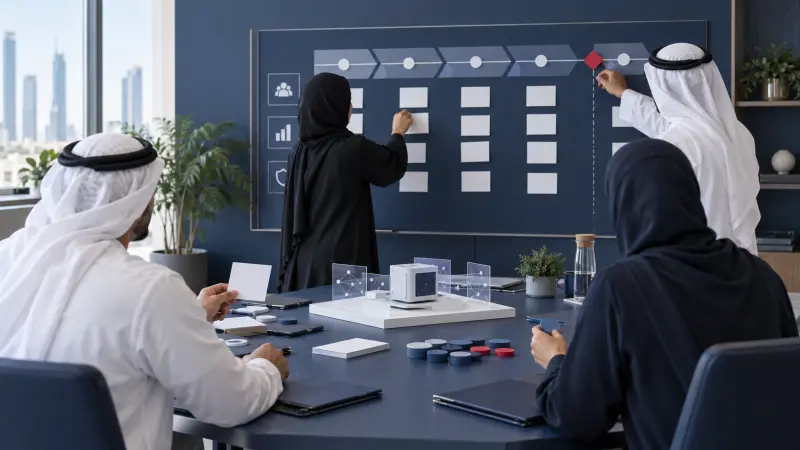
Minimum Viable Product Development Training Course

At a glance
- Duration
- 1 Week
- Format
- Classroom
- Cities
- Jakarta, Madrid, Vienna, Abu Dhabi, Manama, Chicago and more
- Next session
- 9 – 13 November 2026, Jakarta
- Average fee
- 5,750 €
Overview
Minimum Viable Product Development and Validation Training Course is a one-week intermediate course for product managers, product owners, startup founders, innovation teams, and business analysts who leave with an MVP Validation Playbook. Participants convert uncertain ideas into testable hypotheses, use customer discovery interviews, design focused experiments, build fit-for-purpose MVPs, and evaluate behavioral evidence through actionable metrics. The course connects minimum viable product development with documented pivot, persevere, or stop decisions. Agile Leaders Training Center develops practical MVP validation capability.
Who Should Attend
- Product functions responsible for shaping product hypotheses and validation priorities
- Product ownership functions responsible for backlog choices and early-release scope
- Startup functions responsible for testing demand before committing scarce resources
- Innovation functions responsible for running experiments and reviewing evidence
- Business analysis functions responsible for customer needs, assumptions, and decision records
The course assumes participants evaluate new product ideas at work, and it leaves out broad product-manager career development, software engineering, and certification preparation.
Departments and Industries
The course supports departments and industries that test new products, services, and operating concepts before scaling investment.
- Product management, innovation, strategy, and business analysis
- Technology, software services, digital commerce, and financial services
- Healthcare, education, mobility, and professional services
- Manufacturing, energy, consumer products, and industrial services
- Startup studios, accelerators, research teams, and corporate venture functions
Learning Objectives
By the end of this course, participants will be able to:
- Analyze customer problems and riskiest product assumptions
- Build testable hypotheses and evidence thresholds
- Prioritize MVP scope with value and risk criteria
- Apply experiment methods to desirability, feasibility, and viability
- Evaluate actionable metrics and evidence strength
- Use findings for pivot, persevere, or stop decisions
Course Agenda
Day 1: Problem Evidence and Assumptions
- Customer Problem Statement Canvas
- Customer Discovery Interview Guide
- Assumption Mapping Matrix
- Desirability, Feasibility, and Viability Risk Map
- Testable Product Hypothesis Template
Day 2: MVP Scope and Experiment Design
- Value Proposition Evidence Map
- Core Outcome and Feature Prioritization Matrix
- MVP Experiment Design Card
- Evidence Threshold and Kill-Criteria Register
- Prototype, Proof-of-Concept, and MVP Comparison Guide
Day 3: Build and Run Validation Tests
- Concierge and Wizard-of-Oz Test Method
- Landing Page and Call-to-Action Test Plan
- Preorder and Commitment Experiment Protocol
- Usability Test Script and Observation Sheet
- Experiment Ethics and Participant Consent Checklist
Day 4: Metrics, Learning, and Product Decisions
- Build-Measure-Learn Feedback Loop
- Actionable Metric and Vanity Metric Screen
- Experiment Evidence Strength Scale
- Validated Learning Dashboard
- Pivot, Persevere, or Stop Decision Record
Day 5: MVP Validation Practice
- Exercise: Diagnose a Weak Product Hypothesis
- Exercise: Select an MVP Form and Scope
- Exercise: Review Conflicting Customer Evidence
- Exercise: Make a Product Continuation Decision
- Capstone Exercise: MVP Validation Playbook
Practical Exercises
The course uses suggested activities to connect product assumptions with observable customer behavior and documented decisions.
- Suggested activity: conduct a customer discovery interview and separate facts, opinions, and unsupported assumptions.
- Suggested activity: create an MVP experiment with a measurable signal, evidence threshold, and stopping rule.
- Suggested activity: compare qualitative and behavioral evidence, then record a defensible continuation decision.
- Suggested activity: assemble the MVP Validation Playbook from problem framing through decision review.
FAQs
Who suits minimum viable product development training, and what does it assume?
Product, startup, innovation, and analysis functions suit the training. It assumes responsibility for evaluating new concepts but does not require software-development expertise.
How does MVP validation differ from broad product management training?
MVP validation concentrates on assumptions, experiments, evidence, and early product decisions, while broad product management training spans the full lifecycle, organization, career, and market responsibilities.
What makes an MVP experiment useful for a product decision?
A useful MVP experiment links one critical hypothesis to observable behavior, a defined audience, an evidence threshold, and a decision rule established before results are reviewed.
Which metrics support validated learning from an MVP?
Validated learning uses metrics tied to customer behavior, such as activation, repeated use, commitment, conversion, retention, or task completion, selected according to the hypothesis under test.
When should a team pivot, persevere, or stop an MVP?
A team should decide after comparing collected evidence with its stated threshold, reviewing data quality and risk, and documenting whether the tested assumption is supported, uncertain, or contradicted.
Conclusion
Participants take an MVP Validation Playbook back to work. It connects customer problems, assumption mapping, MVP experiment design, scope choices, behavioral evidence, a validated learning dashboard, and decision rules. It changes loosely defined product ideas into traceable validation cycles that teams can review before increasing investment.
credits: 5 credit per day
Course Mode: full-time
Provider: Agile Leaders Training Center
-
Events for this Course
-
Jakarta 9 – 13 November 2026
-
Madrid 16 – 20 November 2026
-
Vienna 23 – 27 November 2026
-
Abu Dhabi 23 – 27 November 2026
-
Manama 29 November – 3 December 2026
-
Chicago 29 November – 3 December 2026
-
Cairo 7 – 11 December 2026
-
Paris 14 – 18 December 2026
-
Athens 14 – 18 December 2026
-
London 21 – 25 December 2026
-
Amsterdam 28 December 2026 – 1 January 2027
-
New York 28 December 2026 – 1 January 2027
-
London 4 – 8 January 2027
-
Montreux 4 – 8 January 2027
-
Berlin 11 – 15 January 2027
-
Bangkok 17 – 21 January 2027
-
Accra 24 – 28 January 2027
-
Vienna 25 – 29 January 2027
-
Zanzibar 31 January – 4 February 2027
-
Amsterdam 1 – 5 February 2027
-
Tbilisi 8 – 12 February 2027
-
Rome 15 – 19 February 2027
-
Porto 15 – 19 February 2027
-
Manama 21 – 25 February 2027
-
Amman 28 February – 4 March 2027
-
Dubai 15 – 19 March 2027
-
Seoul 15 – 19 March 2027
-
Langkawi 21 – 25 March 2027
-
Milan 22 – 26 March 2027
-
London 29 March – 2 April 2027
-
Abu Dhabi 29 March – 2 April 2027
-
Tokyo 5 – 9 April 2027
-
Kuala Lumpur 12 – 16 April 2027
-
Addis Ababa 19 – 23 April 2027
-
Kuwait 25 – 29 April 2027
-
Johannesburg 2 – 6 May 2027
-
Barcelona 3 – 7 May 2027
-
Lagos 9 – 13 May 2027
-
Rome 10 – 14 May 2027
-
Dubai 17 – 21 May 2027
-
San Diego 17 – 21 May 2027
-
Geneva 23 – 27 May 2027
-
London 24 – 28 May 2027
-
Cape town 30 May – 3 June 2027
-
Zoom 31 May – 4 June 2027
-
Cairo 7 – 11 June 2027
-
Abu Dhabi 7 – 11 June 2027
-
Phuket 13 – 17 June 2027
-
Istanbul 14 – 18 June 2027
-
Nairobi 20 – 24 June 2027
-
Singapore 28 June – 2 July 2027
-
Doha 4 – 8 July 2027
-
Tashkent 18 – 22 July 2027
-
Dubai 19 – 23 July 2027
-
Milan 26 – 30 July 2027
-
Barcelona 2 – 6 August 2027
-
Frankfurt 2 – 6 August 2027
-
Baku 9 – 13 August 2027
-
Nice 16 – 20 August 2027
-
Casablanca 23 – 27 August 2027
-
Abu Dhabi 23 – 27 August 2027
-
Amsterdam 30 August – 3 September 2027
-
Trabzon 5 – 9 September 2027
-
Paris 6 – 10 September 2027
-
Bali 12 – 16 September 2027
-
Madrid 20 – 24 September 2027
-
Kuala Lumpur 27 September – 1 October 2027
-
Munich 27 September – 1 October 2027
-
Marbella 3 – 7 October 2027
-
Toronto 10 – 14 October 2027
-
Istanbul 11 – 15 October 2027
-
Prague 18 – 22 October 2027
-
Sharm El-Sheikh 25 – 29 October 2027
-
Muscat 31 October – 4 November 2027
-
Dubai 1 – 5 November 2027
-
Lisbon 8 – 12 November 2027
| Image | Location | Dates | Duration | Mode | Price | Actions |
|---|---|---|---|---|---|---|

|
Abu Dhabi |
Week 34, 2027 23 – 27 August 2027 |
1 Week | Onsite | €4,700 | |

|
Amsterdam |
Week 35, 2027 30 August – 3 September 2027 |
1 Week | Onsite | €5,700 | |

|
Trabzon |
Week 35, 2027 5 – 9 September 2027 |
1 Week | Onsite | €6,800 | |

|
Paris |
Week 36, 2027 6 – 10 September 2027 |
1 Week | Onsite | €5,700 | |

|
Bali |
Week 36, 2027 12 – 16 September 2027 |
1 Week | Onsite | €5,700 | |

|
Madrid |
Week 38, 2027 20 – 24 September 2027 |
1 Week | Onsite | €5,700 | |

|
Kuala Lumpur |
Week 39, 2027 27 September – 1 October 2027 |
1 Week | Onsite | €5,200 | |

|
Munich |
Week 39, 2027 27 September – 1 October 2027 |
1 Week | Onsite | €5,700 | |

|
Marbella |
Week 39, 2027 3 – 7 October 2027 |
1 Week | Onsite | €5,700 | |

|
Toronto |
Week 40, 2027 10 – 14 October 2027 |
1 Week | Onsite | €12,000 | |

|
Istanbul |
Week 41, 2027 11 – 15 October 2027 |
1 Week | Onsite | €4,500 | |

|
Prague |
Week 42, 2027 18 – 22 October 2027 |
1 Week | Onsite | €6,000 | |

|
Sharm El-Sheikh |
Week 43, 2027 25 – 29 October 2027 |
1 Week | Onsite | €4,100 | |

|
Muscat |
Week 43, 2027 31 October – 4 November 2027 |
1 Week | Onsite | €5,700 | |

|
Dubai |
Week 44, 2027 1 – 5 November 2027 |
1 Week | Onsite | €4,500 | |

|
Lisbon |
Week 45, 2027 8 – 12 November 2027 |
1 Week | Onsite | €5,700 |
Frequently asked questions
What does this course cover?
OverviewMinimum Viable Product Development and Validation Training Course is a one-week intermediate course for product managers, product owners, startup founders, innovation teams, and business analysts who leave with an MVP Validation Playbook. Participants convert uncertain ideas into testable hypotheses, use customer discovery interviews, design focus…
Are training dates available?
Yes. Available dates and destinations are listed in the course dates section on this page.
How can I register?
Choose an available date on this page and complete the registration form, or send a programme enquiry.
Can I download the course brochure?
Yes. Use the brochure download link provided on this page.
This course by city
- Agile PM and Project Management Training Courses in Abu Dhabi
- Agile PM and Project Management Training Courses in Accra
- Agile PM and Project Management Training Courses in Addis Ababa
- Agile PM and Project Management Training Courses in Amman
- Agile PM and Project Management Training Courses in Amsterdam
- Agile PM and Project Management Training Courses in Athens
- Agile PM and Project Management Training Courses in Baku
- Agile PM and Project Management Training Courses in Bali
- Agile PM and Project Management Training Courses in Bangkok
- Agile PM and Project Management Training Courses in Barcelona
- Agile PM and Project Management Training Courses in Berlin
- Agile PM and Project Management Training Courses in Cairo
- Agile PM and Project Management Training Courses in Cape town
- Agile PM and Project Management Training Courses in Casablanca
- Agile PM and Project Management Training Courses in Chicago
- Agile PM and Project Management Training Courses in Doha
- Agile PM and Project Management Training Courses in Dubai
- Agile PM and Project Management Training Courses in Frankfurt
- Agile PM and Project Management Training Courses in Geneva
- Agile PM and Project Management Training Courses in Istanbul
- Agile PM and Project Management Training Courses in Jakarta
- Agile PM and Project Management Training Courses in Johannesburg
- Agile PM and Project Management Training Courses in Kuala Lumpur
- Agile PM and Project Management Training Courses in Kuwait
- Agile PM and Project Management Training Courses in Lagos
- Agile PM and Project Management Training Courses in Langkawi
- Agile PM and Project Management Training Courses in Lisbon
- Agile PM and Project Management Training Courses in London
- Agile PM and Project Management Training Courses in Madrid
- Agile PM and Project Management Training Courses in Manama
- Agile PM and Project Management Training Courses in Marbella
- Agile PM and Project Management Training Courses in Milan
- Agile PM and Project Management Training Courses in Montreux
- Agile PM and Project Management Training Courses in Munich
- Agile PM and Project Management Training Courses in Muscat
- Agile PM and Project Management Training Courses in Nairobi
- Agile PM and Project Management Training Courses in New York
- Agile PM and Project Management Training Courses in Nice
- Agile PM and Project Management Training Courses in Paris
- Agile PM and Project Management Training Courses in Phuket
- Agile PM and Project Management Training Courses in Porto
- Agile PM and Project Management Training Courses in Prague
- Agile PM and Project Management Training Courses in Rome
- Agile PM and Project Management Training Courses in San Diego
- Agile PM and Project Management Training Courses in Seoul
- Agile PM and Project Management Training Courses in Sharm El-Sheikh
- Agile PM and Project Management Training Courses in Singapore
- Agile PM and Project Management Training Courses in Tashkent
- Agile PM and Project Management Training Courses in Tbilisi
- Agile PM and Project Management Training Courses in Tokyo
- Agile PM and Project Management Training Courses in Toronto
- Agile PM and Project Management Training Courses in Trabzon
- Agile PM and Project Management Training Courses in Vienna
- Agile PM and Project Management Training Courses in Zanzibar
- Agile PM and Project Management Training Courses in Zoom