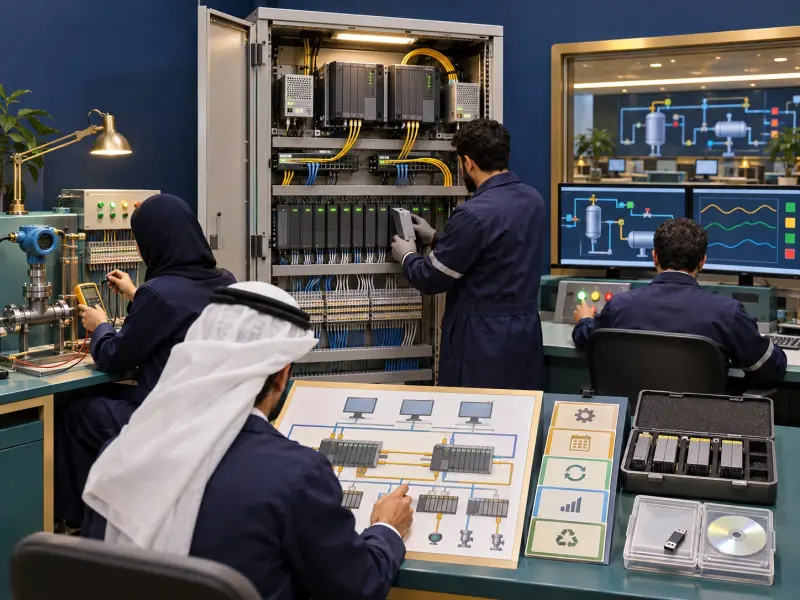
PLC, SCADA and DCS Systems Engineering Training Course

At a glance
- Duration
- 1 Week
- Format
- Classroom
- Cities
- Langkawi, Berlin, Johannesburg, Cape town, Zanzibar, Tashkent and more
- Next session
- 15 – 19 November 2026, Langkawi
- Average fee
- 7,500 €
Overview
The PLC, SCADA and DCS Systems Engineering Training Course is a one-week course for automation engineers, instrumentation specialists, and control room supervisors who leave with an industrial control architecture blueprint and commissioning matrix. Modern facilities confront system integration bottlenecks, legacy protocol mismatches, and operational technology cybersecurity risks that cause unscheduled downtime and process safety events. This course resolves these challenges through structured control logic design, multi-node telemetry mapping, redundant controller configuration, and industrial network defense. Agile Leaders Training Center delivers the PLC, SCADA and DCS Systems Engineering Training Course.
Who Should Attend
- Automation engineers responsible for programming programmable logic controllers and configuring distributed control loops.
- Instrumentation specialists tasked with calibrating field transmitters, configuring remote terminal units, and verifying input-output loops.
- Control system integrators designing supervisory control interfaces, telemetry protocols, and historian architectures.
- Plant electrical supervisors overseeing switchgear automation, motor control centers, and uninterrupted power reliability.
- Operational technology engineers managing industrial network segmentation, firewall rules, and field device cyber defenses.
The course assumes participants actively work with industrial control hardware and digital logic diagrams, leaving out elementary electrical circuitry and basic physics.
Departments and Industries
The course draws practical technical operational scenarios from continuous processing, manufacturing, and critical infrastructure sectors.
- Petrochemical refining and midstream oil processing plants
- Continuous batch pharmaceutical and chemical production facilities
- Municipal water treatment, desalination, and distribution networks
- Thermal power generation, grid transmission, and substation facilities
- Industrial process automation and field engineering divisions
- Plant maintenance, reliability engineering, and technical safety departments
Learning Objectives
By the end of this course, participants will be able to:
- Apply IEC 61131-3:2025 standard programming languages to build structured control logic for complex processes.
- Configure supervisory visualization screens, dynamic trend graphics, and alarm management matrices in SCADA platforms.
- Analyze distributed control architectures to deploy redundant processors, remote input-output drops, and fieldbus segments.
- Evaluate industrial network traffic across Modbus TCP, OPC UA, and DNP3 communication protocols.
- Prioritize operational technology defense controls in accordance with ISA/IEC 62443 security levels.
- Build a complete industrial control architecture blueprint and commissioning matrix for facility deployment.
Course Agenda
Day 1: Controller Hardware Architectures and IEC 61131-3:2025 Programming
- Processor rack configurations, power supply sizing, and isolated digital or analog input-output channel wiring
- Signal conditioning, analog-to-digital resolution scaling, thermocouple integration, and 4-20 milliamp loop verification
- Structured Text syntax, Ladder Diagram rungs, and Function Block Diagram organization under IEC 61131-3:2025
- Software organization units, user-defined data structures, and standard function libraries compliant with PLCopen specifications
- Program scan cycles, task scheduling priorities, watchdog timer allocations, and fault interrupt routines
Day 2: Distributed Control System Engineering and Continuous Process Loops
- DCS system topology, controller redundancy synchronization, and remote input-output cabinet distribution
- Proportional-integral-derivative algorithm execution, loop tuning rules, and cascade control configuration
- Fail-safe logic states, hardware interlock circuits, and voting logic design for critical safety equipment
- Subsystem integration methods connecting third-party packages to central DCS nodes via fieldbus networks
- Historian data collection architectures, deadband logging rules, and long-term trend database sizing
Day 3: SCADA Visualization, Telemetry, and Industrial Network Protocols
- SCADA server-client infrastructure design, human-machine interface graphic creation, and multi-monitor console layout
- ISA-18.2 alarm management rationalization, priority tiering, suppression logic, and alarm flood prevention
- Modbus RTU and Modbus TCP mapping, memory register allocation, and serial-to-Ethernet gateway setup
- OPC Unified Architecture information modeling, secure server certificates, and node endpoint publishing
- Telemetry protocols for wide-area networks, RTU polling cycles, and DNP3 timestamped event buffer management
Day 4: OT Network Infrastructure, ISA/IEC 62443 Defense, and High Availability
- Purdue model network hierarchy, industrial managed switch configuration, and VLAN segmentation schemes
- ISA/IEC 62443 security levels, zone and conduit segregation, and operational technology firewall packet inspection
- Ring topology protocols, spanning tree configuration, and dual-homed media redundancy for uninterrupted uptime
- Remote access architectures, jump server isolation, multi-factor credential policies, and diagnostic port shielding
- Asset inventory tracking, controller firmware baseline auditing, and operational system backup routines
Day 5: Systems Integration Testing, Commissioning, and Capstone Assembly
- Suggested activity: Diagnose controller input-output communication dropouts and address resolution faults across Ethernet networks
- Suggested activity: Evaluate proportional-integral-derivative response data to stabilize oscillating pressure and flow loops
- Suggested activity: Audit supervisory alarm trip logs to identify nuisance alarms and stale process variables
- Suggested activity: Configure industrial firewall rule sets to isolate supervisory control networks from enterprise traffic
- Capstone exercise: Assemble an integrated industrial control architecture blueprint and commissioning matrix for plant operations
Practical Exercises
The course uses engineering design software templates, simulated controller logs, and industrial telemetry packet traces.
- Suggested activity: Program a multi-state motor control logic sequence using Structured Text and Function Block Diagrams.
- Suggested activity: Build an OPC UA client-server tag database connecting distributed controllers to a central SCADA node.
- Suggested activity: Configure an ISA/IEC 62443 network zone boundary using managed switch VLANs and firewall rules.
- Suggested activity: Conduct a simulated loop check and complete input-output cold and hot commissioning sign-off sheets.
FAQs
Who suits the PLC, SCADA and DCS Systems Engineering Training Course?
The PLC, SCADA and DCS Systems Engineering Training Course suits automation, instrumentation, and control systems engineers. The course assumes participants actively manage industrial input-output hardware, read digital schematics, and configure basic control software, leaving out fundamental circuit theory and introductory schoolhouse physics.
How does this course differ from basic PLC wiring courses?
Basic wiring courses focus strictly on physical termination and discrete relay logic. The PLC, SCADA and DCS Systems Engineering Training Course integrates plant-scale distributed control system engineering, supervisory visualization, multi-protocol telemetry integration, and ISA/IEC 62443 operational technology cybersecurity segmentation.
What programming languages does the course utilize?
The course utilizes programming languages defined under IEC 61131-3:2025. Practical engineering exercises center on Structured Text, Function Block Diagrams, and Ladder Diagrams, applying modular program organization units aligned with modern PLCopen standardized software specifications.
How are industrial communication protocols addressed during system integration?
System integration addresses communication protocols by mapping registers and configuring data points across Modbus TCP, DNP3, and OPC Unified Architecture. Participants evaluate network packet exchanges to establish dependable, timestamped telemetry between field controllers, supervisory SCADA consoles, and enterprise historians.
Conclusion
Participants return to their facilities equipped with a verified industrial control architecture blueprint and commissioning matrix. This integrated technical package provides plant operators with validated logic routines, streamlined telemetry mappings, and standardized alarm configurations. Implementing these engineering deliverables improves overall plant stability, accelerates loop commissioning, and strengthens operational resilience across all industrial control networks.
credits: 5 credit per day
Course Mode: full-time
Provider: Agile Leaders Training Center
-
Events for this Course
-
Langkawi 15 – 19 November 2026
-
Berlin 23 – 27 November 2026
-
Johannesburg 29 November – 3 December 2026
-
Cape town 6 – 10 December 2026
-
Zanzibar 13 – 17 December 2026
-
Tashkent 20 – 24 December 2026
-
Marbella 27 – 31 December 2026
-
Dubai 28 December 2026 – 1 January 2027
-
Manama 3 – 7 January 2027
-
Kuwait 10 – 14 January 2027
-
Paris 18 – 22 January 2027
-
Chicago 24 – 28 January 2027
-
Barcelona 1 – 5 February 2027
-
Lagos 7 – 11 February 2027
-
Lisbon 15 – 19 February 2027
-
Toronto 21 – 25 February 2027
-
Doha 28 February – 4 March 2027
-
Athens 8 – 12 March 2027
-
Porto 15 – 19 March 2027
-
Singapore 22 – 26 March 2027
-
Sharm El-Sheikh 29 March – 2 April 2027
-
Madrid 5 – 9 April 2027
-
Phuket 11 – 15 April 2027
-
Nairobi 18 – 22 April 2027
-
Tbilisi 26 – 30 April 2027
-
Addis Ababa 3 – 7 May 2027
-
Baku 10 – 14 May 2027
-
Muscat 16 – 20 May 2027
-
London 24 – 28 May 2027
-
New York 24 – 28 May 2027
-
Trabzon 30 May – 3 June 2027
-
Kuala Lumpur 7 – 11 June 2027
-
Bangkok 13 – 17 June 2027
-
Nice 21 – 25 June 2027
-
Cairo 28 June – 2 July 2027
-
Accra 28 June – 2 July 2027
-
San Diego 5 – 9 July 2027
-
Istanbul 12 – 16 July 2027
-
Munich 19 – 23 July 2027
-
Geneva 25 – 29 July 2027
-
Zoom 2 – 6 August 2027
-
Amsterdam 9 – 13 August 2027
-
Abu Dhabi 16 – 20 August 2027
-
Prague 23 – 27 August 2027
-
Amman 29 August – 2 September 2027
-
Casablanca 30 August – 3 September 2027
-
Vienna 6 – 10 September 2027
-
Frankfurt 13 – 17 September 2027
-
Dubai 20 – 24 September 2027
-
Milan 20 – 24 September 2027
-
London 27 September – 1 October 2027
-
Tokyo 4 – 8 October 2027
-
Jakarta 11 – 15 October 2027
-
Abu Dhabi 18 – 22 October 2027
-
Montreux 25 – 29 October 2027
-
Seoul 1 – 5 November 2027
-
Rome 8 – 12 November 2027
-
Bali 14 – 18 November 2027
| Image | Location | Dates | Duration | Mode | Price | Actions |
|---|---|---|---|---|---|---|

|
Langkawi |
Week 46, 2026 15 – 19 November 2026 |
1 Week | Onsite | €8,000 | |

|
Berlin |
Week 48, 2026 23 – 27 November 2026 |
1 Week | Onsite | €6,500 | |

|
Johannesburg |
Week 48, 2026 29 November – 3 December 2026 |
1 Week | Onsite | €6,000 | |

|
Cape town |
Week 49, 2026 6 – 10 December 2026 |
1 Week | Onsite | €6,000 | |

|
Zanzibar |
Week 50, 2026 13 – 17 December 2026 |
1 Week | Onsite | €6,000 | |

|
Tashkent |
Week 51, 2026 20 – 24 December 2026 |
1 Week | Onsite | €8,000 | |

|
Marbella |
Week 52, 2026 27 – 31 December 2026 |
1 Week | Onsite | €6,500 | |

|
Dubai |
Week 53, 2026 28 December 2026 – 1 January 2027 |
1 Week | Onsite | €6,500 | |

|
Manama |
Week 53, 2027 3 – 7 January 2027 |
1 Week | Onsite | €6,500 | |

|
Kuwait |
Week 01, 2027 10 – 14 January 2027 |
1 Week | Onsite | €7,000 | |

|
Paris |
Week 03, 2027 18 – 22 January 2027 |
1 Week | Onsite | €6,500 | |

|
Chicago |
Week 03, 2027 24 – 28 January 2027 |
1 Week | Onsite | €16,000 | |

|
Barcelona |
Week 05, 2027 1 – 5 February 2027 |
1 Week | Onsite | €6,500 | |

|
Lagos |
Week 05, 2027 7 – 11 February 2027 |
1 Week | Onsite | €6,000 | |

|
Lisbon |
Week 07, 2027 15 – 19 February 2027 |
1 Week | Onsite | €6,500 | |

|
Toronto |
Week 07, 2027 21 – 25 February 2027 |
1 Week | Onsite | €16,000 | |

|
Doha |
Week 08, 2027 28 February – 4 March 2027 |
1 Week | Onsite | €7,000 | |

|
Athens |
Week 10, 2027 8 – 12 March 2027 |
1 Week | Onsite | €7,500 | |

|
Porto |
Week 11, 2027 15 – 19 March 2027 |
1 Week | Onsite | €6,500 | |

|
Singapore |
Week 12, 2027 22 – 26 March 2027 |
1 Week | Onsite | €6,500 |
Frequently asked questions
What does this course cover?
OverviewThe PLC, SCADA and DCS Systems Engineering Training Course is a one-week course for automation engineers, instrumentation specialists, and control room supervisors who leave with an industrial control architecture blueprint and commissioning matrix. Modern facilities confront system integration bottlenecks, legacy protocol mismatches, and operatio…
Are training dates available?
Yes. Available dates and destinations are listed in the course dates section on this page.
How can I register?
Choose an available date on this page and complete the registration form, or send a programme enquiry.
Can I download the course brochure?
Yes. Use the brochure download link provided on this page.
This course by city
- Maintenance Training and Engineering Training Courses in Abu Dhabi
- Maintenance Training and Engineering Training Courses in Accra
- Maintenance Training and Engineering Training Courses in Addis Ababa
- Maintenance Training and Engineering Training Courses in Amman
- Maintenance Training and Engineering Training Courses in Amsterdam
- Maintenance Training and Engineering Training Courses in Athens
- Maintenance Training and Engineering Training Courses in Baku
- Maintenance Training and Engineering Training Courses in Bali
- Maintenance Training and Engineering Training Courses in Bangkok
- Maintenance Training and Engineering Training Courses in Barcelona
- Maintenance Training and Engineering Training Courses in Berlin
- Maintenance Training and Engineering Training Courses in Cairo
- Maintenance Training and Engineering Training Courses in Cape town
- Maintenance Training and Engineering Training Courses in Casablanca
- Maintenance Training and Engineering Training Courses in Chicago
- Maintenance Training and Engineering Training Courses in Doha
- Maintenance Training and Engineering Training Courses in Dubai
- Maintenance Training and Engineering Training Courses in Frankfurt
- Maintenance Training and Engineering Training Courses in Geneva
- Maintenance Training and Engineering Training Courses in Istanbul
- Maintenance Training and Engineering Training Courses in Jakarta
- Maintenance Training and Engineering Training Courses in Johannesburg
- Maintenance Training and Engineering Training Courses in Kuala Lumpur
- Maintenance Training and Engineering Training Courses in Kuwait
- Maintenance Training and Engineering Training Courses in Lagos
- Maintenance Training and Engineering Training Courses in Langkawi
- Maintenance Training and Engineering Training Courses in Lisbon
- Maintenance Training and Engineering Training Courses in London
- Maintenance Training and Engineering Training Courses in Madrid
- Maintenance Training and Engineering Training Courses in Manama
- Maintenance Training and Engineering Training Courses in Marbella
- Maintenance Training and Engineering Training Courses in Milan
- Maintenance Training and Engineering Training Courses in Montreux
- Maintenance Training and Engineering Training Courses in Munich
- Maintenance Training and Engineering Training Courses in Muscat
- Maintenance Training and Engineering Training Courses in Nairobi
- Maintenance Training and Engineering Training Courses in New York
- Maintenance Training and Engineering Training Courses in Nice
- Maintenance Training and Engineering Training Courses in Paris
- Maintenance Training and Engineering Training Courses in Phuket
- Maintenance Training and Engineering Training Courses in Porto
- Maintenance Training and Engineering Training Courses in Prague
- Maintenance Training and Engineering Training Courses in Rome
- Maintenance Training and Engineering Training Courses in San Diego
- Maintenance Training and Engineering Training Courses in Seoul
- Maintenance Training and Engineering Training Courses in Sharm El-Sheikh
- Maintenance Training and Engineering Training Courses in Singapore
- Maintenance Training and Engineering Training Courses in Tashkent
- Maintenance Training and Engineering Training Courses in Tbilisi
- Maintenance Training and Engineering Training Courses in Tokyo
- Maintenance Training and Engineering Training Courses in Toronto
- Maintenance Training and Engineering Training Courses in Trabzon
- Maintenance Training and Engineering Training Courses in Vienna
- Maintenance Training and Engineering Training Courses in Zanzibar
- Maintenance Training and Engineering Training Courses in Zoom