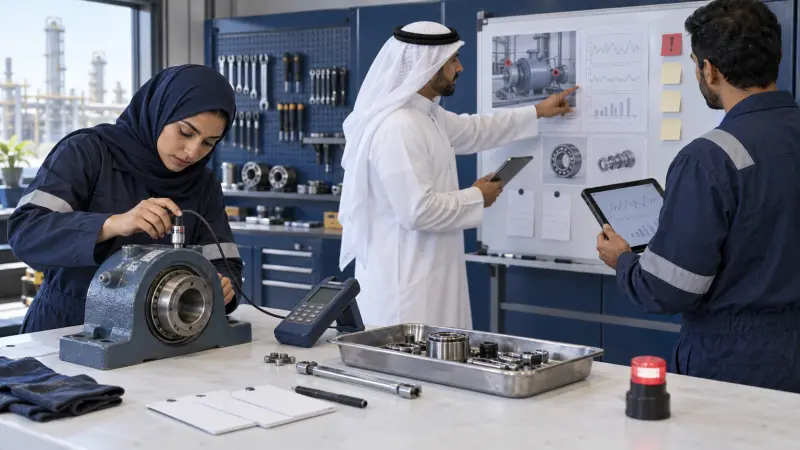
Predictive Maintenance and Asset Performance Training

At a glance
- Duration
- 1 Week
- Format
- Classroom
- Cities
- Trabzon, Kuwait, Paris, Marbella, Jakarta, Barcelona and more
- Next session
- 25 – 29 October 2026, Trabzon
- Average fee
- 7,500 €
Overview
Industrial organizations face increasing pressure to prevent unplanned downtime, extend equipment life, and extract measurable value from physical assets. The Predictive Maintenance and Asset Performance Management Training provides structured methods to transition maintenance operations from reactive firefighting to predictive and prescriptive strategies. Participants explore Industrial IoT architecture, sensor deployment, anomaly detection, machine learning models, and digital twins, bridging the operational gap between field instrumentation and enterprise asset management software. Practical frameworks equip engineering teams to analyze asset criticality, establish reliable failure mode models, and calculate return on investment. This course is delivered by Agile Leaders Training Center.
Who Should Attend
- Maintenance managers and plant supervisors seeking to transition from preventive schedules to condition-based intervention.
- Reliability engineers and condition-monitoring specialists responsible for vibration analysis, thermography, and oil diagnostics.
- Asset managers and plant engineers overseeing equipment lifecycle planning and criticality evaluations.
- Operations engineers and automation specialists integrating field operational technology with enterprise platforms.
- Digital transformation leads and Industrial IoT professionals designing connected asset strategies.
Departments and Industries
This program supports technical teams managing heavy rotating equipment, continuous production lines, and high-capital infrastructure across asset-intensive sectors.
- Maintenance and Reliability Engineering Teams in Manufacturing and Industrial Production
- Plant Operations and Integrity Divisions in Oil, Gas, and Process Industries
- Asset Management Units in Energy, Power Generation, and Utilities
- Condition Monitoring and Technical Services Teams in Mining and Heavy Industry
- Engineering and Automation Divisions in Logistics, Transportation, and Pharmaceuticals
Learning Objectives
By the end of this course, participants will be able to:
- Contrast reactive, preventive, predictive, and prescriptive maintenance operating models.
- Evaluate asset criticality and lifecycle degradation to prioritize monitoring investments.
- Deploy appropriate wired and wireless sensors alongside Industrial IoT network architectures.
- Apply condition-monitoring technologies including vibration, thermography, ultrasonics, and lubricant testing.
- Implement machine learning algorithms for anomaly detection and remaining useful life estimation.
- Integrate digital twins and CMMS platforms with enterprise asset performance management solutions.
- Execute root cause analysis and failure mode and effects analysis on critical production assets.
- Formulate an asset performance management roadmap that incorporates cybersecurity and energy efficiency.
Course Agenda
Day 1: Condition Monitoring and Industrial IoT Architecture
- Evolution of Maintenance Strategies: Reactive, Preventive, Predictive, and Prescriptive Models
- Core Principles of Asset Performance Management and Operational Asset Lifecycle Stages
- Asset Criticality Assessment Frameworks and Failure Consequence Scoring
- Financial Justification, Return on Investment Calculations, and Business Case Formulation
- Industrial IoT Architecture: Smart Sensors, Gateways, Data Acquisition, and Legacy Integration
- Condition-Monitoring Methods: Vibration, Thermography, Ultrasound, Lubricant Analysis, and Acoustic Emission
Day 2: Maintenance Analytics, Digital Twins, and Systems Integration
- Maintenance Data Governance: Ingestion, Cleaning, Normalization, and Quality Control
- Descriptive, Diagnostic, Predictive, and Prescriptive Maintenance Analytics
- Machine Learning Algorithms for Failure Pattern Recognition and Fault Detection
- AI-Driven Anomaly Detection and Remaining Useful Life Estimation Principles
- Digital Twin Foundations: Creating Virtual Representations of Critical Production Assets
- Edge and Cloud Architecture, CMMS Integration, Interoperability, and Scalability
Day 3: Reliability Engineering and Risk-Based Prioritization
- Structured Root Cause Analysis Methodologies for Mechanical and Electrical Failure
- Failure Mode and Effects Analysis for Identifying Failure Mechanisms
- Reliability Data Collection: Weibull Analysis and Failure Distribution Modelling
- Risk-Based Maintenance Planning and Dynamic Work Prioritization
- Resource Allocation, Labor Balancing, and Maintenance Cost-Benefit Analysis
- Asset Performance Metrics: Tracking MTBF, MTTR, Availability, and OEE on Dashboards
Day 4: Operational Cybersecurity, Sustainability, and APM Roadmap
- Connected Asset Cybersecurity: Protecting Industrial IoT and IT/OT Convergence Layers
- Sustainable Maintenance: Energy Consumption Reduction and Decarbonization Targets
- Implementation Planning: Work Streams, Pilot Projects, and Agile Deployment Phases
- Change Management: Operator Buy-In, Skill Gap Analysis, and Workforce Readiness
- Enterprise Scaling: Harmonizing IoT Sensors, AI Models, CMMS, and APM Software
- Capstone Project: Developing an Integrated Predictive Maintenance and Asset Performance Management Roadmap
Practical Exercises
Participants apply classroom concepts through structured analytical exercises focused on industrial applications.
- Suggested activity: Conduct an asset criticality assessment on rotating machinery to define monitoring priorities.
- Suggested activity: Select appropriate condition-monitoring technologies based on specific mechanical failure modes.
- Suggested activity: Evaluate sensor data streams to identify operational anomalies and estimate remaining useful life.
- Suggested activity: Construct an asset performance management roadmap outlining technical integration and governance milestones.
Frequently Asked Questions
What specific qualifications or prerequisites are needed before enrolling in the course?
Participants should have a foundational understanding of industrial maintenance practices, mechanical equipment operation, engineering fundamentals, or plant supervision. Prior experience working with maintenance databases, condition monitoring tools, or automation systems is helpful but not required.
How long is each day's session, and what is the total course duration?
Each training day runs for five to six hours, encompassing lectures, technical case discussions, and practical exercises. The full program spans four days, delivering 20 to 24 instructional hours.
Differentiating Features
Unlike standalone vibration or thermography courses, this program unites field condition monitoring with enterprise asset performance management, digital twins, and machine learning analytics. Participants examine the entire data pipeline from sensor placement and Industrial IoT networking to predictive algorithms and CMMS work order triggering. The curriculum addresses IT/OT cybersecurity and sustainability alongside reliability engineering, concluding with an operational roadmap that aligns technical execution with organizational maintenance budgets.
credits: 5 credit per day
Course Mode: full-time
Provider: Agile Leaders Training Center
-
Events for this Course
-
Trabzon 25 – 29 October 2026
-
Kuwait 1 – 5 November 2026
-
Paris 2 – 6 November 2026
-
Marbella 8 – 12 November 2026
-
Jakarta 9 – 13 November 2026
-
Barcelona 16 – 20 November 2026
-
Tashkent 22 – 26 November 2026
-
Tokyo 23 – 27 November 2026
-
Kuala Lumpur 7 – 11 December 2026
-
Berlin 7 – 11 December 2026
-
Madrid 14 – 18 December 2026
-
London 21 – 25 December 2026
-
Amsterdam 4 – 8 January 2027
-
San Diego 25 – 29 January 2027
-
Vienna 1 – 5 February 2027
-
Nice 15 – 19 February 2027
-
Toronto 21 – 25 February 2027
-
Cape town 28 February – 4 March 2027
-
Dubai 22 – 26 March 2027
-
Accra 28 March – 1 April 2027
-
Manama 4 – 8 April 2027
-
Abu Dhabi 12 – 16 April 2027
-
Baku 19 – 23 April 2027
-
Zanzibar 25 – 29 April 2027
-
Prague 3 – 7 May 2027
-
Frankfurt 3 – 7 May 2027
-
Bangkok 9 – 13 May 2027
-
Lisbon 10 – 14 May 2027
-
Lagos 16 – 20 May 2027
-
Amman 23 – 27 May 2027
-
Singapore 31 May – 4 June 2027
-
London 21 – 25 June 2027
-
Nairobi 11 – 15 July 2027
-
Montreux 12 – 16 July 2027
-
Bali 18 – 22 July 2027
-
New York 19 – 23 July 2027
-
Langkawi 25 – 29 July 2027
-
Chicago 1 – 5 August 2027
-
Tbilisi 2 – 6 August 2027
-
Athens 9 – 13 August 2027
-
Muscat 15 – 19 August 2027
-
Cairo 16 – 20 August 2027
-
Sharm El-Sheikh 16 – 20 August 2027
-
Istanbul 30 August – 3 September 2027
-
Seoul 30 August – 3 September 2027
-
Geneva 5 – 9 September 2027
-
Porto 6 – 10 September 2027
-
Phuket 12 – 16 September 2027
-
Dubai 20 – 24 September 2027
-
Zoom 20 – 24 September 2027
-
Abu Dhabi 20 – 24 September 2027
-
Doha 26 – 30 September 2027
-
Milan 4 – 8 October 2027
-
Munich 11 – 15 October 2027
-
Johannesburg 17 – 21 October 2027
-
Casablanca 18 – 22 October 2027
-
Rome 25 – 29 October 2027
| Image | Location | Dates | Duration | Mode | Price | Actions |
|---|---|---|---|---|---|---|

|
Trabzon |
Week 43, 2026 25 – 29 October 2026 |
1 Week | Onsite | €8,000 | |

|
Kuwait |
Week 44, 2026 1 – 5 November 2026 |
1 Week | Onsite | €7,000 | |

|
Paris |
Week 45, 2026 2 – 6 November 2026 |
1 Week | Onsite | €6,500 | |

|
Marbella |
Week 45, 2026 8 – 12 November 2026 |
1 Week | Onsite | €6,500 | |

|
Jakarta |
Week 46, 2026 9 – 13 November 2026 |
1 Week | Onsite | €8,000 | |

|
Barcelona |
Week 47, 2026 16 – 20 November 2026 |
1 Week | Onsite | €6,500 | |

|
Tashkent |
Week 47, 2026 22 – 26 November 2026 |
1 Week | Onsite | €8,000 | |

|
Tokyo |
Week 48, 2026 23 – 27 November 2026 |
1 Week | Onsite | €12,000 | |

|
Kuala Lumpur |
Week 50, 2026 7 – 11 December 2026 |
1 Week | Onsite | €6,500 | |

|
Berlin |
Week 50, 2026 7 – 11 December 2026 |
1 Week | Onsite | €6,500 | |

|
Madrid |
Week 51, 2026 14 – 18 December 2026 |
1 Week | Onsite | €6,500 | |

|
London |
Week 52, 2026 21 – 25 December 2026 |
1 Week | Onsite | €6,500 | |

|
Amsterdam |
Week 01, 2027 4 – 8 January 2027 |
1 Week | Onsite | €6,500 | |

|
San Diego |
Week 04, 2027 25 – 29 January 2027 |
1 Week | Onsite | €16,000 | |

|
Vienna |
Week 05, 2027 1 – 5 February 2027 |
1 Week | Onsite | €7,500 | |

|
Nice |
Week 07, 2027 15 – 19 February 2027 |
1 Week | Onsite | €8,000 | |

|
Toronto |
Week 07, 2027 21 – 25 February 2027 |
1 Week | Onsite | €16,000 | |

|
Cape town |
Week 08, 2027 28 February – 4 March 2027 |
1 Week | Onsite | €6,000 | |

|
Dubai |
Week 12, 2027 22 – 26 March 2027 |
1 Week | Onsite | €6,500 | |

|
Accra |
Week 12, 2027 28 March – 1 April 2027 |
1 Week | Onsite | €6,000 |
Frequently asked questions
What does this course cover?
OverviewIndustrial organizations face increasing pressure to prevent unplanned downtime, extend equipment life, and extract measurable value from physical assets. The Predictive Maintenance and Asset Performance Management Training provides structured methods to transition maintenance operations from reactive firefighting to predictive and prescriptive st…
Are training dates available?
Yes. Available dates and destinations are listed in the course dates section on this page.
How can I register?
Choose an available date on this page and complete the registration form, or send a programme enquiry.
Can I download the course brochure?
Yes. Use the brochure download link provided on this page.
This course by city
- Maintenance Training and Engineering Training Courses in Abu Dhabi
- Maintenance Training and Engineering Training Courses in Accra
- Maintenance Training and Engineering Training Courses in Amman
- Maintenance Training and Engineering Training Courses in Amsterdam
- Maintenance Training and Engineering Training Courses in Athens
- Maintenance Training and Engineering Training Courses in Baku
- Maintenance Training and Engineering Training Courses in Bali
- Maintenance Training and Engineering Training Courses in Bangkok
- Maintenance Training and Engineering Training Courses in Barcelona
- Maintenance Training and Engineering Training Courses in Berlin
- Maintenance Training and Engineering Training Courses in Cairo
- Maintenance Training and Engineering Training Courses in Cape town
- Maintenance Training and Engineering Training Courses in Casablanca
- Maintenance Training and Engineering Training Courses in Chicago
- Maintenance Training and Engineering Training Courses in Doha
- Maintenance Training and Engineering Training Courses in Dubai
- Maintenance Training and Engineering Training Courses in Frankfurt
- Maintenance Training and Engineering Training Courses in Geneva
- Maintenance Training and Engineering Training Courses in Istanbul
- Maintenance Training and Engineering Training Courses in Jakarta
- Maintenance Training and Engineering Training Courses in Johannesburg
- Maintenance Training and Engineering Training Courses in Kuala Lumpur
- Maintenance Training and Engineering Training Courses in Kuwait
- Maintenance Training and Engineering Training Courses in Lagos
- Maintenance Training and Engineering Training Courses in Langkawi
- Maintenance Training and Engineering Training Courses in Lisbon
- Maintenance Training and Engineering Training Courses in London
- Maintenance Training and Engineering Training Courses in Madrid
- Maintenance Training and Engineering Training Courses in Manama
- Maintenance Training and Engineering Training Courses in Marbella
- Maintenance Training and Engineering Training Courses in Milan
- Maintenance Training and Engineering Training Courses in Montreux
- Maintenance Training and Engineering Training Courses in Munich
- Maintenance Training and Engineering Training Courses in Muscat
- Maintenance Training and Engineering Training Courses in Nairobi
- Maintenance Training and Engineering Training Courses in New York
- Maintenance Training and Engineering Training Courses in Nice
- Maintenance Training and Engineering Training Courses in Paris
- Maintenance Training and Engineering Training Courses in Phuket
- Maintenance Training and Engineering Training Courses in Porto
- Maintenance Training and Engineering Training Courses in Prague
- Maintenance Training and Engineering Training Courses in Rome
- Maintenance Training and Engineering Training Courses in San Diego
- Maintenance Training and Engineering Training Courses in Seoul
- Maintenance Training and Engineering Training Courses in Sharm El-Sheikh
- Maintenance Training and Engineering Training Courses in Singapore
- Maintenance Training and Engineering Training Courses in Tashkent
- Maintenance Training and Engineering Training Courses in Tbilisi
- Maintenance Training and Engineering Training Courses in Tokyo
- Maintenance Training and Engineering Training Courses in Toronto
- Maintenance Training and Engineering Training Courses in Trabzon
- Maintenance Training and Engineering Training Courses in Vienna
- Maintenance Training and Engineering Training Courses in Zanzibar
- Maintenance Training and Engineering Training Courses in Zoom