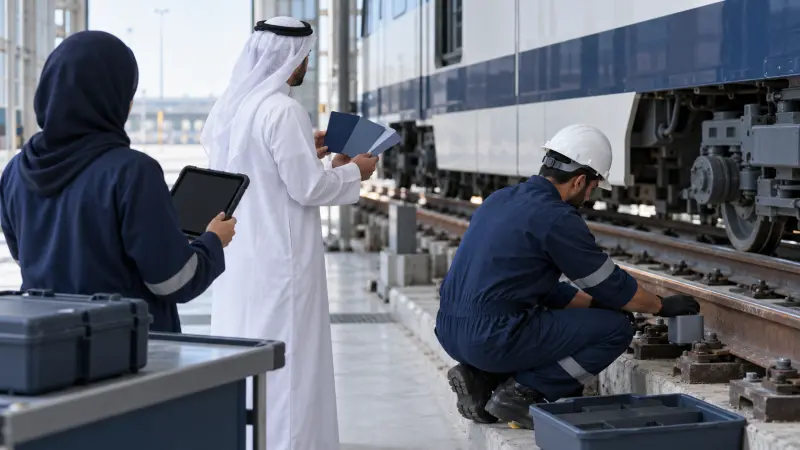
Rail Traction Power Supply Engineering Course

At a glance
- Duration
- 1 Week
- Format
- Classroom
- Cities
- Manama, Johannesburg, Toronto, Kuala Lumpur, Dubai, Bangkok and more
- Next session
- 25 – 29 October 2026, Manama
- Average fee
- 7,500 €
Overview
Rail Traction Power Supply Engineering Training Course is a 1-week course for rail electrification, traction power, infrastructure, operations, and maintenance professionals who leave with a Traction Power Engineering Assurance Portfolio. Participants connect supply architecture, traction substations, feeder arrangements, return circuits, protection, power quality, reliability, SCADA, and safe operational interfaces. The course resolves fragmented technical decisions through system models, coordination studies, diagnostic evidence, and controlled response plans. Agile Leaders Training Center provides this course on rail traction power supply engineering.
Who Should Attend
Teams responsible for rail electrification architecture and technical assurance.
Functions responsible for traction substations, feeders, and switching arrangements.
Engineers responsible for protection coordination and fault investigation.
Operations groups responsible for control, isolation, and service recovery.
Maintenance teams responsible for condition evidence and equipment reliability.
The course assumes participants can interpret single-line diagrams and electrical measurements, and leaves out rolling-stock propulsion design and introductory circuit theory.
Departments and Industries
The course supports engineering and operational decisions across transport infrastructure and power-system services.
Railway and metro infrastructure engineering
Traction power operations and control centers
Electrical maintenance and asset management
Engineering consultancies and system integrators
Utilities and high-voltage service providers
Learning Objectives
By the end of this course, participants will be able to:
Analyze AC and DC traction power architectures and operating constraints.
Evaluate substation, feeder, and sectioning configurations.
Apply return-circuit, earthing, and stray-current controls.
Build protection, power-quality, and reliability evidence.
Diagnose equipment and interface faults from operational data.
Prioritize safe isolation, restoration, and maintenance actions.
Course Agenda
Day 1: System Architecture and Demand
Traction Power Functional Architecture Model
AC and DC Supply Configuration Comparison
Train Load and Diversity Assumption Register
Voltage Profile and Feeding Section Assessment
System Interface Responsibility Matrix
Day 2: Substations and Feeding Arrangements
Traction Substation Single-Line Diagram Review
Transformer and Converter Duty Selection Method
Feeder, Sectioning, and Paralleling Configuration Map
Switchgear Interlocking Logic Checklist
Capacity and Contingency Scenario Model
Day 3: Return Circuits and Electrical Safety
EN 50122-1 Electrical Safety Control Map
Traction Return Circuit Continuity Assessment
Earthing and Equipotential Bonding Review Method
EN 50122-2 Stray-Current Risk Register
Touch-Voltage and Interface Hazard Checklist
Day 4: Protection, Quality, and Reliability
Protection Zone and Selectivity Coordination Study
Fault-Level and Breaker-Duty Evidence Sheet
Power Quality Disturbance Classification Matrix
Power SCADA Alarm and Event Analysis Method
RAMS Failure and Criticality Prioritization
Day 5: Diagnostics and Operational Practice
Suggested Exercise: Supply Architecture Constraint Review
Suggested Exercise: Substation Fault Evidence Diagnosis
Suggested Exercise: Protection and Return-Circuit Coordination
Suggested Exercise: Isolation and Service Restoration Plan
Capstone Exercise: Traction Power Engineering Assurance Portfolio
Practical Exercises
The course uses suggested activities to integrate traction power engineering decisions.
Suggested activity: compare supply configurations against load, voltage, capacity, and contingency evidence.
Suggested activity: trace a fault through substation, feeder, protection, SCADA, and return-circuit records.
Suggested activity: evaluate bonding, stray-current, and touch-voltage controls at a system interface.
Suggested activity: present a controlled isolation, restoration, and maintenance decision.
FAQs
Who suits rail traction power supply engineering and what does it assume?
Rail electrification, traction power, infrastructure, operations, and maintenance professionals suit the course. It assumes participants can read single-line diagrams and electrical measurements and excludes rolling-stock propulsion design and introductory circuit theory.
How does rail traction power supply engineering differ from general electrical maintenance training?
Rail traction power supply engineering integrates moving loads, substations, feeding sections, return circuits, protection, SCADA, and railway safety interfaces rather than concentrating on isolated equipment maintenance.
What belongs in a traction power supply system assessment?
A traction power assessment connects demand, voltage profile, substation duty, feeder configuration, contingency, protection, return-current integrity, power quality, reliability, and operational evidence.
How are traction power faults diagnosed?
Traction power faults are diagnosed by correlating protection operations, SCADA sequences, measurements, equipment condition, return-circuit behavior, and system configuration before selecting isolation and restoration actions.
Why do traction return circuits require dedicated controls?
Traction return circuits require dedicated controls because current continuity, rail potential, bonding, touch voltage, and stray-current paths affect safety, equipment behavior, structures, and fault performance.
Conclusion
Participants take back a Traction Power Engineering Assurance Portfolio linking architecture, substations, feeders, return circuits, protection, diagnostics, and operational controls. The portfolio provides traceable evidence for engineering review and maintenance planning. It improves coordination among design, control, operations, and asset teams when evaluating faults, changes, and restoration decisions.
credits: 5 credit per day
Course Mode: full-time
Provider: Agile Leaders Training Center
-
Events for this Course
-
Manama 25 – 29 October 2026
-
Johannesburg 1 – 5 November 2026
-
Toronto 1 – 5 November 2026
-
Kuala Lumpur 9 – 13 November 2026
-
Dubai 23 – 27 November 2026
-
Bangkok 6 – 10 December 2026
-
Tashkent 6 – 10 December 2026
-
Athens 14 – 18 December 2026
-
Lisbon 14 – 18 December 2026
-
Cape town 20 – 24 December 2026
-
Abu Dhabi 21 – 25 December 2026
-
Munich 28 December 2026 – 1 January 2027
-
Singapore 28 December 2026 – 1 January 2027
-
Tbilisi 4 – 8 January 2027
-
Montreux 18 – 22 January 2027
-
Marbella 24 – 28 January 2027
-
Dubai 25 – 29 January 2027
-
Prague 1 – 5 February 2027
-
Langkawi 7 – 11 February 2027
-
London 15 – 19 February 2027
-
San Diego 22 – 26 February 2027
-
Barcelona 8 – 12 March 2027
-
Kuwait 14 – 18 March 2027
-
Porto 29 March – 2 April 2027
-
Casablanca 5 – 9 April 2027
-
London 12 – 16 April 2027
-
Vienna 19 – 23 April 2027
-
Jakarta 26 – 30 April 2027
-
Doha 2 – 6 May 2027
-
Rome 17 – 21 May 2027
-
Trabzon 23 – 27 May 2027
-
Amman 30 May – 3 June 2027
-
Frankfurt 31 May – 4 June 2027
-
Baku 7 – 11 June 2027
-
Istanbul 14 – 18 June 2027
-
New York 14 – 18 June 2027
-
Amsterdam 28 June – 2 July 2027
-
Zoom 5 – 9 July 2027
-
Sharm El-Sheikh 12 – 16 July 2027
-
Madrid 19 – 23 July 2027
-
Paris 26 – 30 July 2027
-
Nice 26 – 30 July 2027
-
Accra 1 – 5 August 2027
-
Phuket 8 – 12 August 2027
-
Abu Dhabi 16 – 20 August 2027
-
Chicago 22 – 26 August 2027
-
Geneva 29 August – 2 September 2027
-
Lagos 5 – 9 September 2027
-
Milan 6 – 10 September 2027
-
Tokyo 20 – 24 September 2027
-
Muscat 26 – 30 September 2027
-
Bali 3 – 7 October 2027
-
Berlin 4 – 8 October 2027
-
Nairobi 10 – 14 October 2027
-
Cairo 18 – 22 October 2027
-
Seoul 18 – 22 October 2027
-
Zanzibar 24 – 28 October 2027
| Image | Location | Dates | Duration | Mode | Price | Actions |
|---|---|---|---|---|---|---|

|
San Diego |
Week 08, 2027 22 – 26 February 2027 |
1 Week | Onsite | €16,000 | |

|
Barcelona |
Week 10, 2027 8 – 12 March 2027 |
1 Week | Onsite | €6,500 | |

|
Kuwait |
Week 10, 2027 14 – 18 March 2027 |
1 Week | Onsite | €7,000 | |

|
Porto |
Week 13, 2027 29 March – 2 April 2027 |
1 Week | Onsite | €6,500 | |

|
Casablanca |
Week 14, 2027 5 – 9 April 2027 |
1 Week | Onsite | €6,000 | |

|
London |
Week 15, 2027 12 – 16 April 2027 |
1 Week | Onsite | €6,500 | |

|
Vienna |
Week 16, 2027 19 – 23 April 2027 |
1 Week | Onsite | €7,500 | |

|
Jakarta |
Week 17, 2027 26 – 30 April 2027 |
1 Week | Onsite | €8,000 | |

|
Doha |
Week 17, 2027 2 – 6 May 2027 |
1 Week | Onsite | €7,000 | |

|
Rome |
Week 20, 2027 17 – 21 May 2027 |
1 Week | Onsite | €6,500 | |

|
Trabzon |
Week 20, 2027 23 – 27 May 2027 |
1 Week | Onsite | €8,000 | |

|
Amman |
Week 21, 2027 30 May – 3 June 2027 |
1 Week | Onsite | €6,000 | |

|
Frankfurt |
Week 22, 2027 31 May – 4 June 2027 |
1 Week | Onsite | €6,500 | |

|
Baku |
Week 23, 2027 7 – 11 June 2027 |
1 Week | Onsite | €8,000 | |

|
Istanbul |
Week 24, 2027 14 – 18 June 2027 |
1 Week | Onsite | €6,000 | |

|
New York |
Week 24, 2027 14 – 18 June 2027 |
1 Week | Onsite | €16,000 | |

|
Amsterdam |
Week 26, 2027 28 June – 2 July 2027 |
1 Week | Onsite | €6,500 | |

|
Zoom |
Week 27, 2027 5 – 9 July 2027 |
1 Week | Online | €3,000 | |

|
Sharm El-Sheikh |
Week 28, 2027 12 – 16 July 2027 |
1 Week | Onsite | €5,200 | |

|
Madrid |
Week 29, 2027 19 – 23 July 2027 |
1 Week | Onsite | €6,500 |
Frequently asked questions
What does this course cover?
OverviewRail Traction Power Supply Engineering Training Course is a 1-week course for rail electrification, traction power, infrastructure, operations, and maintenance professionals who leave with a Traction Power Engineering Assurance Portfolio. Participants connect supply architecture, traction substations, feeder arrangements, return circuits, protecti…
Are training dates available?
Yes. Available dates and destinations are listed in the course dates section on this page.
How can I register?
Choose an available date on this page and complete the registration form, or send a programme enquiry.
Can I download the course brochure?
Yes. Use the brochure download link provided on this page.
This course by city
- Maintenance Training and Engineering Training Courses in Abu Dhabi
- Maintenance Training and Engineering Training Courses in Accra
- Maintenance Training and Engineering Training Courses in Amman
- Maintenance Training and Engineering Training Courses in Amsterdam
- Maintenance Training and Engineering Training Courses in Athens
- Maintenance Training and Engineering Training Courses in Baku
- Maintenance Training and Engineering Training Courses in Bali
- Maintenance Training and Engineering Training Courses in Bangkok
- Maintenance Training and Engineering Training Courses in Barcelona
- Maintenance Training and Engineering Training Courses in Berlin
- Maintenance Training and Engineering Training Courses in Cairo
- Maintenance Training and Engineering Training Courses in Cape town
- Maintenance Training and Engineering Training Courses in Casablanca
- Maintenance Training and Engineering Training Courses in Chicago
- Maintenance Training and Engineering Training Courses in Doha
- Maintenance Training and Engineering Training Courses in Dubai
- Maintenance Training and Engineering Training Courses in Frankfurt
- Maintenance Training and Engineering Training Courses in Geneva
- Maintenance Training and Engineering Training Courses in Istanbul
- Maintenance Training and Engineering Training Courses in Jakarta
- Maintenance Training and Engineering Training Courses in Johannesburg
- Maintenance Training and Engineering Training Courses in Kuala Lumpur
- Maintenance Training and Engineering Training Courses in Kuwait
- Maintenance Training and Engineering Training Courses in Lagos
- Maintenance Training and Engineering Training Courses in Langkawi
- Maintenance Training and Engineering Training Courses in Lisbon
- Maintenance Training and Engineering Training Courses in London
- Maintenance Training and Engineering Training Courses in Madrid
- Maintenance Training and Engineering Training Courses in Manama
- Maintenance Training and Engineering Training Courses in Marbella
- Maintenance Training and Engineering Training Courses in Milan
- Maintenance Training and Engineering Training Courses in Montreux
- Maintenance Training and Engineering Training Courses in Munich
- Maintenance Training and Engineering Training Courses in Muscat
- Maintenance Training and Engineering Training Courses in Nairobi
- Maintenance Training and Engineering Training Courses in New York
- Maintenance Training and Engineering Training Courses in Nice
- Maintenance Training and Engineering Training Courses in Paris
- Maintenance Training and Engineering Training Courses in Phuket
- Maintenance Training and Engineering Training Courses in Porto
- Maintenance Training and Engineering Training Courses in Prague
- Maintenance Training and Engineering Training Courses in Rome
- Maintenance Training and Engineering Training Courses in San Diego
- Maintenance Training and Engineering Training Courses in Seoul
- Maintenance Training and Engineering Training Courses in Sharm El-Sheikh
- Maintenance Training and Engineering Training Courses in Singapore
- Maintenance Training and Engineering Training Courses in Tashkent
- Maintenance Training and Engineering Training Courses in Tbilisi
- Maintenance Training and Engineering Training Courses in Tokyo
- Maintenance Training and Engineering Training Courses in Toronto
- Maintenance Training and Engineering Training Courses in Trabzon
- Maintenance Training and Engineering Training Courses in Vienna
- Maintenance Training and Engineering Training Courses in Zanzibar
- Maintenance Training and Engineering Training Courses in Zoom