Suspicious Object Initial Response Course
At a glance
- Duration
- 1 Week
- Format
- Classroom
- Cities
- Phuket, Zanzibar, London, Abu Dhabi, Bangkok, Manama and more
- Next session
- 8 – 12 November 2026, Phuket
- Average fee
- 5,750 €
Overview
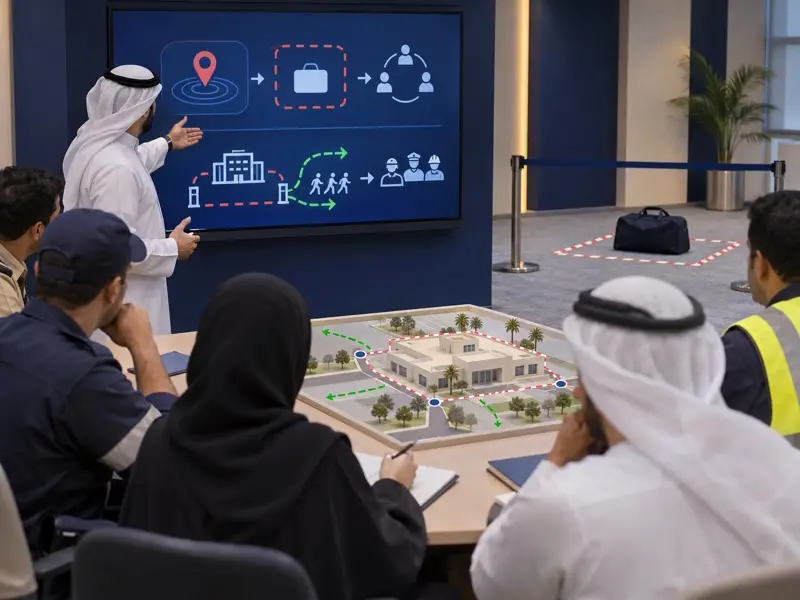
Suspicious Object Initial Response and Coordination Training Course is a one-week intermediate course for facility security, public-space operations, event teams, and emergency coordinators, who leave with a Suspicious Object Initial Response and Coordination Plan. Participants apply suspicious object response, unattended item assessment, scene isolation, incident communication, and evacuation coordination without touching or testing an item. Agile Leaders Training Center presents suspicious-object initial response.
Who Should Attend
- Personnel responsible for security in facilities and public spaces
- Teams responsible for venue, transport, event, and visitor operations
- Managers responsible for evacuation, shelter, and continuity decisions
- Personnel responsible for reporting incidents and controlling access
- Coordinators responsible for liaison with competent emergency authorities
The course assumes participants can follow site emergency procedures, and it leaves technical identification, handling, opening, movement, testing, render-safe work, and disposal to competent authorities.
Departments and Industries
The course supports departments and sectors that must protect people and maintain safe control of a suspicious-object scene.
- Corporate and government facility security
- Transport terminals and public-space operations
- Hotels, retail centers, and event venues
- Education, healthcare, and community facilities
- Industrial sites and business continuity functions
Learning Objectives
By the end of this course, participants will be able to:
- Differentiate unattended and suspicious items using context and visible information.
- Apply no-touch, withdrawal, isolation, and access-control actions.
- Communicate accurate observations without speculation.
- Coordinate evacuation, shelter, accountability, and continuity decisions.
- Preserve scene information and support competent authorities.
- Build a Suspicious Object Initial Response and Coordination Plan.
Course Agenda
Day 1: Recognize and Escalate Safely
- Unattended and Suspicious Item Decision Framework
- Context, Placement, Concealment, and Visible Indicator Checklist
- No-Touch and Non-Interference Safety Rule
- Immediate Withdrawal and Personal Safety Decision
- Initial Notification and Escalation Pathway
Day 2: Isolate and Control the Scene
- Scene Isolation and Access-Control Layout
- Safe Route and Assembly-Point Review
- Public Movement and Crowd-Control Communication
- Site Entry, Exit, and Accountability Register
- Scene Control Handover Checklist
Day 3: Communicate and Coordinate
- Visible Observation and Location Reporting Template
- Incident Communication Roles and Message Map
- Competent-Authority Liaison Information Pack
- Rumor, Image, and Information-Control Protocol
- Stakeholder Notification and Business Escalation Matrix
Day 4: Protect People and Operations
- Evacuation, Shelter, and Movement Decision Framework
- Vulnerable-Person and Assisted-Evacuation Checklist
- Alternative Access and Service Continuity Plan
- Scene Information and Evidence Preservation Log
- Reoccupation and Post-Incident Recovery Criteria
Day 5: Practice Initial Response
- Suggested Exercise: Assess an Unattended Item Report
- Suggested Exercise: Isolate a Public-Space Scene
- Suggested Exercise: Deliver an Authority Notification
- Suggested Exercise: Coordinate Evacuation and Continuity
- Capstone Exercise: Complete a Suspicious Object Initial Response and Coordination Plan
Practical Exercises
The course uses suggested tabletop activities based on facilities, transport areas, events, and public-facing workplaces.
- Suggested activity: assess context and visible information while maintaining distance and avoiding contact or interference.
- Suggested activity: establish scene boundaries, safe movement routes, access control, and accountability arrangements.
- Suggested activity: prepare a factual notification and coordinate roles with competent emergency authorities.
- Suggested activity: sequence evacuation, continuity, handover, recovery, and post-incident documentation.
FAQs
Who suits suspicious object initial response training, and what does it assume?
Suspicious object initial response training suits facility security, venue operations, transport staff, event teams, managers, and emergency coordinators. It assumes participants can follow site emergency procedures.
How does suspicious object response differ from technical explosive-device training?
Suspicious object response covers recognition from a distance, withdrawal, isolation, reporting, people protection, coordination, and handover. Technical identification, handling, testing, render-safe work, and disposal belong to competent specialists.
When does an unattended item become a suspicious object?
An unattended item becomes suspicious when its context, deliberate concealment, placement, visible characteristics, associated behavior, or prior warning creates a reasonable safety concern requiring immediate escalation.
What information should a suspicious-object report contain?
A suspicious-object report should give the precise location, time observed, visible description, surrounding conditions, why it appears suspicious, people or activities nearby, actions already taken, and a safe contact route.
What should staff avoid during a suspicious-object incident?
Staff should avoid touching, opening, moving, testing, photographing closely, speculating publicly, allowing access, or attempting any technical intervention. They should withdraw, isolate, report, and follow competent-authority direction.
Conclusion
Participants take back a Suspicious Object Initial Response and Coordination Plan. It combines recognition, no-touch actions, scene isolation, factual communication, evacuation coordination, access control, authority liaison, continuity, and recovery. The plan changes improvised reactions into a controlled initial response that protects people, preserves information, and supports safe specialist handover.
credits: 5 credit per day
Course Mode: full-time
Provider: Agile Leaders Training Center
-
Events for this Course
-
Phuket 8 – 12 November 2026
-
Zanzibar 8 – 12 November 2026
-
London 16 – 20 November 2026
-
Abu Dhabi 16 – 20 November 2026
-
Bangkok 22 – 26 November 2026
-
Manama 29 November – 3 December 2026
-
Muscat 29 November – 3 December 2026
-
Tashkent 6 – 10 December 2026
-
Dubai 7 – 11 December 2026
-
Marbella 13 – 17 December 2026
-
Amsterdam 14 – 18 December 2026
-
Vienna 21 – 25 December 2026
-
Milan 28 December 2026 – 1 January 2027
-
London 4 – 8 January 2027
-
Madrid 11 – 15 January 2027
-
Seoul 11 – 15 January 2027
-
Rome 18 – 22 January 2027
-
Tbilisi 25 – 29 January 2027
-
Bali 31 January – 4 February 2027
-
Amsterdam 1 – 5 February 2027
-
Zoom 15 – 19 February 2027
-
Chicago 21 – 25 February 2027
-
Istanbul 1 – 5 March 2027
-
Munich 1 – 5 March 2027
-
Dubai 8 – 12 March 2027
-
Kuala Lumpur 15 – 19 March 2027
-
Paris 22 – 26 March 2027
-
Abu Dhabi 22 – 26 March 2027
-
Tokyo 29 March – 2 April 2027
-
Doha 4 – 8 April 2027
-
Toronto 4 – 8 April 2027
-
Porto 12 – 16 April 2027
-
Barcelona 19 – 23 April 2027
-
Amsterdam 26 – 30 April 2027
-
Athens 26 – 30 April 2027
-
London 3 – 7 May 2027
-
Addis Ababa 3 – 7 May 2027
-
Cairo 24 – 28 May 2027
-
Montreux 24 – 28 May 2027
-
Istanbul 31 May – 4 June 2027
-
Lisbon 31 May – 4 June 2027
-
Rome 7 – 11 June 2027
-
Milan 14 – 18 June 2027
-
San Diego 14 – 18 June 2027
-
Dubai 21 – 25 June 2027
-
Abu Dhabi 21 – 25 June 2027
-
Madrid 28 June – 2 July 2027
-
Frankfurt 28 June – 2 July 2027
-
Paris 5 – 9 July 2027
-
Johannesburg 11 – 15 July 2027
-
Manama 25 – 29 July 2027
-
New York 26 – 30 July 2027
-
Sharm El-Sheikh 2 – 6 August 2027
-
Langkawi 8 – 12 August 2027
-
Nairobi 8 – 12 August 2027
-
Geneva 15 – 19 August 2027
-
Cape town 15 – 19 August 2027
-
Kuwait 22 – 26 August 2027
-
Kuala Lumpur 23 – 27 August 2027
-
Casablanca 30 August – 3 September 2027
-
Trabzon 5 – 9 September 2027
-
Jakarta 6 – 10 September 2027
-
Vienna 13 – 17 September 2027
-
Abu Dhabi 13 – 17 September 2027
-
London 20 – 24 September 2027
-
Lagos 26 – 30 September 2027
-
Dubai 27 September – 1 October 2027
-
Prague 4 – 8 October 2027
-
Singapore 11 – 15 October 2027
-
Amman 17 – 21 October 2027
-
Berlin 18 – 22 October 2027
-
Barcelona 25 – 29 October 2027
-
Nice 25 – 29 October 2027
-
Cairo 1 – 5 November 2027
-
Accra 7 – 11 November 2027
-
Baku 8 – 12 November 2027
| Image | Location | Dates | Duration | Mode | Price | Actions |
|---|---|---|---|---|---|---|

|
Phuket |
Week 45, 2026 8 – 12 November 2026 |
1 Week | Onsite | €6,000 | |

|
Zanzibar |
Week 45, 2026 8 – 12 November 2026 |
1 Week | Onsite | €5,500 | |

|
London |
Week 47, 2026 16 – 20 November 2026 |
1 Week | Onsite | €5,700 | |

|
Abu Dhabi |
Week 47, 2026 16 – 20 November 2026 |
1 Week | Onsite | €4,700 | |

|
Bangkok |
Week 47, 2026 22 – 26 November 2026 |
1 Week | Onsite | €6,000 | |

|
Manama |
Week 48, 2026 29 November – 3 December 2026 |
1 Week | Onsite | €4,700 | |

|
Muscat |
Week 48, 2026 29 November – 3 December 2026 |
1 Week | Onsite | €5,700 | |

|
Tashkent |
Week 49, 2026 6 – 10 December 2026 |
1 Week | Onsite | €4,500 | |

|
Dubai |
Week 50, 2026 7 – 11 December 2026 |
1 Week | Onsite | €4,500 | |

|
Marbella |
Week 50, 2026 13 – 17 December 2026 |
1 Week | Onsite | €5,700 | |

|
Amsterdam |
Week 51, 2026 14 – 18 December 2026 |
1 Week | Onsite | €5,700 | |

|
Vienna |
Week 52, 2026 21 – 25 December 2026 |
1 Week | Onsite | €5,700 | |

|
Milan |
Week 53, 2026 28 December 2026 – 1 January 2027 |
1 Week | Onsite | €5,700 | |
|
|
London |
Week 01, 2027 4 – 8 January 2027 |
1 Week | Onsite | €5,700 | |

|
Madrid |
Week 02, 2027 11 – 15 January 2027 |
1 Week | Onsite | €5,700 | |

|
Seoul |
Week 02, 2027 11 – 15 January 2027 |
1 Week | Onsite | €10,000 | |

|
Rome |
Week 03, 2027 18 – 22 January 2027 |
1 Week | Onsite | €5,700 | |

|
Tbilisi |
Week 04, 2027 25 – 29 January 2027 |
1 Week | Onsite | €5,000 | |

|
Bali |
Week 04, 2027 31 January – 4 February 2027 |
1 Week | Onsite | €5,700 | |
|
|
Amsterdam |
Week 05, 2027 1 – 5 February 2027 |
1 Week | Onsite | €5,700 |
Frequently asked questions
What does this course cover?
OverviewSuspicious Object Initial Response and Coordination Training Course is a one-week intermediate course for facility security, public-space operations, event teams, and emergency coordinators, who leave with a Suspicious Object Initial Response and Coordination Plan. Participants apply suspicious object response, unattended item assessment, scene is…
Are training dates available?
Yes. Available dates and destinations are listed in the course dates section on this page.
How can I register?
Choose an available date on this page and complete the registration form, or send a programme enquiry.
Can I download the course brochure?
Yes. Use the brochure download link provided on this page.
This course by city
- IT Security Training & IT Training Courses in Abu Dhabi
- IT Security Training & IT Training Courses in Accra
- IT Security Training & IT Training Courses in Addis Ababa
- IT Security Training & IT Training Courses in Amman
- IT Security Training & IT Training Courses in Amsterdam
- IT Security Training & IT Training Courses in Athens
- IT Security Training & IT Training Courses in Baku
- IT Security Training & IT Training Courses in Bali
- IT Security Training & IT Training Courses in Bangkok
- IT Security Training & IT Training Courses in Barcelona
- IT Security Training & IT Training Courses in Berlin
- IT Security Training & IT Training Courses in Cairo
- IT Security Training & IT Training Courses in Cape town
- IT Security Training & IT Training Courses in Casablanca
- IT Security Training & IT Training Courses in Chicago
- IT Security Training & IT Training Courses in Doha
- IT Security Training & IT Training Courses in Dubai
- IT Security Training & IT Training Courses in Frankfurt
- IT Security Training & IT Training Courses in Geneva
- IT Security Training & IT Training Courses in Istanbul
- IT Security Training & IT Training Courses in Jakarta
- IT Security Training & IT Training Courses in Johannesburg
- IT Security Training & IT Training Courses in Kuala Lumpur
- IT Security Training & IT Training Courses in Kuwait
- IT Security Training & IT Training Courses in Lagos
- IT Security Training & IT Training Courses in Langkawi
- IT Security Training & IT Training Courses in Lisbon
- IT Security Training & IT Training Courses in London
- IT Security Training & IT Training Courses in Madrid
- IT Security Training & IT Training Courses in Manama
- IT Security Training & IT Training Courses in Marbella
- IT Security Training & IT Training Courses in Milan
- IT Security Training & IT Training Courses in Montreux
- IT Security Training & IT Training Courses in Munich
- IT Security Training & IT Training Courses in Muscat
- IT Security Training & IT Training Courses in Nairobi
- IT Security Training & IT Training Courses in New York
- IT Security Training & IT Training Courses in Nice
- IT Security Training & IT Training Courses in Paris
- IT Security Training & IT Training Courses in Phuket
- IT Security Training & IT Training Courses in Porto
- IT Security Training & IT Training Courses in Prague
- IT Security Training & IT Training Courses in Rome
- IT Security Training & IT Training Courses in San Diego
- IT Security Training & IT Training Courses in Seoul
- IT Security Training & IT Training Courses in Sharm El-Sheikh
- IT Security Training & IT Training Courses in Singapore
- IT Security Training & IT Training Courses in Tashkent
- IT Security Training & IT Training Courses in Tbilisi
- IT Security Training & IT Training Courses in Tokyo
- IT Security Training & IT Training Courses in Toronto
- IT Security Training & IT Training Courses in Trabzon
- IT Security Training & IT Training Courses in Vienna
- IT Security Training & IT Training Courses in Zanzibar
- IT Security Training & IT Training Courses in Zoom