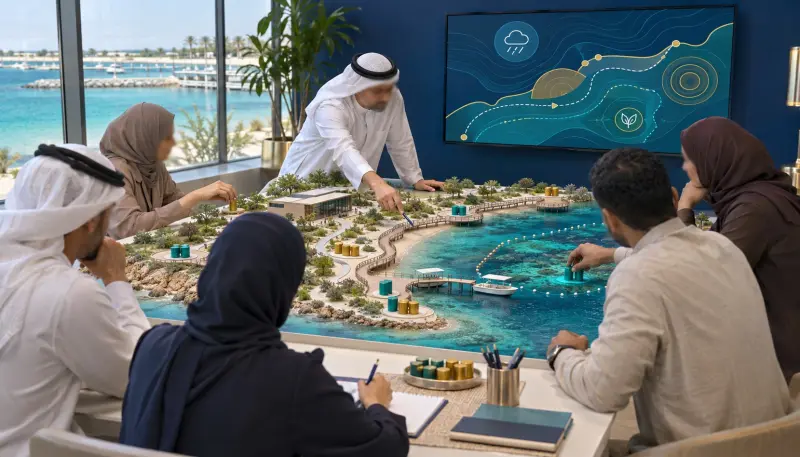
Sustainable Blue Economy Strategy Training Course

At a glance
- Duration
- 1 Week
- Format
- Classroom
- Cities
- Abu Dhabi, Baku, Kuwait, Dubai, Amman, Toronto and more
- Next session
- 9 – 13 November 2026, Abu Dhabi
- Average fee
- 5,750 €
Overview
Sustainable Blue Economy Strategy and Investment Training Course is a one-week professional course for public-sector, maritime, coastal-development, sustainability, finance, and investment professionals, who leave with a Blue Economy Strategy and Investment Action Pack. The course connects ocean-linked sector assessment, blue natural capital, marine ecosystem risk, stakeholder governance, circular resource use, coastal resilience, sustainable blue finance, and performance evidence. Agile Leaders Training Center develops sustainable blue economy strategy practice.
Who Should Attend
- People responsible for ocean and coastal economic policy and planning
- Teams responsible for maritime-sector strategy and portfolio development
- Functions responsible for sustainability, natural capital, and ecosystem risk
- People responsible for investment appraisal and sustainable finance decisions
- Teams responsible for coastal livelihoods, partnerships, and performance reporting
The course assumes participants can assess strategies, projects, or investments and work with stakeholder and performance data; it leaves out vessel operations, marine engineering, tourism operations, and introductory ESG.
Departments and Industries
The course supports blue economy decisions across public, financial, infrastructure, conservation, and coastal-enterprise settings.
- Economic development and public policy functions
- Ports, shipping, fisheries, and aquaculture organizations
- Banks, investment funds, insurers, and project-finance teams
- Coastal infrastructure and renewable-energy developers
- Environmental, conservation, and natural-capital functions
- Community development and coastal-enterprise organizations
Learning Objectives
By the end of this course, participants will be able to:
- Analyze ocean-linked sectors, ecosystem dependencies, and economic opportunities.
- Apply blue natural-capital and marine-risk assessment tools.
- Evaluate governance, stakeholder, and livelihood trade-offs.
- Prioritize circular-resource and coastal-resilience interventions.
- Apply sustainable blue finance principles to investment screening.
- Build blue economy indicators and an implementation action plan.
Course Agenda
Day 1: Frame the Blue Economy
- Blue Economy Development Framework Scope Map
- Ocean-Linked Sector and Value-Chain Inventory
- Blue Natural Capital Dependency Matrix
- Marine Ecosystem Pressure and Impact Register
- Blue Economy Opportunity and Constraint Statement
Day 2: Govern Coastal Trade-Offs
- Marine Spatial Planning Decision Map
- Stakeholder Rights and Influence Matrix
- Coastal Livelihood and Distributional Impact Review
- Cross-Sector Governance Responsibility Chart
- Science and Evidence Quality Checklist
Day 3: Design Resilient Interventions
- Circular Material Flow and Marine-Litter Control Map
- Coastal Climate Risk and Resilience Screen
- Nature-Based Solution Options Appraisal
- Resource-Efficiency Intervention Prioritization Matrix
- Community Partnership and Benefit-Sharing Plan
Day 4: Screen Finance and Performance
- Sustainable Blue Economy Finance Principles Screen
- Ocean Investment Environmental and Social Risk Checklist
- Blue Project Eligibility and Exclusion Criteria
- Blue Economy Performance Indicator Register
- Implementation Governance and Evidence Dashboard
Day 5: Practice Blue Economy Decisions
- Exercise: Diagnose an Ocean-Sector Opportunity Portfolio
- Exercise: Resolve a Coastal Stakeholder Trade-Off
- Exercise: Screen a Blue Investment Proposal
- Exercise: Test Blue Economy Indicators and Evidence
- Capstone Exercise: Complete the Blue Economy Strategy and Investment Action Pack
Practical Exercises
The course uses suggested activities based on ports, fisheries, aquaculture, coastal infrastructure, renewable energy, and conservation projects.
- Suggested activity: map ocean-linked sectors, natural-capital dependencies, pressures, and affected stakeholders.
- Suggested activity: compare resilience and circular-resource interventions against economic, ecosystem, and livelihood criteria.
- Suggested activity: screen an investment using sustainable blue finance, risk, eligibility, and evidence criteria.
- Suggested activity: assemble indicators, responsibilities, and priorities into a blue economy action plan.
FAQs
Who suits sustainable blue economy strategy training?
Sustainable blue economy strategy training suits professionals who assess ocean-linked policies, sectors, projects, or investments and who can work with stakeholder, environmental, economic, and performance evidence.
How does sustainable blue economy strategy differ from general sustainability training?
Sustainable blue economy strategy focuses on ocean and coastal sectors, marine ecosystems, blue natural capital, coastal livelihoods, and ocean-specific finance decisions, while general sustainability training covers broader organizational impacts.
What is blue natural capital in a sustainable blue economy strategy?
Blue natural capital is the stock of marine and coastal ecosystems and the services they provide to economic activity, resilience, livelihoods, and well-being.
How does sustainable blue finance support blue economy investment?
Sustainable blue finance supports investment by applying ocean-specific protection, risk, inclusion, transparency, science, and impact considerations to projects and portfolios.
What should blue economy indicators measure?
Blue economy indicators should connect natural-capital condition, ecosystem pressure, resource productivity, economic opportunity, resilience, livelihood effects, policy response, investment performance, and implementation evidence.
Conclusion
Participants take back a Blue Economy Strategy and Investment Action Pack connecting sectors, natural capital, ecosystem risks, stakeholders, resilience choices, finance screens, indicators, and responsibilities. It makes ocean-economy priorities and trade-offs traceable. The pack supports coordinated investment, implementation, evidence review, and adaptation across future blue economy initiatives.
credits: 5 credit per day
Course Mode: full-time
Provider: Agile Leaders Training Center
-
Events for this Course
-
Abu Dhabi 9 – 13 November 2026
-
Baku 16 – 20 November 2026
-
Kuwait 22 – 26 November 2026
-
Dubai 23 – 27 November 2026
-
Amman 29 November – 3 December 2026
-
Toronto 29 November – 3 December 2026
-
Tashkent 6 – 10 December 2026
-
Montreux 14 – 18 December 2026
-
Cairo 21 – 25 December 2026
-
Milan 21 – 25 December 2026
-
Amsterdam 28 December 2026 – 1 January 2027
-
Vienna 4 – 8 January 2027
-
Geneva 10 – 14 January 2027
-
Madrid 18 – 22 January 2027
-
Barcelona 25 – 29 January 2027
-
New York 1 – 5 February 2027
-
London 8 – 12 February 2027
-
Paris 8 – 12 February 2027
-
Bali 14 – 18 February 2027
-
Istanbul 22 – 26 February 2027
-
Tbilisi 22 – 26 February 2027
-
Vienna 1 – 5 March 2027
-
Trabzon 7 – 11 March 2027
-
Casablanca 8 – 12 March 2027
-
Frankfurt 8 – 12 March 2027
-
Lagos 14 – 18 March 2027
-
Madrid 15 – 19 March 2027
-
Barcelona 22 – 26 March 2027
-
Dubai 29 March – 2 April 2027
-
Abu Dhabi 29 March – 2 April 2027
-
Bangkok 4 – 8 April 2027
-
Zanzibar 11 – 15 April 2027
-
Kuala Lumpur 12 – 16 April 2027
-
Amsterdam 19 – 23 April 2027
-
Singapore 26 – 30 April 2027
-
Nairobi 2 – 6 May 2027
-
Marbella 9 – 13 May 2027
-
Rome 17 – 21 May 2027
-
Doha 23 – 27 May 2027
-
Seoul 31 May – 4 June 2027
-
Abu Dhabi 31 May – 4 June 2027
-
Chicago 6 – 10 June 2027
-
London 7 – 11 June 2027
-
Jakarta 14 – 18 June 2027
-
Addis Ababa 14 – 18 June 2027
-
Dubai 21 – 25 June 2027
-
Berlin 21 – 25 June 2027
-
Amsterdam 28 June – 2 July 2027
-
Johannesburg 4 – 8 July 2027
-
Langkawi 11 – 15 July 2027
-
Muscat 18 – 22 July 2027
-
Sharm El-Sheikh 26 – 30 July 2027
-
Abu Dhabi 26 – 30 July 2027
-
London 2 – 6 August 2027
-
Porto 2 – 6 August 2027
-
Phuket 8 – 12 August 2027
-
Cairo 9 – 13 August 2027
-
Accra 15 – 19 August 2027
-
Lisbon 16 – 20 August 2027
-
Dubai 23 – 27 August 2027
-
Nice 23 – 27 August 2027
-
Prague 30 August – 3 September 2027
-
Manama 5 – 9 September 2027
-
Munich 13 – 17 September 2027
-
Paris 20 – 24 September 2027
-
Rome 20 – 24 September 2027
-
Athens 27 September – 1 October 2027
-
San Diego 4 – 8 October 2027
-
Kuala Lumpur 11 – 15 October 2027
-
Milan 11 – 15 October 2027
-
Zoom 18 – 22 October 2027
-
Cape town 24 – 28 October 2027
-
Istanbul 1 – 5 November 2027
-
Tokyo 1 – 5 November 2027
-
Manama 7 – 11 November 2027
-
London 8 – 12 November 2027
| Image | Location | Dates | Duration | Mode | Price | Actions |
|---|---|---|---|---|---|---|

|
Abu Dhabi |
Week 22, 2027 31 May – 4 June 2027 |
1 Week | Onsite | €4,700 | |

|
Chicago |
Week 22, 2027 6 – 10 June 2027 |
1 Week | Onsite | €12,000 | |

|
London |
Week 23, 2027 7 – 11 June 2027 |
1 Week | Onsite | €5,700 | |

|
Jakarta |
Week 24, 2027 14 – 18 June 2027 |
1 Week | Onsite | €5,700 | |

|
Addis Ababa |
Week 24, 2027 14 – 18 June 2027 |
1 Week | Onsite | €4,500 | |

|
Dubai |
Week 25, 2027 21 – 25 June 2027 |
1 Week | Onsite | €4,500 | |

|
Berlin |
Week 25, 2027 21 – 25 June 2027 |
1 Week | Onsite | €5,700 | |

|
Amsterdam |
Week 26, 2027 28 June – 2 July 2027 |
1 Week | Onsite | €5,700 | |

|
Johannesburg |
Week 26, 2027 4 – 8 July 2027 |
1 Week | Onsite | €4,500 | |

|
Langkawi |
Week 27, 2027 11 – 15 July 2027 |
1 Week | Onsite | €6,000 | |

|
Muscat |
Week 28, 2027 18 – 22 July 2027 |
1 Week | Onsite | €5,700 | |

|
Sharm El-Sheikh |
Week 30, 2027 26 – 30 July 2027 |
1 Week | Onsite | €4,100 | |
|
|
Abu Dhabi |
Week 30, 2027 26 – 30 July 2027 |
1 Week | Onsite | €4,700 | |
|
|
London |
Week 31, 2027 2 – 6 August 2027 |
1 Week | Onsite | €5,700 | |

|
Porto |
Week 31, 2027 2 – 6 August 2027 |
1 Week | Onsite | €5,700 | |

|
Phuket |
Week 31, 2027 8 – 12 August 2027 |
1 Week | Onsite | €6,000 | |

|
Cairo |
Week 32, 2027 9 – 13 August 2027 |
1 Week | Onsite | €4,100 | |

|
Accra |
Week 32, 2027 15 – 19 August 2027 |
1 Week | Onsite | €4,100 | |

|
Lisbon |
Week 33, 2027 16 – 20 August 2027 |
1 Week | Onsite | €5,700 | |
|
|
Dubai |
Week 34, 2027 23 – 27 August 2027 |
1 Week | Onsite | €4,500 |
Frequently asked questions
What does this course cover?
OverviewSustainable Blue Economy Strategy and Investment Training Course is a one-week professional course for public-sector, maritime, coastal-development, sustainability, finance, and investment professionals, who leave with a Blue Economy Strategy and Investment Action Pack. The course connects ocean-linked sector assessment, blue natural capital, mari…
Are training dates available?
Yes. Available dates and destinations are listed in the course dates section on this page.
How can I register?
Choose an available date on this page and complete the registration form, or send a programme enquiry.
Can I download the course brochure?
Yes. Use the brochure download link provided on this page.
This course by city
- Environment & Sustainability Training Courses in Abu Dhabi
- Environment & Sustainability Training Courses in Accra
- Environment & Sustainability Training Courses in Addis Ababa
- Environment & Sustainability Training Courses in Amman
- Environment & Sustainability Training Courses in Amsterdam
- Environment & Sustainability Training Courses in Athens
- Environment & Sustainability Training Courses in Baku
- Environment & Sustainability Training Courses in Bali
- Environment & Sustainability Training Courses in Bangkok
- Environment & Sustainability Training Courses in Barcelona
- Environment & Sustainability Training Courses in Berlin
- Environment & Sustainability Training Courses in Cairo
- Environment & Sustainability Training Courses in Cape town
- Environment & Sustainability Training Courses in Casablanca
- Environment & Sustainability Training Courses in Chicago
- Environment & Sustainability Training Courses in Doha
- Environment & Sustainability Training Courses in Dubai
- Environment & Sustainability Training Courses in Frankfurt
- Environment & Sustainability Training Courses in Geneva
- Environment & Sustainability Training Courses in Istanbul
- Environment & Sustainability Training Courses in Jakarta
- Environment & Sustainability Training Courses in Johannesburg
- Environment & Sustainability Training Courses in Kuala Lumpur
- Environment & Sustainability Training Courses in Kuwait
- Environment & Sustainability Training Courses in Lagos
- Environment & Sustainability Training Courses in Langkawi
- Environment & Sustainability Training Courses in Lisbon
- Environment & Sustainability Training Courses in London
- Environment & Sustainability Training Courses in Madrid
- Environment & Sustainability Training Courses in Manama
- Environment & Sustainability Training Courses in Marbella
- Environment & Sustainability Training Courses in Milan
- Environment & Sustainability Training Courses in Montreux
- Environment & Sustainability Training Courses in Munich
- Environment & Sustainability Training Courses in Muscat
- Environment & Sustainability Training Courses in Nairobi
- Environment & Sustainability Training Courses in New York
- Environment & Sustainability Training Courses in Nice
- Environment & Sustainability Training Courses in Paris
- Environment & Sustainability Training Courses in Phuket
- Environment & Sustainability Training Courses in Porto
- Environment & Sustainability Training Courses in Prague
- Environment & Sustainability Training Courses in Rome
- Environment & Sustainability Training Courses in San Diego
- Environment & Sustainability Training Courses in Seoul
- Environment & Sustainability Training Courses in Sharm El-Sheikh
- Environment & Sustainability Training Courses in Singapore
- Environment & Sustainability Training Courses in Tashkent
- Environment & Sustainability Training Courses in Tbilisi
- Environment & Sustainability Training Courses in Tokyo
- Environment & Sustainability Training Courses in Toronto
- Environment & Sustainability Training Courses in Trabzon
- Environment & Sustainability Training Courses in Vienna
- Environment & Sustainability Training Courses in Zanzibar
- Environment & Sustainability Training Courses in Zoom