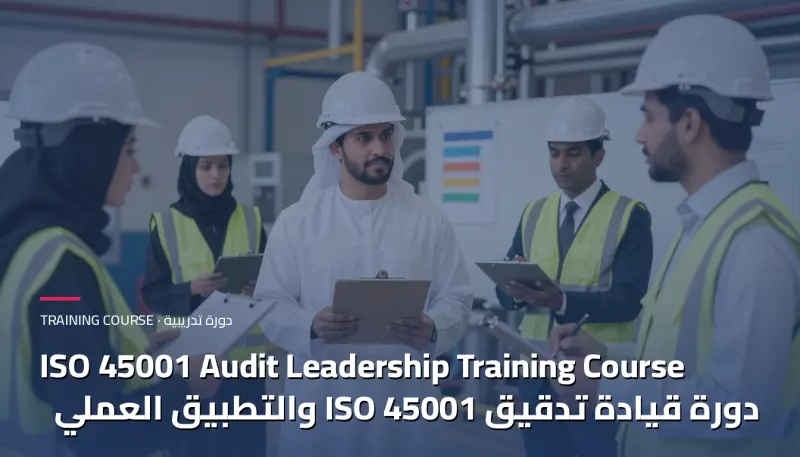
ISO 45001 Lead Auditor: OH&S Management Systems Course

Course Details
-
# 103600478_104281
-
10 – 21 October 2027 21.Oct.2027
-
Toronto
-
20000 €
Overview
Verifying workforce protection and organizational risk controls demands rigorous, independent evaluation methodologies. The ISO 45001 Lead Auditor: OH&S Management Systems Course delivers intensive, two-week professional preparation for assessors tasked with conducting formal third-party assessment protocols. Participants examine structural criteria within ISO 45001:2018 and ISO 19011:2018, dissecting hazard mitigation mechanisms, occupational health and safety frameworks, and legal registers across complex industrial environments. The extended two-week curriculum provides deep immersion into worker consultation verification, hierarchy of control appraisal, opening assemblies, and corrective action evaluation. This course is delivered by Agile Leaders Training Center.
Who Should Attend
- Senior health and safety practitioners qualifying for international third-party register assessor credentials.
- Quality and environmental assessors seeking dual certification credentials in Occupational Health frameworks.
- Corporate risk officers supervising enterprise workplace safety protocols and legal conformity registers.
- Independent technical consultants conducting external diagnostic reviews and gap analyses for client facilities.
- Assurance directors directing cross-functional verification teams across high-hazard operating environments.
Departments and Industries
This two-week qualification pathway serves governance professionals across risk-intensive industrial environments.
- Corporate Occupational Health, Hygiene, and Environment Directorates
- Conformity Assessment and Third-Party Registrar Inspection Bodies
- Quality, Risk, and Statutory Governance Divisions in Petrochemical Refining
- Heavy Manufacturing, Primary Metal Production, and Foundry Operations
- Infrastructure Engineering, Mining, and Civil Works Organizations
- Logistics Terminals, Port Authorities, and Marine Transportation Networks
Learning Objectives
By the end of this course, participants will be able to:
- Interpret ISO 45001:2018 structural requirements through formal third-party inquiry techniques.
- Apply ISO 19011:2018 principles to oversee risk-prioritized multi-site assessment programs.
- Examine documented safety protocols, legal registers, and baseline readiness criteria during Stage 1 evaluations.
- Execute Stage 2 on-site verifications, including site walk-throughs, workforce interviews, and physical inspections.
- Appraise hierarchy of controls, hazard elimination initiatives, and emergency containment safeguards.
- Verify genuine worker participation, consultation structures, and joint committee effectiveness.
- Classify systemic deficiencies and formulate defensible nonconformity statements supported by objective facts.
- Critique root cause analyses and confirm corrective action implementation for final formal closure.
Course Agenda
Day 1: Regulatory Architecture and System Principles
- High-level structure and intent of ISO 45001:2018 within modern corporate governance
- Deming cycle dynamics applied to occupational hazard mitigation and worker well-being
- Organizational boundaries, physical scope determinations, and operational interfaces
- Corporate leadership accountability, occupational policies, and assigned organizational roles
- Professional ethics, assessor impartiality, and code of conduct under international standards
- Foundational exercise on delineating organizational context and interested party expectations
Day 2: Worker Participation, Consultation, and Leadership
- Assessing executive commitment and safety policy alignment across operational levels
- Methods for evaluating workforce consultation mechanisms and safety committee performance
- Appraising worker representation, collective dialogue, and barrier removal initiatives
- Techniques for interviewing frontline personnel while mitigating managerial intimidation
- Gathering verifiable facts on reporting channels for near-misses and dangerous occurrences
- Practical simulation on evaluating worker participation during supervisory interviews
Day 3: Hazard Identification and Statutory Registers
- Systematic appraisal of hazard identification protocols for routine and non-routine activities
- Evaluating acute versus chronic health exposures, ergonomics, and psychosocial risk factors
- Verification of legal compliance registers, statutory obligations, and update routines
- Assessing risk evaluation methodologies, severity scoring, and probability weighting
- Determining the integrity of organizational change management procedures
- Case appraisal on high-hazard industrial process evaluations and statutory compliance
Day 4: Hierarchy of Controls and Operational Safeguards
- Appraising operational controls across engineering barriers, interlocks, and procedural rules
- Auditing contractor pre-qualification, field supervision, and permit-to-work disciplines
- Procurement verification for capital machinery, technical tools, and hazardous chemical agents
- Evaluating emergency preparedness plans, drill frequency records, and containment facilities
- Incident causation review methods, immediate factor classification, and systemic analyses
- Simulation workshop on scrutinizing safe systems of work during facility walk-throughs
Day 5: Performance Monitoring and Management Appraisal
- Leading and lagging safety performance indicators, occupational illness rates, and dashboards
- Evaluating organizational compliance tracking systems and periodic reassessment evidence
- Appraising internal assessment program effectiveness, schedule adherence, and independence
- Scrutinizing executive management review records, strategic outputs, and resource allocations
- Continual improvement metrics, preventive programs, and maturity benchmarking
- Synthesis workshop on evaluating occupational health data trends and management summaries
Day 6: Assessor Fundamentals and Program Oversight
- Core principles of assessment under ISO 19011:2018: integrity, confidentiality, and rigor
- Defining lead assessor roles, team selection criteria, and technical specialist integration
- Establishing assessment program objectives, frequency matrices, and resource allocations
- Risk-based sampling techniques across high-volume records and multi-shift operations
- Constructing robust process-oriented assessment trails across operational departments
- Workshop on designing comprehensive assessment programs for multi-site organizations
Day 7: Initial Assessment and Readiness Verification
- Purpose, operational boundaries, and protocols of Stage 1 readiness evaluations
- Detailed examination of documented operating procedures, risk registers, and hazard maps
- Determining organizational preparedness for comprehensive on-site Stage 2 appraisal
- Identifying critical vulnerability areas, missing legal records, and high-consequence gaps
- Drafting the formal Stage 2 verification schedule and allocating thematic focus areas
- Formulating and communicating Stage 1 conclusion findings to executive sponsors
Day 8: On-Site Verification and Fact Gathering
- Organizing and directing formal opening assemblies with executive leadership
- Tactical questioning techniques, active listening, and triangulation of physical facts
- Executing unannounced operational observations, site tours, and equipment inspections
- Handling defensive auditee responses, documentation delays, and interview disruptions
- Synthesizing multi-team assessor notes into verified factual findings and observations
- Conducting daily interim briefings to prevent surprises prior to final presentations
Day 9: Findings Categorization and Defensible Reporting
- Differentiating between conformities, minor lapses, and systemic major deficiencies
- Drafting clear nonconformity statements linking observed facts directly to standard clauses
- Evaluating auditee proposed containment actions versus underlying root cause fixes
- Distinguishing value-added improvement observations from impermissible consultancy advice
- Authoring the formal assessment summary report for certification review committees
- Hands-on clinic on drafting defensible nonconformity records under time pressure
Day 10: Assessor Leadership, Follow-Up, and System Closure
- Directing the formal closing conference and presenting findings with professional authority
- Managing client rebuttals, technical disputes, and consensus-building protocols
- Evaluating post-assessment corrective action plans and objective evidence submissions
- Desk reviews versus on-site surveillance visits for validating corrective action completion
- Issuing formal assessment completion statements and maintaining assessor CPD logs
- Comprehensive capstone simulation spanning the complete lead assessor engagement lifecycle
Practical Exercises
Participants build practical assessment capabilities through realistic workplace simulations and diagnostic workshops.
- Suggested activity: Formulate an assessment checklist targeting worker participation and leadership commitments.
- Suggested activity: Review a simulated contractor management file to identify compliance gaps.
- Suggested activity: Draft an evidence-based nonconformity statement based on a simulated machine safety scenario.
- Suggested activity: Conduct a mock closing meeting addressing auditee pushback on reported findings.
Frequently Asked Questions
What prerequisites are required before enrolling in this two-week lead assessor course?
Participants should hold foundational familiarity with occupational safety concepts, basic hazard identification techniques, and standard Plan-Do-Check-Act management systems. Prior operational experience within industrial environments, safety departments, or internal inspection functions is highly advantageous.
How is the two-week schedule structured compared to standard one-week courses?
Unlike accelerated one-week programs that condense clause interpretation and assessment mechanics into brief exercises, this two-week format provides extensive practical workshops. Participants conduct multiple mock opening meetings, full Stage 1 and Stage 2 simulation cycles, live workforce interviews, and nonconformity reporting drills to build independent lead assessor mastery.
Does the curriculum address legal compliance across different operating sectors?
Yes. The training guides participants on how to evaluate legal registers and assess whether organizations systematically identify, maintain, and verify adherence to applicable occupational safety statutes and regulations across diverse operating facilities.
Course Distinction
This two-week program bridges technical clause interpretation with authoritative lead assessor field craft. By devoting two complete weeks to structured simulations, evidence triangulation, and reporting clinics, the curriculum develops the communication composure and analytical precision required to direct complex third-party assessment initiatives and advance workforce protection.
Certified Courses By International Bodies
ISO 45001 Lead Auditor: OH&S Management Systems Course (103600478_104281)
Course Details
# 103600478_104281
10 – 21 October 2027
Toronto
Fees : 20000 €
ISO 45001 Lead Auditor: OH&S Management Systems Course runs in Toronto over 12 days, with 1 upcoming date in Toronto. The course fee is 20,000 €.
All dates in Toronto
| Dates | Price | Actions |
|---|---|---|
| 10 – 21 October 2027 | 20,000 € | Register |
Training in Toronto
Professional training courses in Toronto designed to enhance leadership, technical, and business skills!
All courses in TorontoThis course in other cities
- Abu Dhabi
- Accra
- Amman
- Amsterdam
- Athens
- Baku
- Bali
- Bangkok
- Barcelona
- Berlin
- Cairo
- Cape town
- Casablanca
- Chicago
- Doha
- Dubai
- Frankfurt
- Geneva
- Istanbul
- Jakarta
- Johannesburg
- Kuala Lumpur
- Kuwait
- Langkawi
- Lisbon
- London
- Madrid
- Manama
- Marbella
- Milan
- Montreux
- Munich
- Muscat
- Nairobi
- New York
- Nice
- Paris
- Phuket
- Porto
- Prague
- Rome
- San Diego
- Seoul
- Sharm El-Sheikh
- Singapore
- Tashkent
- Tbilisi
- Tokyo
- Trabzon
- Vienna
- Zanzibar
- Zoom