AI-Assisted Medical Diagnostic Assurance Course
Course Details
-
# 219_119392
-
11 – 15 April 2027 15.Apr.2027
-
Trabzon
-
6800 €
Overview
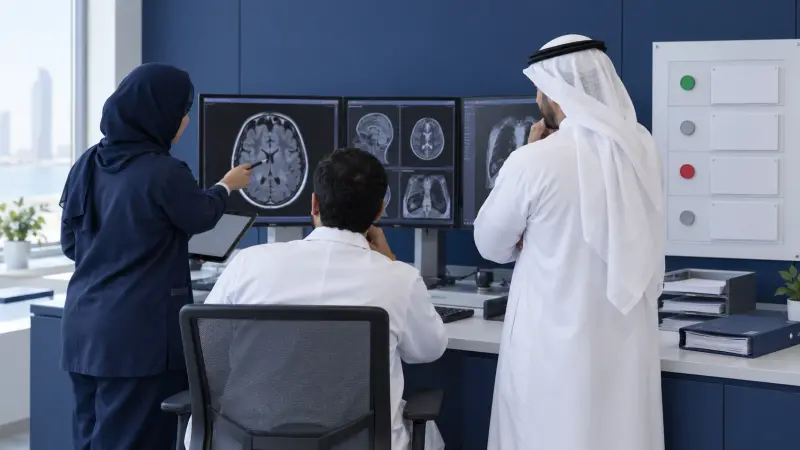
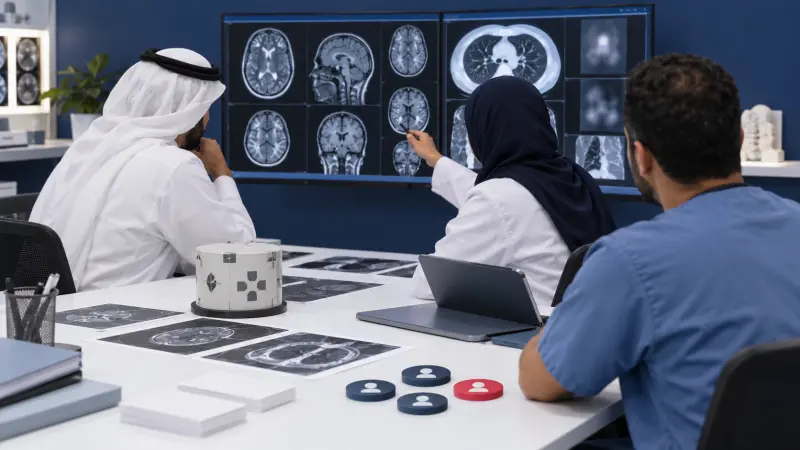
AI-Assisted Medical Diagnostic Assurance Course is a one-week course for diagnostic service managers, laboratory and imaging operations personnel, clinical quality teams, health informatics personnel, and diagnostic governance staff, who leave with an AI Diagnostic Assurance File. Participants define intended use, trace data provenance, review performance and subgroup evidence, place human checkpoints, integrate controls into workflows, and manage incidents, monitoring, and changes. Agile Leaders Training Center provides training in AI-assisted medical diagnostic assurance.
Who Should Attend
- Diagnostic service personnel responsible for safe adoption, resources, and operational oversight
- Laboratory operations personnel responsible for diagnostic workflows, evidence, and quality controls
- Imaging operations personnel responsible for interpretation workflows, handoffs, and performance review
- Clinical quality personnel responsible for patient safety, incidents, corrective actions, and assurance
- Health informatics personnel responsible for integration, data lineage, access, and monitoring
- Governance personnel responsible for intended use, human authority, risk decisions, and change approval
The course assumes participants support diagnostic services or their governance, and it leaves out independent diagnosis, clinical treatment decisions, model development, coding, and advanced biostatistics.
Departments and Industries
The course supports diagnostic AI assurance across healthcare providers, diagnostic networks, technology suppliers, and assurance functions.
- Medical imaging and radiology operations
- Laboratory medicine and pathology services
- Clinical quality and patient safety
- Health informatics and digital health
- Medical technology operations
- Risk, privacy, and internal assurance
Learning Objectives
By the end of this course, participants will be able to:
- Diagnose diagnostic AI use cases and intended-use boundaries
- Analyze data provenance and reference-standard evidence
- Evaluate performance measures and subgroup variation
- Build human review and workflow integration controls
- Apply incident, monitoring, and change-control methods
- Build an AI Diagnostic Assurance File
Course Agenda
Day 1: Use Cases and Intended Use
- Diagnostic AI Use-Case Definition Canvas
- Intended-Use and Exclusion Boundary Statement
- Patient, User, and Setting Context Map
- Diagnostic Harm and Benefit Scenario Register
- Human Authority and Accountability Charter
Day 2: Data and Reference Evidence
- Diagnostic Data Provenance Map
- Reference Standard Selection Record
- Data Quality and Missingness Checklist
- Population Representation and Subgroup Matrix
- Privacy and Minimum-Data Control Sheet
Day 3: Performance and Human Review
- Diagnostic Performance Measure Definition Sheet
- Threshold and Error Tradeoff Table
- Subgroup Performance Comparison Grid
- Human Review and Override Decision Tree
- Evidence Limitation and Uncertainty Log
Day 4: Workflow, Incidents, and Change
- Diagnostic Workflow Integration and Handoff Map
- AI Output Verification Checkpoint Design
- Diagnostic Incident and Escalation Record
- Performance Monitoring and Drift Dashboard
- Change Request and Reassurance Gate
Day 5: Diagnostic Assurance Practice
- Suggested Exercise: Define Intended Use and Diagnostic Boundaries
- Suggested Exercise: Audit Data and Reference Evidence
- Suggested Exercise: Review Performance and Subgroup Variation
- Suggested Exercise: Map Workflow, Incident, and Change Controls
- Capstone Exercise: AI Diagnostic Assurance File
Practical Exercises
The course uses suggested activities that turn diagnostic AI evidence into controlled operational assurance artifacts.
- Suggested activity: define a diagnostic use case, exclusions, affected parties, foreseeable harms, and accountable human authority
- Suggested activity: trace data origins, select reference evidence, inspect missingness and representation, and apply minimum-data controls
- Suggested activity: compare performance measures, thresholds, error tradeoffs, subgroup results, overrides, and uncertainty
- Suggested activity: map an imaging or laboratory workflow, place checkpoints, record an incident, and define monitoring and change gates
FAQs
Who suits AI-assisted medical diagnostic assurance, and what does the course assume?
AI-assisted medical diagnostic assurance suits diagnostic operations, quality, informatics, and governance personnel. The course assumes experience supporting diagnostic services or their controls.
How does medical diagnostic assurance differ from clinical diagnosis training?
Medical diagnostic assurance governs intended use, evidence, performance, oversight, workflows, incidents, monitoring, and change, while clinical diagnosis training develops professional examination and diagnostic reasoning.
How should diagnostic AI performance be reviewed?
Diagnostic AI performance should be reviewed against defined measures, thresholds, reference evidence, error consequences, relevant populations, subgroup variation, workflow conditions, uncertainty, and accountable human judgment.
Why does diagnostic AI require human review and override controls?
Human review and override controls keep accountable professionals able to question outputs, recognize missing context, compare other evidence, stop unsafe use, document decisions, and escalate concerns.
What belongs in an AI Diagnostic Assurance File?
The file should contain intended use, exclusions, context, data provenance, reference evidence, performance and subgroup reviews, human controls, workflow checkpoints, incidents, monitoring, changes, approvals, and corrective actions.
Conclusion
Participants take back an AI Diagnostic Assurance File linking intended use, data, reference evidence, performance, subgroup checks, human authority, workflows, incidents, monitoring, and changes. It changes how diagnostic teams move from informal adoption to traceable operational assurance. The file supports accountable review, escalation, approval, and continuing control.
Healthcare Management Training Courses
AI-Assisted Medical Diagnostic Assurance Course (219_119392)
Course Details
# 219_119392
11 – 15 April 2027
Trabzon
Fees : 6800 €
AI-Assisted Medical Diagnostic Assurance Course runs in Trabzon over 5 days, with 1 upcoming date in Trabzon. The course fee is 6,800 €.
All dates in Trabzon
| Dates | Price | Actions |
|---|---|---|
| 11 – 15 April 2027 | 6,800 € | Register |
Training in Trabzon
Experience our top-notch training courses in Trabzon, the stunning Black Sea gem of Turkey. Join one of our professional training programs in Trabzon today and elevate your skills in a truly inspiring setting!
All courses in TrabzonThis course in other cities
- Abu Dhabi
- Accra
- Amman
- Amsterdam
- Athens
- Baku
- Bali
- Bangkok
- Barcelona
- Berlin
- Cairo
- Cape town
- Casablanca
- Chicago
- Doha
- Dubai
- Frankfurt
- Geneva
- Istanbul
- Jakarta
- Johannesburg
- Kuala Lumpur
- Kuwait
- Lagos
- Langkawi
- Lisbon
- London
- Madrid
- Manama
- Marbella
- Milan
- Montreux
- Munich
- Muscat
- Nairobi
- New York
- Nice
- Paris
- Phuket
- Porto
- Prague
- Rome
- San Diego
- Seoul
- Sharm El-Sheikh
- Singapore
- Tashkent
- Tbilisi
- Tokyo
- Toronto
- Vienna
- Zanzibar
- Zoom