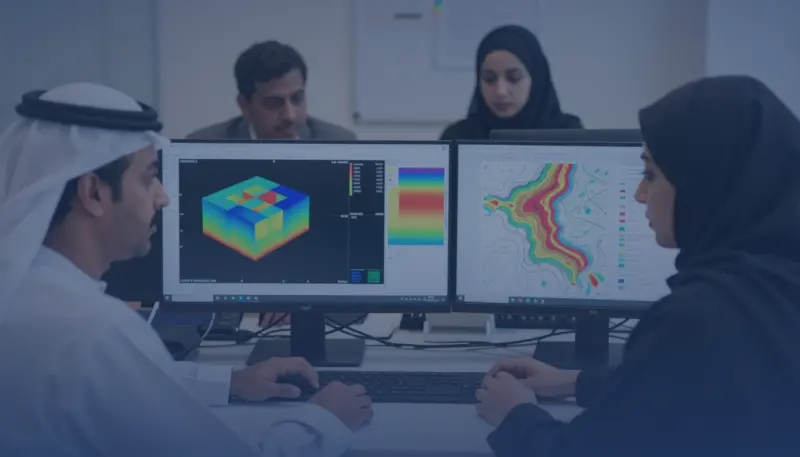
Petroleum Geoscience Machine Learning Interpretation Course

Course Details
-
# 314_126413
-
31 October – 4 November 2027 04.Nov.2027
-
Bali
-
6500 €
Overview
Petroleum Geoscience Machine Learning Interpretation Course is a one-week intermediate course for petroleum geoscientists, geologists, geophysicists, reservoir teams, subsurface data professionals, and technical decision-makers, who leave with a Petroleum Geoscience ML Interpretation Review Pack. Participants evaluate seismic, well-log, core, and reservoir data for classification, prediction, anomaly, validation, and uncertainty tasks without building production code. The course keeps geological interpretation central to model review. Agile Leaders Training Center provides training in petroleum geoscience machine learning interpretation.
Who Should Attend
- Teams responsible for seismic interpretation and attribute analysis
- Teams responsible for well-log, core, and petrophysical interpretation
- Teams responsible for facies, lithology, and rock classification
- Teams responsible for reservoir characterization and property prediction
- Teams responsible for subsurface data quality, validation, and technical assurance
The course assumes participants interpret petroleum geoscience data and leaves out Python programming, algorithm development, seismic processing, reserves certification, software configuration, and autonomous interpretation.
Departments and Industries
The course supports machine-learning review across petroleum exploration, field development, reservoir characterization, geophysical services, geoscience consulting, and subsurface data teams.
- Exploration geology and geophysics
- Petrophysics, formation evaluation, and well-log analysis
- Reservoir characterization and static modeling
- Seismic interpretation and attribute analysis
- Subsurface data management and technical assurance
Learning Objectives
By the end of this course, participants will be able to:
- Analyze subsurface data readiness, labels, scale, and geological context
- Build seismic and well-log feature review profiles
- Evaluate facies, lithology, and rock-classification evidence
- Compare reservoir-property predictions, anomalies, and uncertainty
- Apply validation, monitoring, and human-interpretation controls
- Build a Petroleum Geoscience ML Interpretation Review Pack
Course Agenda
Day 1: Geoscience ML Context and Data
- Petroleum Geoscience ML Use Case Canvas
- Seismic, Well Log, Core, and Reservoir Data Map
- Geological Scale, Sampling, Resolution, and Support Check
- Label Source and Interpretation Consistency Review
- Human Geoscience Decision Authority Canvas
Day 2: Features and Data Readiness
- Seismic Attribute Meaning and Coupling Matrix
- Well-Log Curve Quality and Depth Alignment Check
- Core-to-Log Scale Integration Profile
- Data Conditioning, Missing Values, and Outlier Guide
- Subsurface ML Data-Readiness Scorecard
Day 3: Classification and Prediction
- Facies and Lithology Classification Evidence Sheet
- Supervised and Unsupervised Rock-Class Comparison
- Reservoir Property Regression Review
- Hydrocarbon Zone and Anomaly Signal Assessment
- Training, Validation, and Blind-Well Split Check
Day 4: Uncertainty and Interpretation Assurance
- Prediction Probability and Confidence Review
- Class Imbalance and Rare Geology Impact Matrix
- Spatial Leakage and Generalization Questions
- Geological Plausibility and Interpretation Challenge
- Model Monitoring, Version, and Escalation Plan
Day 5: ML Interpretation Practice
- Suggested Exercise: Diagnose Subsurface Data Readiness
- Suggested Exercise: Review Seismic and Log Features
- Suggested Exercise: Challenge a Facies Classification
- Suggested Exercise: Assess Property Prediction Uncertainty
- Capstone Exercise: Petroleum Geoscience ML Interpretation Review Pack
Practical Exercises
The course uses suggested activities to connect machine-learning evidence with geological interpretation.
- Suggested activity: frame a subsurface use case with data types, scale, labels, intended decision, owners, and exclusions
- Suggested activity: inspect seismic attributes and well logs for conditioning, alignment, missing data, coupling, and geological meaning
- Suggested activity: review classification or regression evidence using validation design, blind wells, errors, uncertainty, and plausibility
- Suggested activity: assemble an interpretation review pack with assumptions, limitations, monitoring, human authority, and escalation
FAQs
Who suits petroleum geoscience machine learning interpretation training, and what does it assume?
The course suits geologists, geophysicists, petrophysicists, reservoir teams, data professionals, and technical reviewers. It assumes experience with subsurface interpretation but not machine-learning coding.
How does petroleum geoscience ML interpretation differ from data science training?
Petroleum geoscience ML interpretation focuses on geological context, data scale, features, validation, uncertainty, plausibility, and technical decisions. Data science training focuses on programming, algorithms, model tuning, and deployment.
How can machine learning support petroleum geoscience interpretation?
Machine learning can support seismic feature recognition, facies and lithology classification, rock typing, log reconstruction, property prediction, anomaly screening, and interpretation prioritization when data, validation, uncertainty, and geological controls are appropriate.
Why are blind wells and spatial validation important in geoscience ML?
Nearby samples can share geology and create optimistic results when split randomly. Blind wells or spatially separated validation better test whether patterns generalize beyond the locations used to train or tune a model.
Conclusion
Participants take back a Petroleum Geoscience ML Interpretation Review Pack linking subsurface context, data readiness, seismic and log features, classification, property prediction, uncertainty, validation, plausibility, monitoring, human authority, and escalation. It improves collaboration between geoscience and data teams. It keeps accountable interpretation with qualified professionals.
Oil & Gas Training and Other Technical Courses
Petroleum Geoscience Machine Learning Course (314_126413)
Course Details
# 314_126413
31 October – 4 November 2027
Bali
Fees : 6500 €
Petroleum Geoscience Machine Learning Interpretation Course runs in Bali over 5 days, with 1 upcoming date in Bali. The course fee is 6,500 €.
All dates in Bali
| Dates | Price | Actions |
|---|---|---|
| 31 October – 4 November 2027 | 6,500 € | Register |
Training in Bali
Sunset view over rice terraces in Bali with palm trees and mountains in the background, showcasing natural island beauty.
All courses in BaliThis course in other cities
- Abu Dhabi
- Accra
- Amman
- Amsterdam
- Athens
- Baku
- Bangkok
- Barcelona
- Berlin
- Cairo
- Cape town
- Casablanca
- Chicago
- Doha
- Dubai
- Frankfurt
- Geneva
- Istanbul
- Jakarta
- Johannesburg
- Kuala Lumpur
- Kuwait
- Lagos
- Langkawi
- Lisbon
- London
- Madrid
- Manama
- Marbella
- Milan
- Montreux
- Munich
- Muscat
- Nairobi
- New York
- Nice
- Paris
- Phuket
- Porto
- Prague
- Rome
- San Diego
- Seoul
- Sharm El-Sheikh
- Singapore
- Tashkent
- Tbilisi
- Tokyo
- Toronto
- Trabzon
- Vienna
- Zanzibar
- Zoom