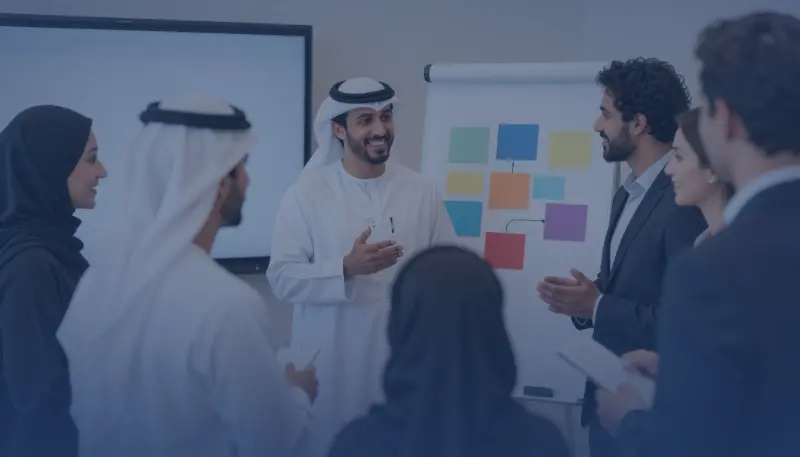
Agile Team Facilitation and Collaboration Skills Course

Course Details
-
# 958_173095
-
18 – 22 April 2027 22.Apr.2027
-
Bali
-
5700 €
Overview
Agile Team Facilitation and Collaboration Skills Course is a 1-week course for Scrum Masters, agile coaches, delivery leads, product professionals, team facilitators, and managers who leave with an Agile Team Facilitation Plan. Participants practice facilitation mindset, Scrum event facilitation, inclusive collaboration, visual working methods, conflict response, distributed agile teams, prioritization, feedback, and continuous improvement. Agile Leaders Training Center delivers this course on agile team facilitation.
Who Should Attend
Roles responsible for facilitating planning, daily coordination, reviews, retrospectives, and refinement.
Functions responsible for coaching teams toward collaboration, self-management, and improvement.
Professionals responsible for product decisions, stakeholder participation, and value-focused conversations.
Leaders responsible for delivery flow, impediment discussions, and cross-functional alignment.
Teams responsible for distributed collaboration and visual work practices.
The course assumes participants work with agile teams and leaves out introductory agile theory, software-tool administration, and certification assessment.
Departments and Industries
The course supports agile collaboration across technology, product development, financial services, engineering, healthcare, and public-service delivery.
Digital product, software, and technology delivery
Project, delivery, and transformation offices
Product management and customer experience
Engineering, operations, and service improvement
Learning, organizational development, and internal consulting
Learning Objectives
By the end of this course, participants will be able to:
Apply a facilitation stance to agile team interactions.
Build purpose-led designs for Scrum events and team sessions.
Use inclusive questioning, listening, and visual collaboration methods.
Diagnose conflict, difficult dynamics, and participation barriers.
Compare agile decision and prioritization methods.
Build a facilitation plan for colocated and distributed teams.
Course Agenda
Day 1: Facilitation Stance and Purpose
Agile Facilitator Stance Reflection Canvas
Session Purpose and Outcome Definition Sheet
Team Working Agreement and Safety Checklist
Stakeholder Participation and Influence Map
Facilitator Boundary and Intervention Guide
Day 2: Scrum Event Facilitation
Sprint Planning Purpose and Flow Map
Daily Scrum Focus and Timebox Pattern
Sprint Review Stakeholder Feedback Design
Retrospective Inquiry and Improvement Cycle
Product Backlog Refinement Conversation Board
Day 3: Participation and Team Dynamics
Inclusive Participation Method Selection Matrix
Powerful Questioning and Active Listening Ladder
Visual Collaboration and Information Radiator Design
Conflict Pattern and Response Decision Tree
Difficult Behavior and Impediment Intervention Menu
Day 4: Decisions and Distributed Teams
Agile Decision Rights and Delegation Grid
Dot Voting and Criteria Prioritization Matrix
Consent Check and Fist-to-Five Method
Distributed Team Channel and Participation Map
Feedback Loop and Action Follow-Through Tracker
Day 5: Agile Facilitation Practice
Suggested Exercise: Scrum Event Purpose Review
Suggested Exercise: Inclusive Team Conversation
Suggested Exercise: Conflict and Impediment Intervention
Suggested Exercise: Distributed Decision Simulation
Capstone Exercise: Agile Team Facilitation Plan
Practical Exercises
The course uses suggested activities to connect agile event design, participation, team dynamics, and decision methods.
Suggested activity: redesign a Sprint Planning session around purpose, participation, timeboxes, and visible outcomes.
Suggested activity: facilitate a retrospective where unequal participation and unresolved conflict obstruct improvement.
Suggested activity: compare prioritization and consent methods for a product, engineering, or service decision.
Suggested activity: rehearse a distributed team session and capture decisions, feedback, owners, and follow-through.
FAQs
Who suits agile team facilitation training, and what does it assume?
Scrum Masters, agile coaches, delivery leads, product professionals, team facilitators, and supporting managers suit the course. It assumes workplace exposure to agile teams and excludes introductory agile theory and certification assessment.
How does agile team facilitation differ from general meeting facilitation?
Agile team facilitation connects group-process choices to iterative delivery, Scrum events, visible work, feedback, adaptation, team self-management, and continuous improvement rather than treating each meeting as an isolated event.
How should Scrum event facilitation protect the event purpose?
Scrum event facilitation protects purpose by clarifying the outcome, preserving the timebox, enabling relevant participation, keeping work and evidence visible, and helping the team inspect and adapt without the facilitator taking over decisions.
How can agile facilitation manage conflict within a team?
Agile facilitation manages conflict by surfacing observations, separating positions from needs, balancing voices, reconnecting discussion to team goals, and selecting an intervention proportionate to the conflict and the team's ability to resolve it.
What helps distributed agile teams participate effectively?
Distributed agile teams participate effectively when channels, turn-taking, visual work, preparation, decision rules, technology contingencies, and follow-through give every participant practical access to the same conversation and evidence.
Conclusion
Participants take back an Agile Team Facilitation Plan linking event purposes, working agreements, participation methods, visual tools, interventions, decisions, distributed channels, and feedback loops. The plan improves how teams conduct Scrum events and difficult conversations. It makes facilitation choices visible, reviewable, and adaptable during delivery.
Agile PM and Project Management Training Courses
Agile Team Facilitation and Collaboration Course (958_173095)
Course Details
# 958_173095
18 – 22 April 2027
Bali
Fees : 5700 €
Agile Team Facilitation and Collaboration Skills Course runs in Bali over 5 days, with 1 upcoming date in Bali. The course fee is 5,700 €.
All dates in Bali
| Dates | Price | Actions |
|---|---|---|
| 18 – 22 April 2027 | 5,700 € | Register |
Training in Bali
Sunset view over rice terraces in Bali with palm trees and mountains in the background, showcasing natural island beauty.
All courses in BaliThis course in other cities
- Abu Dhabi
- Accra
- Amman
- Amsterdam
- Athens
- Baku
- Bangkok
- Barcelona
- Berlin
- Cairo
- Cape town
- Casablanca
- Chicago
- Doha
- Dubai
- Frankfurt
- Geneva
- Istanbul
- Jakarta
- Johannesburg
- Kuala Lumpur
- Kuwait
- Lagos
- Langkawi
- Lisbon
- London
- Madrid
- Manama
- Marbella
- Milan
- Montreux
- Munich
- Muscat
- Nairobi
- New York
- Nice
- Paris
- Phuket
- Porto
- Prague
- Rome
- San Diego
- Seoul
- Sharm El-Sheikh
- Singapore
- Tashkent
- Tbilisi
- Tokyo
- Toronto
- Trabzon
- Vienna
- Zanzibar
- Zoom