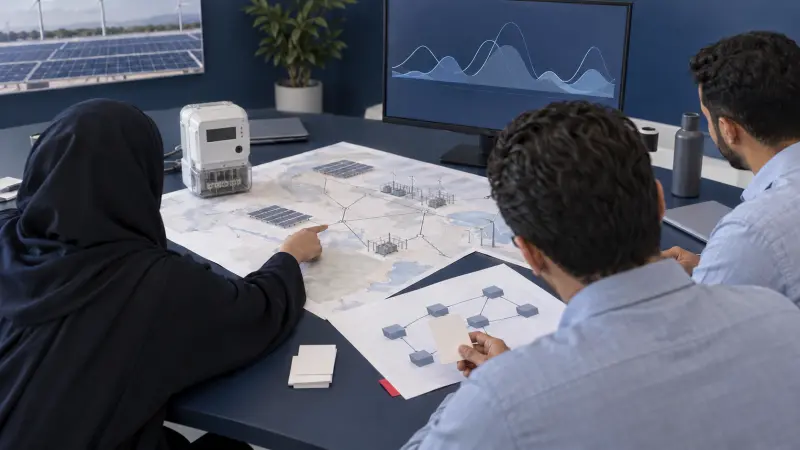
CCUS and Energy Storage Concepts Training Course

Course Details
-
# 979_174550
-
6 – 10 June 2027 10.Jun.2027
-
Zanzibar
-
5500 €
Overview
CCUS and Energy Storage Concepts Training Course is a one-week foundation course for professionals who need to distinguish carbon capture, utilization and storage from electrical and other energy-storage technologies. Participants connect value chains, technology families, system services, project boundaries, selection criteria, integration points, risks, and early-stage evidence. The course resolves confusion between CO2 storage and energy storage through separate concept maps and a combined screening file. Agile Leaders Training Center delivers this CCUS and energy storage concepts course.
Who Should Attend
Energy professionals exploring transition technology opportunities
Engineers who support early-stage technical screening
Sustainability teams that compare decarbonization options
Project analysts who organize technology and interface evidence
Technical managers who review concept-selection decisions
The course assumes general energy-sector knowledge, while detailed process design, reservoir engineering, storage sizing, financial modelling, and certification preparation remain outside scope.
Departments and Industries
The course supports concept screening across organizations evaluating carbon management and energy-system flexibility.
Energy strategy and project development in power and industry
Sustainability and decarbonization teams in process facilities
Engineering functions in utilities and infrastructure
Technology assessment groups in manufacturing and transport
Investment and technical assurance teams reviewing early concepts
Learning Objectives
By the end of this course, participants will be able to:
Map the CCUS capture, transport, utilization, and storage value chain
Classify electrical, mechanical, thermal, and chemical energy storage
Compare technology purposes, system boundaries, and interfaces
Match storage characteristics to energy-system use cases
Identify project evidence, risks, dependencies, and screening gaps
Build a concept screening file for CCUS and energy storage options
Course Agenda
Day 1: Technology Context and Boundaries
Energy-System Challenge and Technology Role Map
CCUS and Energy Storage Boundary Comparison
Project Objective, Use Case, and Stakeholder Register
Technology Readiness and Evidence-Level Scale
Concept Screening Question and Assumption Log
Day 2: CCUS Value Chain Concepts
Point-Source and Direct-Air Capture Route Map
CO2 Conditioning, Compression, and Transport Chain
Utilization Pathway and Product-Destination Matrix
Geological Storage Site and Containment Concept
CCUS Chain Interface and Dependency Register
Day 3: Energy Storage Technology Concepts
Electrochemical Storage Technology Family Guide
Mechanical, Thermal, and Chemical Storage Map
Power Capacity, Energy Capacity, and Duration Model
Round-Trip Efficiency and Operating Profile Comparison
Safety, Reliability, and Performance Evidence Matrix
Day 4: Integration and Opportunity Screening
Energy Storage Service and Use-Case Matching Grid
CCUS Host Facility and Infrastructure Interface Map
Site, Resource, Network, and Supply-Chain Constraint Register
Technical Risk and Evidence Confidence Matrix
Concept Comparison and Next-Study Decision Table
Day 5: Concept Screening Practice and Capstone
Exercise on Technology Boundary and Use-Case Definition
Exercise on CCUS Value-Chain Interface Mapping
Exercise on Energy Storage Family and Service Matching
Exercise on Risk, Evidence, and Constraint Screening
Capstone Exercise: CCUS and Energy Storage Concept Screening File
Practical Exercises
The course uses suggested activities that turn technology information into structured concept comparisons.
Suggested activity: separate a proposed opportunity into CCUS and energy-storage system boundaries
Suggested activity: map capture, transport, utilization, and geological storage interfaces
Suggested activity: match storage technology families to duration and service needs
Suggested activity: present a screening file with evidence gaps and next-study decisions
FAQs
Who suits CCUS and energy storage concepts, and what does it assume?
Energy professionals, engineers, sustainability teams, analysts, and technical managers suit the course. It assumes general energy-sector knowledge, while detailed design, reservoir engineering, storage sizing, financial modelling, and certification preparation remain outside scope.
How does CCUS differ from energy storage?
CCUS manages carbon dioxide through capture, transport, utilization, and geological storage. Energy storage captures energy for later release or use through electrochemical, mechanical, thermal, or chemical technologies. The two fields have different system boundaries and decision criteria.
What are the main stages in a CCUS value chain?
A CCUS value chain includes capture, conditioning and compression, transport, utilization or injection, geological storage, monitoring, and interface management. A viable chain requires compatible capacities, specifications, timing, infrastructure, and responsibilities across stages.
How are energy storage technologies compared?
Energy storage technologies are compared through power, energy, duration, response, efficiency, life, safety, site needs, reliability, maturity, and service fit. No single measure determines suitability across all use cases.
What evidence is needed for early CCUS and energy storage screening?
Early screening needs a defined objective, system boundary, use case, technology assumptions, site and infrastructure constraints, performance evidence, dependencies, risks, and decision gaps. The output identifies what further technical study is required.
Conclusion
Participants take back a CCUS and Energy Storage Concept Screening File containing boundaries, value chains, technology families, use cases, interfaces, evidence, risks, and next-study decisions. The file changes mixed technology claims into a structured comparison. Teams can update it as evidence improves and use it to govern concept development.
Environment & Sustainability Training Courses
CCUS and Energy Storage Fundamentals Course (979_174550)
Course Details
# 979_174550
6 – 10 June 2027
Zanzibar
Fees : 5500 €
CCUS and Energy Storage Concepts Training Course runs in Zanzibar over 5 days, with 1 upcoming date in Zanzibar. The course fee is 5,500 €.
All dates in Zanzibar
| Dates | Price | Actions |
|---|---|---|
| 6 – 10 June 2027 | 5,500 € | Register |
Training in Zanzibar
Experience our top-notch training course programs in the vibrant city of Zanzibar, Tanzania.
All courses in ZanzibarThis course in other cities
- Abu Dhabi
- Accra
- Amman
- Amsterdam
- Athens
- Baku
- Bali
- Bangkok
- Barcelona
- Berlin
- Cairo
- Cape town
- Casablanca
- Chicago
- Doha
- Dubai
- Frankfurt
- Geneva
- Istanbul
- Jakarta
- Johannesburg
- Kuala Lumpur
- Kuwait
- Lagos
- Langkawi
- Lisbon
- London
- Madrid
- Manama
- Marbella
- Milan
- Montreux
- Munich
- Muscat
- Nairobi
- New York
- Nice
- Paris
- Phuket
- Porto
- Prague
- Rome
- San Diego
- Seoul
- Sharm El-Sheikh
- Singapore
- Tashkent
- Tbilisi
- Tokyo
- Toronto
- Trabzon
- Vienna
- Zoom