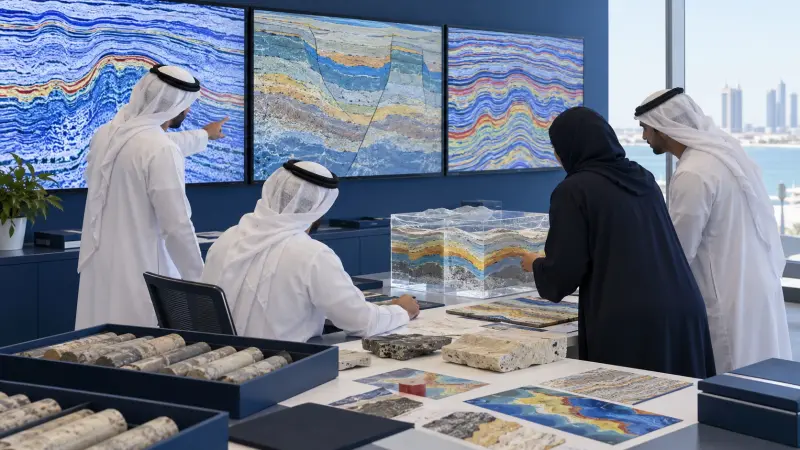
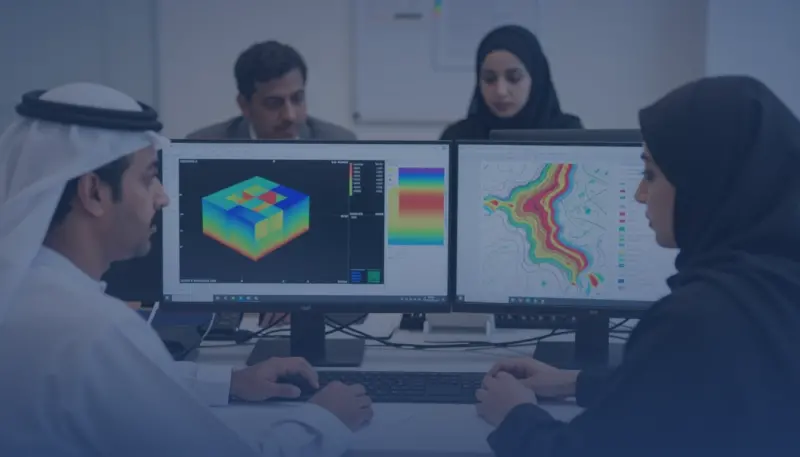
Advanced Techlog Formation Evaluation Training Course

Course Details
-
# 1180_187129
-
27 September – 1 October 2027 01.Oct.2027
-
Tokyo
-
12000 €
Overview
Advanced Techlog Formation Evaluation Training Course is a one-week course for petrophysicists, formation-evaluation specialists, reservoir teams, well-log analysts, and subsurface professionals who need a Techlog Formation Evaluation Interpretation Pack. Participants connect Techlog well-log interpretation, petrophysical data quality control, lithology and porosity analysis, saturation modeling, and multimineral formation evaluation through traceable workflows and uncertainty review. Agile Leaders Training Center develops Techlog formation-evaluation practice.
Who Should Attend
Teams responsible for petrophysical interpretation and formation evaluation
Teams responsible for well-log loading, conditioning, and quality control
Teams responsible for reservoir characterization and property integration
Teams responsible for core, pressure, fluid, and log-data calibration
Teams responsible for subsurface assurance, uncertainty, and technical reporting
The course assumes participants can interpret common open-hole logs and basic petrophysical equations; it leaves out software installation, vendor certification, tool physics design, and field-data acquisition.
Departments and Industries
The course supports departments and industries that evaluate subsurface formations and integrate wellbore evidence into reservoir decisions.
Petrophysics, formation evaluation, geology, geophysics, and reservoir engineering teams
Well-data management, drilling, completions, production, and subsurface assurance departments
Exploration, development, energy-services, and well-logging organizations
Carbon storage, geothermal, groundwater, and subsurface-resource projects
Technical consulting, research, software support, and data-governance teams
Learning Objectives
By the end of this course, participants will be able to:
Build governed Techlog projects and log-data views
Diagnose depth, unit, environmental, and quality issues
Apply lithology, shale-volume, and porosity workflows
Compare clean and shaly-sand saturation models
Evaluate multimineral results, calibration, and uncertainty
Create integrated multiwell interpretation and reporting packs
Course Agenda
Day 1: Techlog Project and Data Control
Techlog Project Structure and Data-Governance Map
Well, Dataset, Variable, and Unit Loading Checklist
Depth Matching and Curve-Splice Control Workflow
Environmental and Signal-Quality Correction Log
Logview Design and Data-Quality Flag Track
Day 2: Lithology and Porosity Interpretation
Zone and Formation-Top Management Framework
Gamma-Ray and Shale-Volume Model Comparison
Density-Neutron-Sonic Porosity Reconciliation
Lithology Crossplot and Mineral-Response Template
Core-to-Log Calibration and Assumption Register
Day 3: Saturation and Fluid Evaluation
Resistivity and Formation-Water Parameter QC Sheet
Archie Clean-Formation Saturation Workflow
Simandoux and Indonesian Shaly-Sand Comparison
Dual-Water and Waxman-Smits Applicability Matrix
Fluid Contact and Saturation-Height Evidence Plot
Day 4: Multimineral and Uncertainty Analysis
Deterministic Multimineral Solver Configuration
Mineral, Fluid, and Tool-Response Constraint Table
Probabilistic Interpretation and Uncertainty Envelope
Sensitivity Scenario and Parameter-Ranking Dashboard
Multiwell Correlation and Net-Interval Summary
Day 5: Integrated Techlog Interpretation Practice
Exercise: Condition Logs and Build Quality Tracks
Exercise: Calculate Lithology and Porosity Outputs
Exercise: Compare Saturation Model Results
Exercise: Test Multimineral Uncertainty Scenarios
Capstone Exercise: Techlog Formation Evaluation Interpretation Pack
Practical Exercises
The course uses suggested activities that connect Techlog calculations with geological evidence, data quality, and reservoir interpretation.
Suggested activity: condition a multi-vendor log suite and document rejected, repaired, and retained curves
Suggested activity: reconcile lithology and porosity results against core evidence in a clastic and carbonate interval
Suggested activity: compare clean and shaly-sand saturation results and explain model selection
Suggested activity: present a multiwell interpretation with uncertainty ranges, net intervals, and review actions
FAQs
Who suits advanced Techlog formation evaluation training?
Petrophysicists, formation-evaluation specialists, reservoir teams, well-log analysts, and subsurface professionals suit the training. Participants should already interpret common open-hole logs and basic petrophysical equations.
How does Techlog formation evaluation differ from general well-log interpretation training?
Techlog formation evaluation combines governed data preparation, calculations, model configuration, calibration, uncertainty, multiwell comparison, and reporting inside a software workflow, while general training may focus on log concepts without an integrated project environment.
How are well logs quality-controlled in Techlog formation evaluation?
Well logs are quality-controlled by checking metadata, units, depth alignment, splices, environmental effects, signal behavior, borehole conditions, cross-curve consistency, and calibration evidence, then recording flags and corrective actions.
Which saturation models can Techlog formation evaluation compare?
Techlog formation evaluation can compare the Archie clean-formation method with shaly-sand approaches such as Simandoux, Indonesian, Dual Water, and Waxman-Smits when their assumptions and inputs suit the formation.
How is uncertainty managed in Techlog petrophysical interpretation?
Uncertainty is managed through documented assumptions, constrained mineral and fluid responses, parameter ranges, deterministic and probabilistic runs, sensitivity ranking, calibration checks, and reporting of interpretation envelopes.
Conclusion
Participants take back a Techlog Formation Evaluation Interpretation Pack containing governed data views, quality flags, lithology and porosity models, saturation comparisons, calibration records, multimineral results, uncertainty scenarios, and multiwell summaries. The pack makes each result traceable to inputs, assumptions, and evidence. It also aligns petrophysics, geology, reservoir, and assurance teams around review decisions.
Maintenance Training and Engineering Training Courses
Techlog Formation Evaluation Training Course (1180_187129)
Course Details
# 1180_187129
27 September – 1 October 2027
Tokyo
Fees : 12000 €
Advanced Techlog Formation Evaluation Training Course runs in Tokyo over 5 days, with 1 upcoming date in Tokyo. The course fee is 12,000 €.
All dates in Tokyo
| Dates | Price | Actions |
|---|---|---|
| 27 September – 1 October 2027 | 12,000 € | Register |
Training in Tokyo
Experience our professional training courses in Tokyo, Japan. Benefit from our industry-focused programs and enhance your capabilities.
All courses in TokyoThis course in other cities
- Abu Dhabi
- Accra
- Amman
- Amsterdam
- Athens
- Baku
- Bali
- Bangkok
- Barcelona
- Berlin
- Cairo
- Cape town
- Casablanca
- Chicago
- Doha
- Dubai
- Frankfurt
- Geneva
- Istanbul
- Jakarta
- Johannesburg
- Kuala Lumpur
- Kuwait
- Lagos
- Langkawi
- Lisbon
- London
- Madrid
- Manama
- Marbella
- Milan
- Montreux
- Munich
- Muscat
- Nairobi
- New York
- Nice
- Paris
- Phuket
- Porto
- Prague
- Rome
- San Diego
- Seoul
- Sharm El-Sheikh
- Singapore
- Tashkent
- Tbilisi
- Toronto
- Trabzon
- Vienna
- Zanzibar
- Zoom