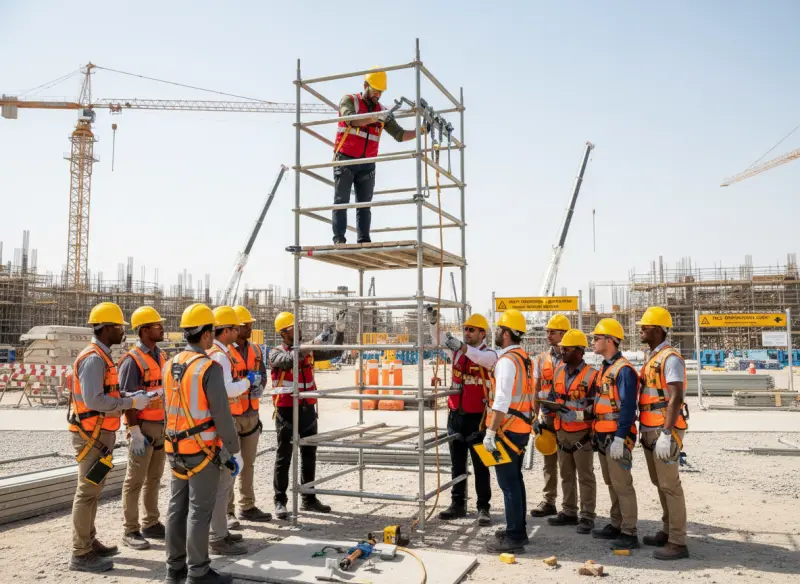
Advanced Scaffolding Hazards and Safety Precautions Course

Course Details
-
# 1391_202732
-
13 – 17 December 2026 17.Dec.2026
-
Cape town
-
4500 €
Overview
Advanced Scaffolding Hazards and Safety Precautions Course is a one-week advanced course for scaffolding supervisors, safety professionals, site engineers, inspectors, contractors, and operational leaders who leave with a Scaffold Hazard Control and Inspection Pack. Participants examine design inputs, loading, foundations, ties, platforms, access, fall and falling-object protection, environmental exposure, and work interfaces across the scaffold lifecycle. The approach combines hazard zoning, competent inspection, change triggers, evidence, and withdrawal decisions. Agile Leaders Training Center presents scaffold safety as a lifecycle control discipline.
Who Should Attend
- Functions responsible for scaffold planning, design inputs, and site coordination
- Teams that direct erection, alteration, dismantling, and handover
- Functions responsible for scaffold inspection and corrective decisions
- Teams managing work at height, fall protection, and rescue readiness
- Contractor-management functions controlling interfaces and permits
- Operational leaders accountable for safe scaffold use and loading
The course assumes participants already supervise, inspect, coordinate, or use scaffolding in operational settings and leaves out basic trade skills and scaffold-system assembly instruction.
Departments and Industries
The course serves departments and industries that plan, provide, inspect, or use temporary access structures.
- Construction, civil engineering, and infrastructure delivery teams
- Oil, gas, petrochemical, energy, and utilities operations
- Industrial maintenance, shutdown, and turnaround functions
- Manufacturing, warehousing, and facilities-management teams
- Marine, port, transport, and logistics operations
- Health, safety, contractor, and project-assurance functions
Learning Objectives
By the end of this course, participants will be able to:
- Analyze scaffold hazards across the work lifecycle
- Evaluate design inputs, capacity, stability, and access controls
- Apply fall, falling-object, electrical, and interface precautions
- Build competent inspection and defect records
- Prioritize weather, alteration, loading, and deterioration triggers
- Build a scaffold control, handover, and withdrawal plan
Course Agenda
Day 1: Scaffold Hazard Planning
- Scaffold Lifecycle Hazard Map
- Site Information and Design Input Checklist
- Scaffold Type and Intended-Use Decision Matrix
- Electrical, Traffic, and Interface Hazard Zone Plan
- Competence, Roles, and Authority Matrix
Day 2: Capacity, Stability, and Access
- Foundation and Support Condition Assessment
- Load Class and Material Control Register
- Tie, Bracing, and Stability Verification Method
- Platform, Edge, and Opening Inspection Test
- Safe Access and Egress Configuration Review
Day 3: Protection During Scaffold Work
- Collective Fall Protection Selection Plan
- Personal Fall-Arrest Dependency Review
- Falling-Object and Exclusion-Zone Controls
- Erection, Alteration, and Dismantling Sequence Check
- Emergency Response and Rescue Readiness Plan
Day 4: Inspection and Change Control
- Pre-Use and Periodic Inspection Record
- Weather, Impact, and Deterioration Trigger Matrix
- Alteration and Unauthorized Change Detection Test
- Defect Classification and Corrective Action Log
- Handover, Tagging, and Withdrawal Decision Protocol
Day 5: Scaffold Safety Assurance Practice
- Exercise: Map Hazards Around a Scaffold Workface
- Exercise: Verify Load, Stability, and Access Evidence
- Exercise: Inspect Protection and Work Interfaces
- Exercise: Decide Handover, Restriction, or Withdrawal
- Capstone Exercise: Scaffold Hazard Control and Inspection Pack
Practical Exercises
The course uses construction, industrial maintenance, energy, logistics, and facilities scenarios.
- Suggested activity: map fall, collapse, falling-object, electrical, access, loading, vehicle, and weather hazards around a scaffold workface.
- Suggested activity: challenge design information, foundation conditions, ties, bracing, loading, platforms, and access arrangements against field evidence.
- Suggested activity: document defects, classify urgency, select corrective controls, and determine whether use should continue, be restricted, or stop.
- Suggested activity: integrate hazards, controls, inspection evidence, handover conditions, change triggers, and rescue readiness into a Scaffold Hazard Control and Inspection Pack.
FAQs
Who suits advanced scaffolding hazard training, and what does it assume?
Advanced scaffolding hazard training suits professionals who already supervise, inspect, coordinate, contract, or manage scaffold work and need stronger lifecycle control and decision skills.
How does advanced scaffolding safety differ from basic scaffold-user training?
Advanced scaffolding safety evaluates planning, capacity, stability, interfaces, inspection evidence, change triggers, and withdrawal decisions rather than introducing routine scaffold access and user behavior.
What hazards should a scaffold safety inspection prioritize?
A scaffold safety inspection should prioritize instability, overloading, deficient supports or ties, incomplete platforms, unsafe access, missing fall and falling-object protection, electrical exposure, unauthorized changes, deterioration, and adverse environmental conditions.
When should scaffolding be withdrawn from use?
Scaffolding should be withdrawn or restricted when defects, unauthorized alterations, impact, weather, overload, instability, missing protection, or uncertain design and inspection evidence could compromise safe use.
Why is a scaffold tag not enough to prove safety?
A scaffold tag communicates status but does not replace competent inspection, a recorded report, verification of current conditions, control of alterations, or user checks before work.
Conclusion
The course integrates lifecycle planning, stability, loading, access, fall and falling-object controls, inspection evidence, change triggers, and rescue readiness. Participants take back a Scaffold Hazard Control and Inspection Pack that turns site observations into controlled decisions. The pack strengthens handover quality, defect escalation, interface coordination, and timely restriction or withdrawal of unsafe scaffolding.
Occupational Health, Safety and Security Training Courses
Scaffolding Hazards and Safety Precautions Course (1391_202732)
Course Details
# 1391_202732
13 – 17 December 2026
Cape town
Fees : 4500 €
Advanced Scaffolding Hazards and Safety Precautions Course runs in Cape town over 5 days, with 1 upcoming date in Cape town. The course fee is 4,500 €.
All dates in Cape town
| Dates | Price | Actions |
|---|---|---|
| 13 – 17 December 2026 | 4,500 € | Register |
Training in Cape town
Aerial view of Cape Town with Table Mountain, Cape Town Stadium, and the coastline under clear blue skies.
All courses in Cape townThis course in other cities
- Abu Dhabi
- Accra
- Amman
- Amsterdam
- Athens
- Baku
- Bali
- Bangkok
- Barcelona
- Berlin
- Cairo
- Casablanca
- Chicago
- Doha
- Dubai
- Frankfurt
- Geneva
- Istanbul
- Jakarta
- Johannesburg
- Kuala Lumpur
- Kuwait
- Lagos
- Langkawi
- Lisbon
- London
- Madrid
- Manama
- Marbella
- Milan
- Montreux
- Munich
- Muscat
- Nairobi
- New York
- Nice
- Paris
- Phuket
- Porto
- Prague
- Rome
- San Diego
- Seoul
- Sharm El-Sheikh
- Singapore
- Tashkent
- Tbilisi
- Tokyo
- Toronto
- Trabzon
- Vienna
- Zanzibar
- Zoom