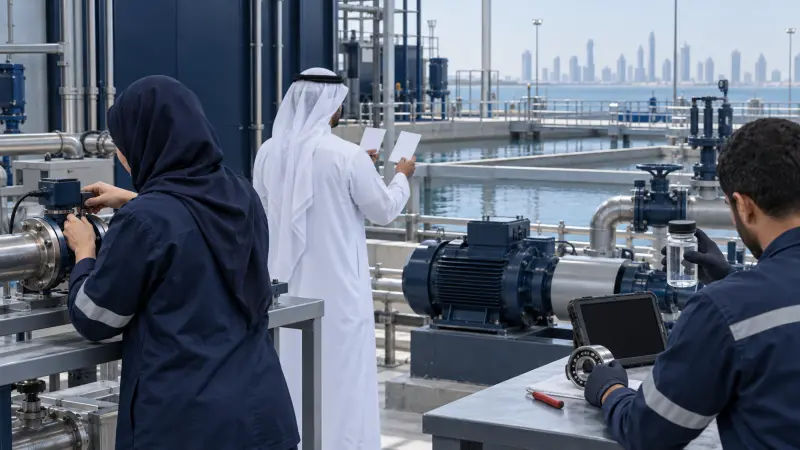
Advanced Water Treatment Process Control Training Course

Course Details
-
# 1408_203972
-
3 – 7 October 2027 07.Oct.2027
-
Johannesburg
-
4500 €
Overview
Advanced Water Treatment Process Control Training Course is a one-week course for utility, operations, laboratory, maintenance, environmental, and engineering functions who leave with a Water Treatment Process Control and Verification Dossier. Participants connect source-water characterization, treatment-train selection, coagulation, clarification, filtration, disinfection, residuals, instrumentation, troubleshooting, safety, and performance verification. Agile Leaders Training Center presents water treatment process control as an evidence-based operating discipline.
Who Should Attend
- Utility functions responsible for treatment performance and service continuity
- Operations functions controlling chemical dosing, clarification, filtration, and disinfection
- Laboratory functions producing source-water and process-monitoring evidence
- Maintenance functions sustaining chemical feed, instrumentation, filters, and residuals equipment
- Engineering functions evaluating treatment trains and improvement options
- Environmental and quality functions reviewing risks, controls, records, and verification
The course assumes participants already support water-treatment operations, laboratory testing, maintenance, engineering, environmental control, or quality assurance and leaves out introductory chemistry, detailed civil design, and predetermined water-quality or operating results.
Departments and Industries
The course supports departments and industries that treat source water for utility, industrial, commercial, or institutional use.
- Municipal and private water utilities
- Food, beverage, pharmaceutical, and healthcare operations
- Manufacturing, power, mining, and process industries
- Water operations, laboratory, and quality departments
- Mechanical, electrical, instrumentation, and maintenance teams
- Engineering, environment, safety, and technical-services functions
Learning Objectives
By the end of this course, participants will be able to:
- Analyze source-water risks and treatment requirements
- Compare conventional and advanced treatment-train options
- Apply coagulation, clarification, filtration, and disinfection controls
- Diagnose process deviations using operating and laboratory evidence
- Evaluate residuals, safety, instrumentation, and maintenance constraints
- Build a performance verification and improvement plan
Course Agenda
Day 1: Source Water and Treatment Barriers
- Source-Water Characterization Profile
- Hazard and Treatment Barrier Map
- Treatment-Train Selection Matrix
- Sampling Point and Data Quality Plan
- Baseline Performance and Uncertainty Register
Day 2: Coagulation and Clarification Control
- Coagulation Chemistry and Dose Control Model
- Jar-Test Design and Interpretation Method
- Flocculation Energy and Contact-Time Review
- Clarifier Loading and Settling Performance Sheet
- Chemical Feed Safety and Control Checklist
Day 3: Filtration and Disinfection Control
- Filter Loading and Head-Loss Trend Chart
- Backwash Trigger and Recovery Protocol
- Disinfection Contact and Residual Control Worksheet
- Activated Carbon Treatment Option Screen
- Membrane Treatment Applicability Matrix
Day 4: Monitoring and Plant Reliability
- Online Instrument Validation Schedule
- Process Alarm and Response Matrix
- Treatment Residuals Management Plan
- Equipment Criticality and Maintenance Map
- Performance Indicator and Evidence Dictionary
Day 5: Water Treatment Control Practice
- Exercise: Reconcile a Source-Water Risk Profile
- Exercise: Diagnose a Coagulation and Clarification Deviation
- Exercise: Evaluate Filtration and Disinfection Trends
- Exercise: Prioritize a Treatment Improvement Case
- Capstone Exercise: Water Treatment Process Control and Verification Dossier
Practical Exercises
The course uses suggested activities drawn from utility, food-processing, manufacturing, and institutional treatment settings.
- Suggested activity: connect source-water characteristics, hazards, operating constraints, treatment barriers, sampling points, and data-quality notes within a defined system boundary.
- Suggested activity: interpret jar-test, clarification, filter, and disinfectant-residual evidence to diagnose linked process deviations.
- Suggested activity: compare activated carbon and membrane options against contaminant, operating, residuals, maintenance, safety, and monitoring criteria.
- Suggested activity: assemble baseline, control, troubleshooting, reliability, verification, and improvement artifacts in the capstone dossier.
FAQs
Who suits advanced water treatment process control training, and what does it assume?
Advanced water treatment process control training suits experienced utility, operations, laboratory, maintenance, environmental, quality, and engineering personnel who already support treatment decisions or plant performance.
How does water treatment process control training differ from introductory water-treatment training?
Water treatment process control training emphasizes linked operating evidence, dose control, barrier performance, diagnostics, reliability, and verification rather than basic descriptions of treatment stages.
How is a jar test used in water treatment process control?
A jar test compares coagulation conditions under controlled mixing, dose, pH, and settling arrangements so operators can interpret floc formation and support dosing decisions alongside plant evidence.
What evidence supports water-treatment troubleshooting?
Water-treatment troubleshooting uses source-water results, chemical doses, flows, levels, turbidity trends, head loss, residual measurements, alarms, maintenance condition, sampling quality, and operating changes.
How should water treatment performance be verified?
Water treatment performance should be verified against defined baselines, barrier objectives, consistent sampling and calculation methods, validated instruments, assigned evidence owners, and documented response actions.
Conclusion
The course connects source-water risks, treatment barriers, process controls, instrumentation, residuals, maintenance, safety, troubleshooting, and verification. Participants take back a Water Treatment Process Control and Verification Dossier containing operating and improvement tools. The dossier helps teams interpret evidence, prioritize responses, document uncertainty, and govern treatment-performance decisions.
Environment & Sustainability Training Courses
Water Treatment Process Control Training Course (1408_203972)
Course Details
# 1408_203972
3 – 7 October 2027
Johannesburg
Fees : 4500 €
Advanced Water Treatment Process Control Training Course runs in Johannesburg over 5 days, with 1 upcoming date in Johannesburg. The course fee is 4,500 €.
All dates in Johannesburg
| Dates | Price | Actions |
|---|---|---|
| 3 – 7 October 2027 | 4,500 € | Register |
Training in Johannesburg
Aerial view of Johannesburg skyline featuring modern skyscrapers, vibrant urban energy, and a dynamic cityscape under clear blue skies.
All courses in JohannesburgThis course in other cities
- Abu Dhabi
- Accra
- Amman
- Amsterdam
- Athens
- Baku
- Bali
- Bangkok
- Barcelona
- Berlin
- Cairo
- Cape town
- Casablanca
- Chicago
- Doha
- Dubai
- Frankfurt
- Geneva
- Istanbul
- Jakarta
- Kuala Lumpur
- Kuwait
- Lagos
- Langkawi
- Lisbon
- London
- Madrid
- Manama
- Marbella
- Milan
- Montreux
- Munich
- Muscat
- Nairobi
- New York
- Nice
- Paris
- Phuket
- Porto
- Prague
- Rome
- San Diego
- Seoul
- Sharm El-Sheikh
- Singapore
- Tashkent
- Tbilisi
- Tokyo
- Toronto
- Trabzon
- Vienna
- Zanzibar
- Zoom