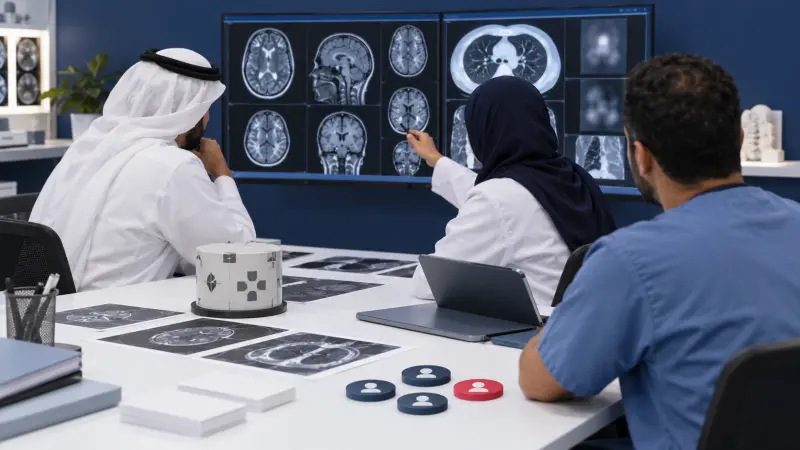
Advanced Diagnostic Safety and Error Reduction Training Course

Course Details
-
# 1440_206265
-
20 – 24 September 2027 24.Sep.2027
-
Milan
-
5700 €
Overview
Advanced Diagnostic Safety and Error Reduction Training Course is a one-week advanced course for physicians, nurses, diagnostic service leads, governance professionals, safety specialists, quality managers, and healthcare educators who leave with a Diagnostic Safety Improvement Portfolio. Participants connect diagnostic-process mapping, clinical reasoning, cognitive and system factors, uncertainty communication, closed-loop follow-up, patient engagement, event learning, and measurement. Agile Leaders Training Center presents diagnostic safety and error reduction through collaborative practice, reliable systems, and organizational learning.
Who Should Attend
- Clinical functions responsible for diagnostic reasoning, testing decisions, and communicating working diagnoses
- Nursing functions responsible for observation, escalation, follow-up, and care coordination
- Diagnostic service functions responsible for test performance, result communication, and critical findings
- Governance and safety functions responsible for event review, measurement, and improvement
- Education functions responsible for reasoning feedback, simulation, teamwork, and learning design
The course assumes participants already contribute to diagnostic care or safety and leaves out specialty-specific diagnosis, initial clinical qualification, and prescribing.
Departments and Industries
The course supports departments and industries that deliver, coordinate, review, or improve diagnostic processes.
- Hospitals, ambulatory services, and primary care organizations
- Laboratory, imaging, pathology, and diagnostic support services
- Clinical governance, quality, and patient-safety departments
- Health information, referral, and care-coordination teams
- Professional education and simulation centers
Learning Objectives
By the end of this course, participants will be able to:
- Analyze diagnostic processes and reliability gaps
- Apply clinical reasoning and cognitive safeguards
- Build closed-loop result, referral, and handoff controls
- Use uncertainty and patient-engagement communication methods
- Evaluate diagnostic safety events and contributory factors
- Prioritize diagnostic measurement and improvement actions
Course Agenda
Day 1: Diagnostic Process and Reliability
- Patient-Centered Diagnostic Process Map
- Information Gathering and Integration Review
- Working Diagnosis and Uncertainty Record
- Diagnostic Team Responsibility Matrix
- Diagnostic Reliability Gap Register
Day 2: Reasoning and Cognitive Safeguards
- Differential Diagnosis Calibration Grid
- Cognitive Contribution Reflection Tool
- Diagnostic Time-Out Method
- Disconfirming Evidence Prompt Set
- Reasoning Feedback and Learning Log
Day 3: Communication and Closed-Loop Follow-Up
- Uncertainty Communication Conversation Guide
- Patient Diagnostic Partnership Checklist
- Critical Test Result Escalation Pathway
- Closed-Loop Result Tracking Board
- Referral and Handoff Reliability Record
Day 4: Event Learning and Improvement
- Diagnostic Safety Event Detection Plan
- Measure Dx Readiness Checklist
- Cognitive and System Factor Analysis
- Diagnostic Safety Measurement Dashboard
- Learning Action and Governance Tracker
Day 5: Diagnostic Safety Practice
- Exercise: Map a Diagnostic Reliability Failure
- Exercise: Apply a Reasoning Safeguard
- Exercise: Design a Closed-Loop Follow-Up Control
- Exercise: Review a Diagnostic Safety Event
- Capstone Exercise: Diagnostic Safety Improvement Portfolio
Practical Exercises
The course uses suggested activities from hospitals, primary care, diagnostic services, ambulatory care, governance teams, and professional education.
- Suggested activity: map a diagnostic journey across presentation, information gathering, testing, interpretation, communication, referral, and follow-up.
- Suggested activity: examine a reasoning scenario for assumptions, uncertainty, disconfirming evidence, teamwork, and feedback opportunities.
- Suggested activity: design a closed-loop control for test results, referrals, handoffs, patient communication, and escalation.
- Suggested activity: analyze a diagnostic safety event and assemble measures, learning actions, ownership, and governance review.
FAQs
Who suits advanced diagnostic safety and error reduction training, and what does it assume?
Advanced diagnostic safety and error reduction training suits experienced clinical, nursing, diagnostic-service, governance, safety, quality, and education functions. It assumes current involvement in diagnosis or diagnostic-process improvement.
How does diagnostic safety and error reduction differ from general patient-safety training?
Diagnostic safety focuses on information gathering, reasoning, testing, interpretation, communication, referrals, follow-up, and learning across the diagnostic journey. General patient-safety training covers a wider range of clinical and operational harm.
What creates diagnostic error in healthcare?
Diagnostic error can arise from interacting cognitive, communication, workflow, technology, teamwork, workload, follow-up, and organizational factors. Reliable improvement examines the entire work system rather than assigning a single cause.
Why is closed-loop follow-up important for diagnostic safety?
Closed-loop follow-up confirms that results and referrals are received, reviewed, communicated, acted on, documented, and escalated when necessary. It reduces failures caused by uncertain ownership or incomplete handoffs.
How should healthcare organizations learn from diagnostic safety events?
Healthcare organizations should detect events through multiple sources, analyze cognitive and system contributions, involve patients and staff appropriately, identify patterns, assign actions, measure change, and provide feedback without reducing learning to blame.
Conclusion
The course connects diagnostic-process mapping, reasoning safeguards, uncertainty communication, patient partnership, closed-loop follow-up, event analysis, measurement, and governance. Participants take back a Diagnostic Safety Improvement Portfolio. The portfolio changes how teams identify reliability gaps, communicate uncertainty, track results, learn from events, and improve diagnostic safety.
Healthcare Management Training Courses
Diagnostic Safety and Error Reduction Training Course (1440_206265)
Course Details
# 1440_206265
20 – 24 September 2027
Milan
Fees : 5700 €
Advanced Diagnostic Safety and Error Reduction Training Course runs in Milan over 5 days, with 2 upcoming dates in Milan. The course fee is 5,700 €.
All dates in Milan
| Dates | Price | Actions |
|---|---|---|
| 7 – 11 June 2027 | 5,700 € | Register |
| 20 – 24 September 2027 | 5,700 € | Register |
Training in Milan
Experience our top-notch training courses in Milan one of the most vibrant cities of Italy, Join one of our vocational training courses in Italy Today!
All courses in MilanThis course in other cities
- Abu Dhabi
- Accra
- Amman
- Amsterdam
- Athens
- Baku
- Bali
- Bangkok
- Barcelona
- Berlin
- Cairo
- Cape town
- Casablanca
- Chicago
- Doha
- Dubai
- Frankfurt
- Geneva
- Istanbul
- Jakarta
- Johannesburg
- Kuala Lumpur
- Kuwait
- Lagos
- Langkawi
- Lisbon
- London
- Madrid
- Manama
- Marbella
- Montreux
- Munich
- Muscat
- Nairobi
- New York
- Nice
- Paris
- Phuket
- Porto
- Prague
- Rome
- San Diego
- Seoul
- Sharm El-Sheikh
- Singapore
- Tashkent
- Tbilisi
- Tokyo
- Toronto
- Trabzon
- Vienna
- Zanzibar
- Zoom