Advanced Healthcare Natural Language Processing Training Course

Course Details
-
# 1520_212265
-
13 – 17 September 2027 17.Sep.2027
-
Milan
-
5700 €
Overview
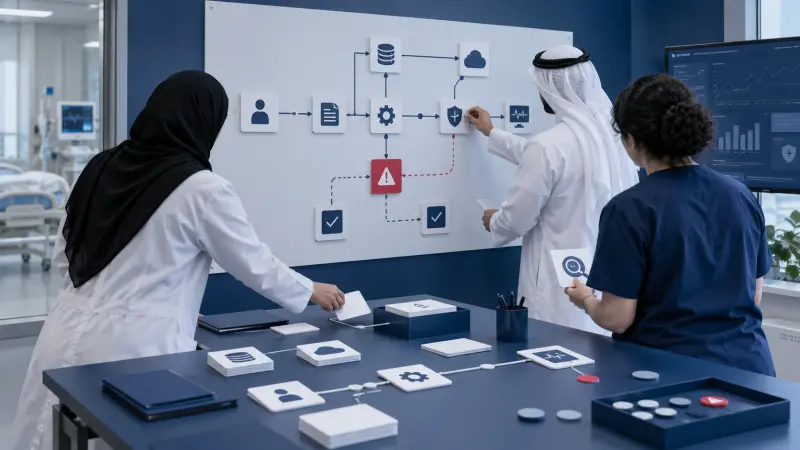
Advanced Healthcare Natural Language Processing Training Course is a one-week course for healthcare data science, clinical informatics, analytics, AI, digital health, quality, and technical product professionals, who leave with a Healthcare NLP Development and Assurance Pack. The course connects clinical text, governance, de-identification, annotation, preprocessing, embeddings, information extraction, classification, summarization, retrieval, evaluation, bias, safety, human review, workflow integration, and monitoring. Agile Leaders Training Center presents healthcare natural language processing as a governed technical capability supporting human-led health workflows.
Who Should Attend
- Functions responsible for healthcare data science and AI
- Teams responsible for clinical informatics and analytics
- Personnel responsible for data engineering and annotation
- Services responsible for digital health products and integration
- Functions responsible for quality, safety, and AI governance
The course assumes participants work with healthcare data, analytics, software, or governance and leaves out medical diagnosis authority, independent clinical decision-making, and basic programming instruction.
Departments and Industries
The course supports departments and organizations that develop, assess, integrate, or govern language technologies using health information.
- Hospitals and clinical care networks
- Health information and digital health services
- Research and life-science organizations
- Insurance and health administration functions
- Technology, quality, and governance teams
Learning Objectives
By the end of this course, participants will be able to:
- Analyze clinical text sources, terminology, and risks
- Build governed annotation and preprocessing pipelines
- Apply extraction, classification, summarization, and retrieval methods
- Compare embeddings, language models, and evaluation approaches
- Evaluate factuality, bias, safety, and subgroup performance
- Use human review, integration, and monitoring controls
Course Agenda
Day 1: Clinical Text and Governance
- Clinical Narrative Source and Use-Case Map
- Health Terminology and Coding Context Matrix
- Data Access and Purpose Limitation Register
- Clinical Text De-identification Workflow
- NLP Risk and Human Oversight Charter
Day 2: Annotation and Representation
- Annotation Guideline and Label Schema
- Inter-Annotator Agreement Review
- Clinical Text Cleaning and Tokenization Pipeline
- Terminology Normalization and Concept Mapping
- Embedding and Language Model Selection Grid
Day 3: Healthcare NLP Tasks
- Named Entity Recognition Evaluation Set
- Clinical Relation Extraction Pipeline
- Text Classification and Triage Model
- Clinical Summarization Factuality Checklist
- Retrieval-Augmented Clinical Knowledge Workflow
Day 4: Assurance and Deployment
- Task and Subgroup Performance Dashboard
- Bias, Error, and Failure Mode Register
- Human Review and Escalation Decision Gate
- Clinical Workflow Integration Blueprint
- Drift, Feedback, and Deployment Monitoring Plan
Day 5: Healthcare NLP Practice
- Suggested Exercise: Annotation and Agreement Review
- Suggested Exercise: Extraction and Classification Evaluation
- Suggested Exercise: Summarization Factuality Assessment
- Suggested Exercise: Human Review and Workflow Integration
- Capstone Exercise: Healthcare NLP Development and Assurance Pack
Practical Exercises
The course uses suggested activities based on fictional clinical notes, discharge text, service requests, knowledge sources, and administrative narratives.
- Suggested activity: define a use case, data purpose, annotation schema, and de-identification control.
- Suggested activity: compare extraction and classification approaches using task and subgroup metrics.
- Suggested activity: assess a clinical summary for omission, contradiction, unsupported content, and review needs.
- Suggested activity: design a human-led deployment workflow with escalation, feedback, drift monitoring, and accountability.
FAQs
Who suits healthcare natural language processing training, and what does it assume?
Healthcare data, informatics, analytics, AI, product, quality, and governance professionals suit the training; it assumes relevant technical or domain experience and excludes independent clinical decision authority.
How does healthcare NLP differ from general natural language processing training?
Healthcare NLP adds clinical terminology, sensitive-data controls, annotation complexity, factuality, subgroup evaluation, patient-safety risk, human oversight, workflow integration, and deployment governance to core language-processing methods.
Which clinical text tasks can healthcare NLP support?
Healthcare NLP can support information extraction, relation extraction, classification, coding assistance, summarization, retrieval, search, documentation support, quality review, and research, subject to validation, governance, and human responsibility.
How should a healthcare NLP system be evaluated?
A healthcare NLP system should be evaluated against its intended task, setting, representative test data, clinically meaningful errors, factuality, subgroup performance, usability, human-AI team performance, safety controls, and monitoring requirements.
Why is human review necessary in healthcare NLP?
Human review is necessary because clinical language is contextual and models can omit, distort, or generate unsupported information; accountable professionals must interpret outputs, resolve uncertainty, escalate risk, and retain decision responsibility.
Conclusion
Participants leave with a Healthcare NLP Development and Assurance Pack containing data, annotation, representation, task, evaluation, bias, safety, human-review, integration, and monitoring tools. The pack connects model work with clinical context and organizational accountability. It helps teams design, test, deploy, and monitor NLP systems while preserving human responsibility and traceability.
Leadership and Management Training Courses
Healthcare Natural Language Processing Course (1520_212265)
Course Details
# 1520_212265
13 – 17 September 2027
Milan
Fees : 5700 €
Advanced Healthcare Natural Language Processing Training Course runs in Milan over 5 days, with 2 upcoming dates in Milan. The course fee is 5,700 €.
All dates in Milan
| Dates | Price | Actions |
|---|---|---|
| 5 – 9 April 2027 | 5,700 € | Register |
| 13 – 17 September 2027 | 5,700 € | Register |
Training in Milan
Experience our top-notch training courses in Milan one of the most vibrant cities of Italy, Join one of our vocational training courses in Italy Today!
All courses in MilanThis course in other cities
- Abu Dhabi
- Accra
- Amman
- Amsterdam
- Athens
- Baku
- Bali
- Bangkok
- Barcelona
- Berlin
- Cairo
- Cape town
- Casablanca
- Chicago
- Doha
- Dubai
- Frankfurt
- Geneva
- Istanbul
- Jakarta
- Johannesburg
- Kuala Lumpur
- Kuwait
- Lagos
- Langkawi
- Lisbon
- London
- Madrid
- Manama
- Marbella
- Montreux
- Munich
- Muscat
- Nairobi
- New York
- Nice
- Paris
- Phuket
- Porto
- Prague
- Rome
- San Diego
- Seoul
- Sharm El-Sheikh
- Singapore
- Tashkent
- Tbilisi
- Tokyo
- Toronto
- Trabzon
- Vienna
- Zanzibar
- Zoom