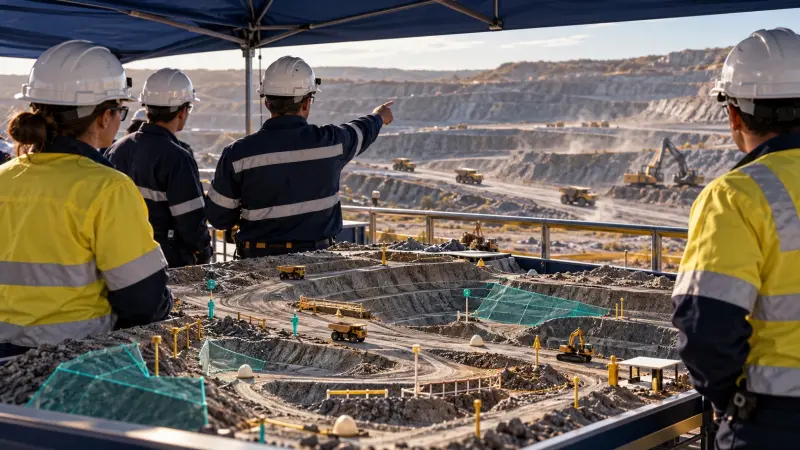
Mining Lifecycle Fundamentals Training Course

Course Details
-
# 1731_229980
-
1 – 5 November 2027 05.Nov.2027
-
Kuala Lumpur
-
5200 €
Overview
Mining Lifecycle Fundamentals Training Course is a one-week foundation course for new mining-sector employees and non-specialist professionals who need an end-to-end view of how mineral projects move from early exploration to closure. Participants connect geological evidence, resource confidence, mine planning, extraction choices, mineral processing, operating controls, environmental responsibilities, and closure decisions in one Mining Lifecycle Decision Map. The course builds practical techno-commercial literacy and better cross-functional questions without preparing participants to perform regulated geological or engineering work. Agile Leaders Training Center delivers this mining lifecycle foundation.
Who Should Attend
- New employees entering mining, minerals, or mine-support organizations
- Finance and investment professionals reviewing mining assumptions and project stages
- Legal, procurement, supply chain, and contract professionals supporting mineral projects
- Government, community, and corporate affairs professionals engaging with mining stakeholders
- Consultants, analysts, and service providers needing shared mining terminology
The course assumes no specialist geology or mining-engineering background and leaves out detailed reserve certification, equipment operation, plant design, blasting design, and professional engineering calculations.
Departments and Industries
The course supports cross-functional teams that interpret mining information, coordinate decisions, or provide services across the mineral value chain.
- Exploration support, mine planning, operations, and mineral processing functions
- Finance, strategy, investment, insurance, and commercial departments
- Legal, contracts, procurement, logistics, and supply chain teams
- Safety, environment, sustainability, community, and corporate affairs functions
- Mining companies, engineering services, equipment suppliers, laboratories, and public institutions
Learning Objectives
By the end of this course, participants will be able to:
- Map the principal stages, decisions, and information flows in a mining lifecycle
- Interpret the purpose of exploration evidence, geological models, and resource confidence
- Compare surface and underground extraction choices at a foundation level
- Explain how comminution, separation, recovery, and tailings fit into mineral processing
- Analyze links among production, safety, environmental controls, cost, and stakeholder needs
- Build a cross-functional decision map for development, operations, closure, and reclamation
Course Agenda
Day 1: Mineral Projects and Exploration Evidence
- Mining Lifecycle Stage Map
- Minerals, Ores, Grades, and Economic Context
- Exploration Methods and Evidence Sources
- Sampling, Data Quality, and Geological Uncertainty
- Exploration Decision-Gate Checklist
Day 2: Resources, Studies, and Mine Development
- Geological Model and Orebody Concept Map
- Resource and Reserve Confidence Ladder
- Study Stages and Development Decision Gates
- Mine Layout, Infrastructure, and Production Assumptions
- Techno-Commercial Assumption Register
Day 3: Extraction and Mine Operations
- Surface and Underground Mining Comparison Matrix
- Drilling, Blasting, Loading, and Haulage Workflow
- Grade Control, Dilution, Recovery, and Reconciliation
- Production Constraints and Operating Interfaces
- Mining Method Decision Question Set
Day 4: Mineral Processing and Product Flow
- Ore-to-Product Process Flow Diagram
- Crushing, Grinding, and Size Reduction Logic
- Separation, Concentration, and Recovery Concepts
- Water, Energy, Tailings, and Waste-Rock Interfaces
- Plant Performance and Recovery Question Board
Day 5: Assurance, Closure, and Integrated Decisions
- Safety and Critical-Control Conversation Guide
- Environmental and Social Interface Map
- Closure, Reclamation, and Post-Closure Responsibilities
- Lifecycle Tradeoff and Stakeholder Review
- Capstone Exercise: Mining Lifecycle Decision Map
Practical Exercises
Participants work with simplified scenarios designed for cross-functional interpretation rather than technical authorization.
- Sequence a mineral project from target generation through closure
- Identify evidence gaps in an exploration and development briefing
- Compare extraction options using operational and commercial questions
- Trace ore, product, water, energy, and waste through a processing flow
- Build a lifecycle decision map with owners, assumptions, controls, and review points
FAQs
Is this mining lifecycle course suitable for non-engineers?
Yes. It is designed for new entrants and cross-functional professionals who need to understand terminology, stages, interfaces, and decision questions without performing specialist calculations.
Does the course teach participants to estimate mineral resources or design mines?
No. It explains the purpose and relationships of geological models, resource confidence, mine planning, extraction, and processing while leaving regulated technical work to qualified specialists.
How are exploration and mineral processing connected?
Exploration evidence shapes the geological model and expected ore characteristics. Those characteristics influence mining assumptions, processing routes, recovery expectations, waste streams, and project decisions.
What practical output do participants complete?
Participants complete a Mining Lifecycle Decision Map linking stages, evidence, assumptions, operating interfaces, controls, stakeholders, and review questions.
Does the course cover mine closure?
Yes. Closure, reclamation, post-closure responsibilities, environmental interfaces, and lifecycle tradeoffs are integrated into the final day and capstone.
Conclusion
Participants leave with a structured view of the mineral value chain and a practical language for discussing exploration, development, extraction, processing, assurance, and closure. Their Mining Lifecycle Decision Map supports clearer briefings, stronger questions, and better coordination with qualified technical specialists.
Data Analytics Training and Data Science Courses
Mining Lifecycle Fundamentals Training Course (1731_229980)
Course Details
# 1731_229980
1 – 5 November 2027
Kuala Lumpur
Fees : 5200 €