Process Measurement, Instrumentation and Control Training Course

Course Details
-
# 1909_242101
-
3 – 7 May 2027 07.May.2027
-
London
-
6500 €
Overview
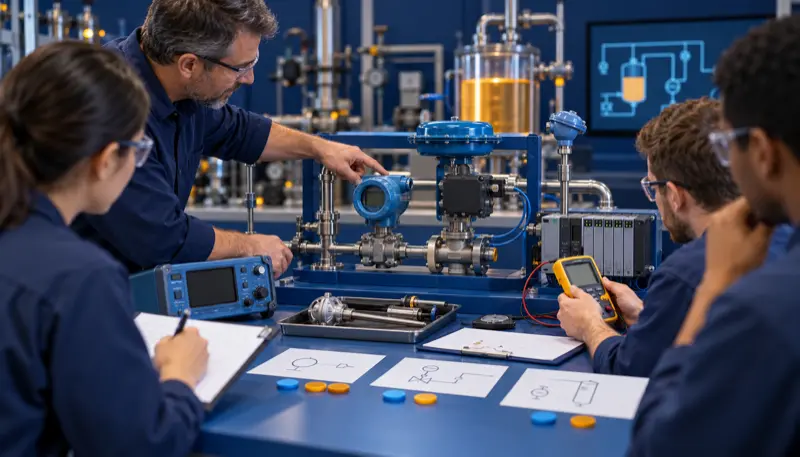
Process Measurement, Instrumentation and Control Training Course is a one-week course for plant professionals who leave with a Measurement and Control Loop Verification Workbook. Participants connect process measurement and instrumentation, pressure temperature level and flow measurement, sensor and transmitter selection, instrument calibration and traceability, and control loop troubleshooting into one field workflow. The course uses diagrams, signal checks, calibration evidence, basic control response, and fault isolation while excluding specialist design depth. Agile Leaders Training Center delivers this course on industrial measurement and control loops.
Who Should Attend
- Teams responsible for selecting, installing, and maintaining process instruments
- Functions responsible for automation signals, controller configuration, and loop performance
- Operations groups responsible for interpreting measurements and responding to process deviations
- Maintenance teams responsible for calibration, testing, and field fault diagnosis
- Engineering groups responsible for instrument documents and equipment interfaces
The course assumes participants can read basic process diagrams and use routine plant procedures, and it leaves out specialist flow-meter design, custody transfer, advanced PID tuning, valve sizing, fieldbus engineering, and safety instrumented systems.
Departments and Industries
The course supports measurement and control work across process plants and industrial utilities.
- Instrumentation, automation, and control engineering
- Operations, maintenance, and reliability departments
- Oil, gas, refining, and chemical processing
- Power generation, water treatment, and utilities
- Food, pharmaceutical, and industrial manufacturing
Learning Objectives
By the end of this course, participants will be able to:
- Analyze measurement requirements for process variables
- Compare sensor and transmitter technologies against service conditions
- Apply signal, range, and calibration checks
- Use P&IDs and loop diagrams to trace instrument functions
- Diagnose basic measurement and control-loop faults
- Build a documented loop verification record
Course Agenda
Day 1: Measurement Foundations and Documentation
- Measurement Accuracy, Precision, Range, and Uncertainty Matrix
- ANSI/ISA-5.1 Instrument Identification and Symbol Method
- Process and Instrumentation Diagram Reading Checklist
- Instrument Data Sheet and Service-Condition Review
- Measurement Chain and Error-Source Map
Day 2: Pressure and Temperature Measurement
- Pressure Reference, Sensing Element, and Installation Selection Guide
- Differential Pressure Application and Impulse-Line Check
- Thermocouple Measurement Principle and Cold-Junction Review
- Resistance Temperature Detector Selection and Wiring Check
- Pressure and Temperature Transmitter Range Worksheet
Day 3: Level and Flow Measurement
- Hydrostatic, Displacer, Radar, and Ultrasonic Level Comparison
- Level Installation Constraint and Error Checklist
- Differential Pressure, Variable-Area, and Velocity Flow Method Map
- Volumetric and Mass Flow Application Screening
- Primary Element and Transmitter Interface Review
Day 4: Signals, Calibration, and Control Loops
- 4–20 mA Signal Path and Scaling Worksheet
- Zero, Span, Linearity, and As-Found Calibration Record
- Metrological Traceability and Calibration Chain Checklist
- Feedback Loop Sensor-Controller-Actuator Function Map
- Basic PID Action and Control-Response Interpretation Guide
Day 5: Loop Verification and Troubleshooting Practice
- Suggested Exercise: Trace an Instrument Loop from Field Device to Controller
- Suggested Exercise: Diagnose a Signal Scaling and Range Mismatch
- Suggested Exercise: Evaluate Calibration Evidence and Measurement Uncertainty
- Suggested Exercise: Isolate Sensor, Wiring, Controller, and Final-Element Faults
- Capstone Exercise: Complete the Measurement and Control Loop Verification Workbook
Practical Exercises
The course uses suggested activities to connect measurement evidence, documents, and operating symptoms.
- Suggested activity: select instruments for defined pressure, temperature, level, and flow services
- Suggested activity: complete a five-point calibration check and classify zero, span, and linearity errors
- Suggested activity: trace a loop diagram and verify signal scaling from field transmitter to display
- Suggested activity: build a fault-isolation record from trends, readings, and inspection evidence
FAQs
Who suits process measurement and instrumentation training, and what does it assume?
Plant engineering, operations, automation, and maintenance personnel suit the course. It assumes basic process-diagram literacy and routine field experience, while specialist metering design and advanced control strategy remain outside scope.
How does process measurement and instrumentation training differ from advanced PID tuning?
Process measurement and instrumentation training integrates sensors, transmitters, signals, calibration, documentation, and basic loop behavior. Advanced PID tuning concentrates on dynamic models, tuning methods, interaction, and advanced control structures.
How are pressure, temperature, level, and flow instruments selected?
Instrument selection starts with the process variable, range, accuracy, fluid properties, pressure, temperature, environment, installation limits, response needs, and maintenance evidence. The selected technology must fit both service conditions and the control purpose.
What does instrument calibration and traceability require?
Calibration compares indications against a suitable reference under documented conditions. Traceability requires a documented, unbroken chain of calibrations to a stated reference, with each step contributing to measurement uncertainty.
How does control loop troubleshooting separate instrument and process faults?
Control loop troubleshooting compares field readings, signal values, controller behavior, final-element response, process trends, and operating context. The evidence isolates whether the symptom originates in sensing, wiring, configuration, actuation, or the process itself.
Conclusion
Participants take back a Measurement and Control Loop Verification Workbook containing selection, signal, calibration, documentation, and diagnostic records. It gives plant teams a repeatable method for checking instruments and tracing loop behavior. The workbook supports clearer fault isolation, maintenance decisions, and communication across operations, instrumentation, and control functions.
Maintenance Training and Engineering Training Courses
Process Measurement and Instrumentation Training Course (1909_242101)
Course Details
# 1909_242101
3 – 7 May 2027
London
Fees : 6500 €