Industrial Servo Motors and Motion Control Training Course

Course Details
-
# 1913_242368
-
5 – 9 July 2027 09.Jul.2027
-
Montreux
-
8000 €
Overview
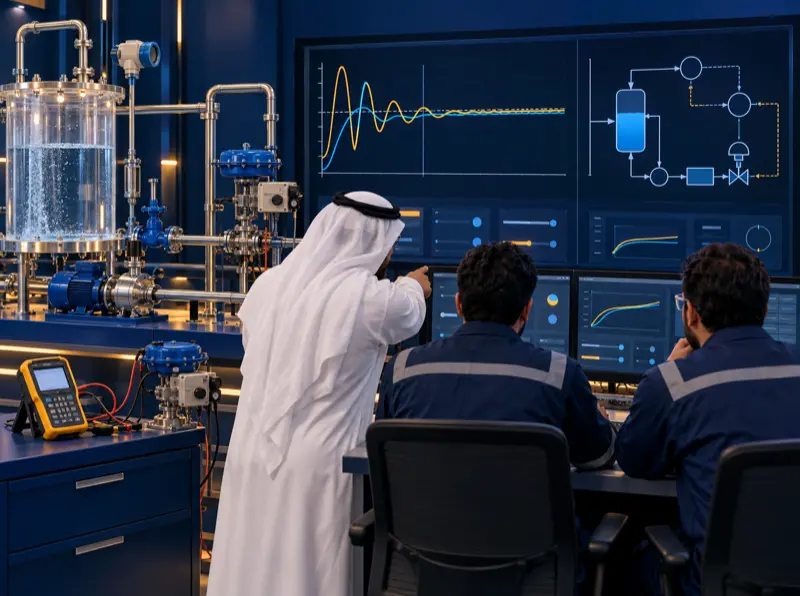
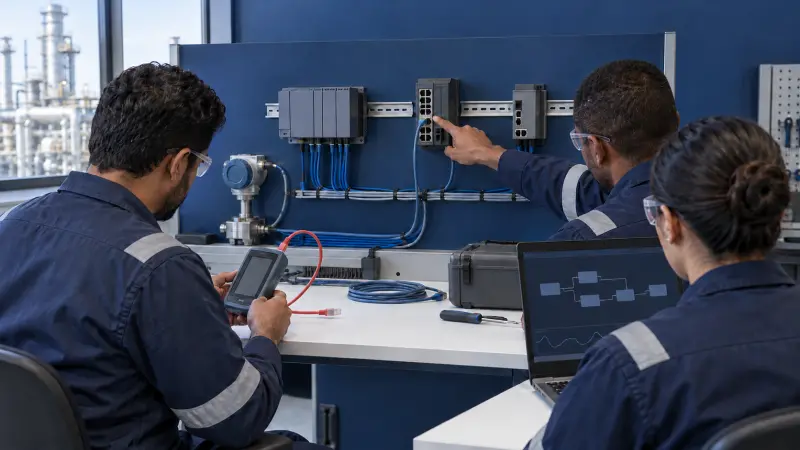
Industrial Servo Motors and Motion Control Training Course is a one-week intermediate course for automation, electrical maintenance, controls, and commissioning teams who leave with a Servo Axis Commissioning and Diagnostic Pack. Participants connect industrial servo motor selection, encoder feedback systems, closed-loop motion control, motion profiles, servo axis tuning, controller integration, and servo drive fault diagnosis. The course separates precision positioning applications from general variable-speed motor systems. Agile Leaders Training Center delivers this course on industrial servo motors and motion control.
Who Should Attend
- Teams responsible for selecting and commissioning servo motors and drives
- Functions responsible for programming and integrating motion-control axes
- Groups responsible for encoder, feedback, and positioning-system diagnostics
- Maintenance teams responsible for alarms, faults, replacement, and recommissioning
- Machine-support functions responsible for motion profiles and production recovery
The course assumes participants can read electrical and control diagrams and work with industrial automation systems, and it leaves out live energized work, vendor certification, and mechanical machine design.
Departments and Industries
The course supports precision-motion work across automated manufacturing and equipment-service environments.
- Automation, controls, and electrical maintenance departments
- Packaging, converting, printing, and material-handling operations
- Robotics, machine building, and assembly-system teams
- Food, pharmaceutical, and electronics manufacturing facilities
- Commissioning, field service, and technical-support functions
Learning Objectives
By the end of this course, participants will be able to:
- Compare servo motor, drive, feedback, and load requirements
- Build position, speed, and torque control-loop maps
- Use motion-profile and axis-configuration records
- Analyze tuning response and mechanical resonance evidence
- Apply controller integration and commissioning checks
- Diagnose alarms, feedback faults, and motion deviations
Course Agenda
Day 1: Servo Axis Architecture and Selection
- Servo Motor, Drive, Controller, and Load Functional Map
- Rotary and Linear Servo Application Selection Matrix
- Torque, Speed, Inertia, and Duty-Cycle Screening Sheet
- Motor, Gearbox, Coupling, and Load Matching Checklist
- Power, Feedback, Brake, and Grounding Connection Diagram
Day 2: Feedback and Closed-Loop Control
- Encoder, Resolver, and Absolute-Feedback Comparison
- Position, Speed, and Torque Loop Block Diagram
- Command, Feedback, Following-Error, and Limit Register
- Homing, Referencing, and Travel-Limit Method
- Signal Scaling, Direction, Polarity, and Resolution Check
Day 3: Motion Profiles and Controller Integration
- Position, Velocity, Acceleration, and Jerk Profile Chart
- Point-to-Point and Synchronized Motion Selection Guide
- Axis Object, Tag, and State-Machine Configuration Record
- PLC and Motion-Controller Command Sequence Map
- Industrial Communication and Axis-Data Verification Plan
Day 4: Tuning, Commissioning, and Diagnostics
- Inertia Estimate and Mechanical-Compliance Review
- Autotuning and Manual-Tuning Decision Method
- Gain, Filter, Resonance, and Response Trace Analysis
- Commissioning Baseline and Acceptance-Test Checklist
- Alarm, Fault, Trace, Backup, and Replacement Workflow
Day 5: Servo Motion Practice
- Suggested Exercise: Select a Servo Axis for a Defined Load
- Suggested Exercise: Configure Feedback and Motion Limits
- Suggested Exercise: Build and Evaluate a Motion Profile
- Suggested Exercise: Diagnose Following Error and Oscillation
- Capstone Exercise: Complete the Servo Axis Commissioning and Diagnostic Pack
Practical Exercises
The course uses suggested activities to connect servo-axis evidence with commissioning and maintenance decisions.
- Suggested activity: compare motor, drive, encoder, gearbox, and load combinations for a positioning duty
- Suggested activity: map position, speed, and torque loops and identify relevant traces
- Suggested activity: adjust a motion profile and evaluate acceleration, jerk, settling, and following error
- Suggested activity: isolate a fault using alarm history, feedback evidence, wiring checks, and response traces
FAQs
Who suits industrial servo motors and motion control training, and what does it assume?
Automation, controls, electrical maintenance, commissioning, and machine-support personnel suit the course. It assumes diagram-reading ability and industrial automation experience while leaving live energized work, vendor certification, and detailed machine design outside scope.
How does servo motion control training differ from AC motor and VFD maintenance?
Servo motion control training focuses on closed-loop position, speed, and torque regulation, precision feedback, motion profiles, axis synchronization, and tuning. AC motor and VFD maintenance concentrates on variable-speed motor operation, electrical condition, protection, and drive faults.
What information is needed for industrial servo motor selection?
Selection uses required torque, speed, travel, precision, duty cycle, inertia, acceleration, load mechanics, environment, brake needs, feedback type, controller compatibility, and available power. The motor, drive, gearbox, coupling, and load must be evaluated as one axis.
How is a servo axis tuned without causing instability?
Tuning starts from verified mechanics, correct feedback, load inertia, safe limits, and a controlled test profile. Response traces then guide gain, filter, feedforward, and profile adjustments while checking oscillation, overshoot, settling, resonance, and following error.
What causes servo drive alarms and positioning errors?
Common causes include feedback loss, wiring or grounding faults, incorrect scaling or polarity, excessive load or acceleration, poor tuning, mechanical binding, resonance, travel-limit activation, communication loss, parameter mismatch, and damaged components.
Conclusion
Participants take back a Servo Axis Commissioning and Diagnostic Pack containing selection evidence, loop maps, axis records, motion profiles, tuning traces, commissioning checks, and fault-isolation steps. It creates a repeatable basis for startup and recovery decisions. The pack supports clearer coordination between automation, maintenance, controls, and machine-service teams.
Maintenance Training and Engineering Training Courses
Industrial Servo Motors and Motion Control Course (1913_242368)
Course Details
# 1913_242368
5 – 9 July 2027
Montreux
Fees : 8000 €
Industrial Servo Motors and Motion Control Training Course runs in Montreux over 5 days, with 1 upcoming date in Montreux. The course fee is 8,000 €.
All dates in Montreux
| Dates | Price | Actions |
|---|---|---|
| 5 – 9 July 2027 | 8,000 € | Register |
Training in Montreux
Experience our top-notch training courses and programs in the vibrant city of Montreux.
All courses in MontreuxThis course in other cities
- Abu Dhabi
- Accra
- Addis Ababa
- Amman
- Amsterdam
- Athens
- Baku
- Bali
- Bangkok
- Barcelona
- Berlin
- Cairo
- Cape town
- Casablanca
- Chicago
- Doha
- Dubai
- Frankfurt
- Geneva
- Istanbul
- Jakarta
- Johannesburg
- Kuala Lumpur
- Kuwait
- Lagos
- Langkawi
- Lisbon
- London
- Madrid
- Manama
- Marbella
- Milan
- Munich
- Muscat
- Nairobi
- New York
- Nice
- Paris
- Phuket
- Porto
- Prague
- Rome
- San Diego
- Seoul
- Sharm El-Sheikh
- Singapore
- Tashkent
- Tbilisi
- Tokyo
- Toronto
- Trabzon
- Vienna
- Zanzibar
- Zoom