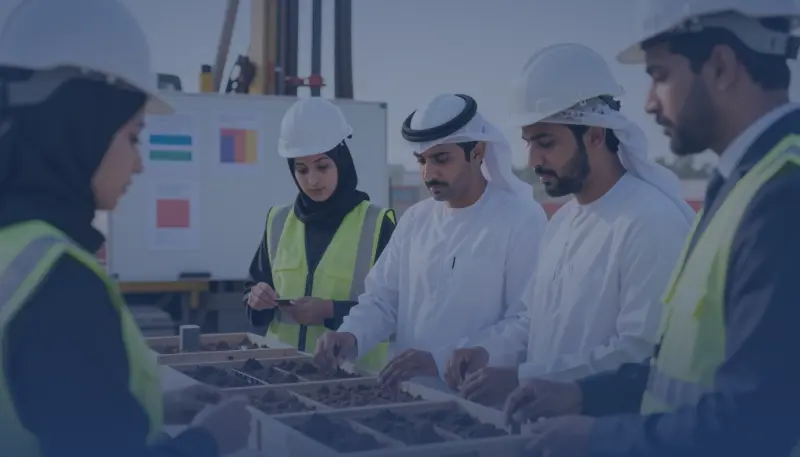
Geotechnical Engineering and Soil Analysis Training Course – Manama, 14–18 Feb 2027

Course Details
-
# 2254_264689
-
14 – 18 February 2027 18.Feb.2027
-
Manama
-
6500 €
This session: 14–18 Feb 2027
This Geotechnical Engineering and Soil Analysis Training Course session in Manama runs from Sunday 14 February to Thursday 18 February 2027 (week 6, Q1 2027). It is the only date in Manama in 2027, at a fee of 6,500 €. Registration is open for this date. It is held in person.
- Dates
- Sunday 14 Feb – Thursday 18 Feb 2027
- Week
- 6 of 2027
- Duration
- 5 days
- Fee
- 6,500 €
- Status
- Open for registration
- Format
- In person
Overview
The Geotechnical Engineering and Soil Analysis Training Course is a one-week course for civil engineers, foundation design specialists, and geotechnical project managers who leave with an engineered foundation design dossier and soil characterization register. Inadequate assessment of problematic ground, miscalculated bearing capacities, and undetected soil volume changes cause severe foundation settlement and structural cracking across industrial and civil developments. This course delivers rigorous design methodologies for laboratory classification, field logging, settlement prediction, and earthwork quality control under SBC 303, ASTM standards, and SAES-A-113 criteria. Agile Leaders Training Center delivers the Geotechnical Engineering and Soil Analysis Training Course.
Who Should Attend
- Civil engineers designing shallow footings, deep pile systems, and earth retaining structures.
- Geotechnical project engineers evaluating borehole logs, electronic piezocone soundings, and laboratory testing data.
- Site preparation managers supervising mass grading, subgrade compaction, and borrow pit earthworks.
- Structural engineers incorporating soil stiffness coefficients, presumptive bearing pressures, and differential settlement tolerances into superstructure models.
- Infrastructure quality managers auditing geotechnical compliance documentation and field testing reports.
The course assumes participants actively evaluate engineering mechanics and interpret civil infrastructure blueprints, leaving out basic soil physics terminology and elementary statics equations.
Departments and Industries
The course draws operational scenarios from industrial infrastructure development and heavy civil construction.
- Civil engineering and structural infrastructure design divisions
- Industrial plant engineering and petrochemical facility construction units
- Commercial building development and geotechnical consulting practices
- Transportation infrastructure, bridge foundation, and highway earthwork divisions
- Municipal utility expansion and heavy ground engineering operations
Learning Objectives
By the end of this course, participants will be able to:
- Apply SBC 303 and ASTM standards to classify field soils using Unified Soil Classification System procedures.
- Analyze Standard Penetration Testing and Cone Penetration Testing soundings to calculate allowable bearing capacities.
- Evaluate laboratory compaction curves against the 95 percent Maximum Dry Density subgrade requirement under ASTM D698.
- Diagnose volumetric expansion hazards in expansive clays and collapse mechanisms in arid collapsible horizons.
- Design shallow strip and pad footings maintaining the mandatory 1.0-meter minimum embedment depth under SBC 201.
- Build an engineered foundation design dossier and soil characterization register for complex ground conditions.
Course Agenda
Day 1: Ground Investigation Frameworks and Soil Classification
- Geotechnical investigation scopes and borehole spacing criteria under SBC 303 Chapter 2
- Unified Soil Classification System laboratory protocols and Atterberg limits determination
- Standard Penetration Testing energy ratios and borehole sampling techniques
- Electronic piezocone penetration testing logging and pore pressure dissipation analysis
- Onshore geotechnical technical submission protocols governed by SAES-A-113 requirements
Day 2: Soil Mechanics, Compaction, and Strength Characterization
- Direct shear testing evaluation and effective shear strength parameters
- Consolidated undrained triaxial compression testing and Mohr-Coulomb failure envelopes
- Moisture-density relationships and compaction verification using ASTM D698 methods
- Field subgrade compaction control reaching 95 percent Maximum Dry Density thresholds
- Lateral earth pressure computation for retaining wall stability assessments
Day 3: Problematic Soils and Ground Risk Mitigation
- Expansive soil identification, swell pressure testing, and chemical stabilization options
- Deep arid collapsible soil mechanics and hydro-collapse settlement estimation
- Sabkha soil geotechnical properties, saline flats geochemistry, and ground improvement solutions
- Sand drift hazards, dune migration risk mitigation, and industrial site grading design
- Borrow pit qualification criteria and structural fill selection under SAES-A-111 guidelines
Day 4: Foundation Design and Settlement Computation
- Presumptive bearing capacity benchmarks for dense sands and cohesive clay strata
- Minimum foundation embedment depth compliance set at 1.0 meter under SBC 201
- Elastic settlement analysis and one-dimensional consolidation settlement estimation
- Single and group pile axial capacity calculations utilizing static analysis methods
- Excavation support design, dewatering impacts, and backfill execution under SAES-A-114
Day 5: Practical Engineering Calculations and Capstone Case
- Suggested activity: Calculate allowable bearing capacity and immediate settlement for shallow footings
- Suggested activity: Evaluate Cone Penetration Testing data to delineate sabkha soil horizons
- Suggested activity: Formulate subgrade compaction test review sheets compliant with ASTM standards
- Suggested activity: Check deep foundation pile load capacities against lateral earth pressure limits
- Capstone exercise: Assemble an engineered foundation design dossier and soil characterization register for an industrial facility
Practical Exercises
The course uses authentic geotechnical borelogs, soil laboratory curves, and foundation layout prints.
- Suggested activity: Interpret triaxial and direct shear test data to establish drained soil parameters.
- Suggested activity: Calculate bearing capacity and footing settlement under SBC 303 design rules.
- Suggested activity: Formulate ground mitigation strategies for collapsible and saline sabkha soils.
- Suggested activity: Review field density tests to verify the 95 percent Maximum Dry Density standard.
FAQs
Who suits the Geotechnical Engineering and Soil Analysis Training Course?
The Geotechnical Engineering and Soil Analysis Training Course suits civil engineers, geotechnical practitioners, and structural foundation designers. The course assumes participants calculate structural loadings and interpret soil mechanics data, leaving out elementary physics concepts and basic surveying operations.
How does this course differ from general site characterization courses?
General site characterization courses focus on borehole drilling logistics and basic sampling methods. The Geotechnical Engineering and Soil Analysis Training Course delivers advanced engineering calculations, foundation bearing capacity determination, laboratory strength interpretation, and specialized design strategies for sabkha and collapsible soils.
What specific soil conditions does the Geotechnical Engineering and Soil Analysis Training Course address?
The Geotechnical Engineering and Soil Analysis Training Course addresses problematic desert and coastal soils, including saline sabkha flats, collapsible arid deposits, and expansive clays, alongside dense sands and bedrock formations governed by SBC 303 guidelines.
What foundation standards does the Geotechnical Engineering and Soil Analysis Training Course utilize?
The Geotechnical Engineering and Soil Analysis Training Course utilizes SBC 303 foundation criteria, SBC 201 minimum embedment guidelines, SAES-A-113 onshore requirements, and relevant ASTM standards for laboratory classification and compaction verification.
Conclusion
Participants return with an engineered foundation design dossier and soil characterization register ready for direct application in capital works. This comprehensive technical package eliminates bearing capacity estimation errors, prevents differential settlement, and ensures earthworks achieve mandatory subgrade compaction thresholds. Adopting these structured engineering practices protects structural integrity and streamlines regulatory approvals across industrial and civil infrastructure projects.
Maintenance Training and Engineering Training Courses
Geotechnical Engineering and Soil Analysis Course (2254_264689)
Course Details
# 2254_264689
14 – 18 February 2027
Manama
Fees : 6500 €
Geotechnical Engineering and Soil Analysis Training Course runs in Manama over 5 days, with 1 upcoming date in Manama. The course fee is 6,500 €.
All dates in Manama
| Dates | Price | Actions |
|---|---|---|
| 14 – 18 February 2027 This session | 6,500 € | Register |
Training in Manama
Experience our top-notch training courses and programs in the vibrant city of Manama, the capital of Bahrain.
All courses in ManamaThis course in other cities
- Abu Dhabi
- Accra
- Addis Ababa
- Amman
- Amsterdam
- Athens
- Baku
- Bali
- Bangkok
- Barcelona
- Berlin
- Cairo
- Cape town
- Casablanca
- Chicago
- Doha
- Dubai
- Frankfurt
- Geneva
- Istanbul
- Jakarta
- Johannesburg
- Kuala Lumpur
- Kuwait
- Lagos
- Langkawi
- Lisbon
- London
- Madrid
- Marbella
- Milan
- Montreux
- Munich
- Muscat
- Nairobi
- New York
- Nice
- Paris
- Phuket
- Porto
- Prague
- Rome
- San Diego
- Seoul
- Sharm El-Sheikh
- Singapore
- Tashkent
- Tbilisi
- Tokyo
- Toronto
- Trabzon
- Vienna
- Zanzibar
- Zoom