H2S Safety Essentials for Oil and Gas Operations
Course Details
-
# 103600630_82133
-
13 – 17 June 2027 17.Jun.2027
-
Manama
-
4700 €
Course Overview:
The H2S Safety Training Course for Oil and Gas Operations is a practical one-week programme designed to strengthen the ability of personnel to recognize, assess, and control hydrogen sulfide hazards across upstream, midstream, downstream, offshore, and refinery environments. Hydrogen sulfide is a colorless, highly toxic, flammable gas that can accumulate in enclosed and low-lying areas. Although its rotten-egg odor may be detected at low concentrations, workers must never rely on smell because H2S can rapidly impair the sense of smell and eliminate this warning mechanism.
This H2S Safety Training combines H2S Awareness Training, Hydrogen Sulfide Hazard Training, H2S Gas Detection Training, H2S Respiratory Protection Training, and H2S Emergency Response Training within one workplace-focused programme. Participants examine where H2S can occur around wellheads, pumps, pipelines, tanks, flare systems, drilling equipment, mud pits, drains, sampling points, valves, seals, and process vessels.
The Hydrogen Sulfide Safety Training also addresses exposure effects, occupational limits, gas-monitor checks, alarm response, wind direction, escape routes, respiratory protection, confined-space precautions, breaking containment, rescue limitations, and first-response priorities.
Target Audience:
- Drilling, production, and well-service personnel
- Refinery, petrochemical, and gas-processing operators
- Offshore platform and rig personnel
- Pipeline, terminal, and storage facility employees
- Mechanical, electrical, and instrumentation technicians
- Maintenance, inspection, and reliability personnel
- HSE officers, safety supervisors, and permit coordinators
- Confined-space entrants, attendants, and entry supervisors
Targeted Organizational Departments:
- Health, Safety, Environment, and Quality
- Drilling and Well Operations
- Oil and Gas Production Operations
- Refinery and Process Operations
- Gas Processing and Sulfur Recovery
- Mechanical and Electrical Maintenance
- Instrumentation and Control
- Inspection, Integrity, and Reliability
- Emergency Response and Fire Services
Targeted Industries:
- Oil and gas exploration and production
- Offshore drilling and platform operations
- Petroleum refining
- Natural gas processing
- Petrochemical and chemical manufacturing
- Pipeline transportation and terminals
- Sulfur recovery and sour gas treatment
- Tank farms and bulk storage facilities
Course Offerings:
By the end of this course, participants will be able to:
- Explain the physical, chemical, toxic, and flammable properties of hydrogen sulfide.
- Identify potential H2S sources across drilling, production, refining, storage, and maintenance activities.
- Interpret H2S concentrations in ppm and relate exposure levels to likely health effects.
- Explain why odor is unreliable as a warning method for H2S Exposure Prevention.
- Distinguish between routine, elevated, and immediately dangerous H2S atmospheres.
- Conduct structured pre-use checks for portable and personal gas detectors.
- Select suitable monitoring approaches for personal, portable, area, and fixed detection.
- Respond correctly to H2S alarms using wind direction, escape routes, and muster arrangements.
- Apply H2S Respiratory Protection Training principles to escape, work, and rescue situations.
Training Methodology:
The H2S Safety Course uses a practical corporate training methodology that connects technical knowledge with field-level decision-making. Instructor-led sessions explain H2S properties, toxicology, exposure pathways, flammability, gas behavior, occupational limits, detection technologies, respiratory protection, confined spaces, escape, and emergency response.
Case studies are used to examine how routine refinery and maintenance activities can become fatal when gas alarms, permits, isolation, monitoring, or protective equipment are ignored. The supporting material includes incidents involving H2S exposure during tower work, unauthorized maintenance, and wastewater sampling, enabling participants to identify both immediate causes and underlying organizational failures.
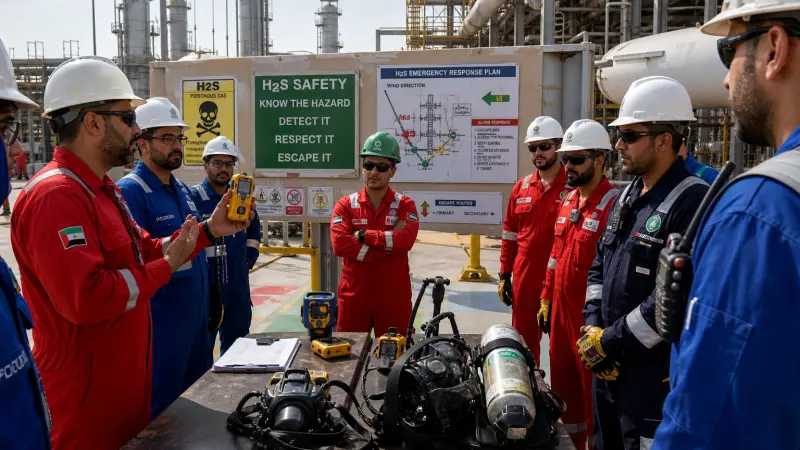
Group exercises require participants to map H2S sources, analyze alarm scenarios, select safe evacuation directions, review detector checks, and assess breaking-containment activities. Demonstrations may illustrate gas-monitor inspection, alarm interpretation, escape equipment, SCBA components, and the sequence for donning respiratory protection. The training reference specifically emphasizes demonstrations of SCBA, portable gas detectors, personal monitors, rescue planning, and explosive-range concepts.
Interactive discussions, scenario simulations, guided incident reviews, and daily feedback sessions reinforce H2S Hazard Awareness. Practical activities are adapted to the client’s procedures, equipment, alarm settings, and emergency plans. Any hands-on use of breathing apparatus or rescue equipment must be supervised by qualified personnel and conducted under approved site procedures.
Course Toolbox:
The course provides professional insights, examples, and reference formats relevant to the subject. Physical equipment and operational tools are not supplied unless separately arranged by the client.
- H2S hazard-identification checklist
- H2S exposure-effects reference chart
- Example H2S area-classification guide
- Gas-monitor pre-use inspection checklist
- Example bump-test and calibration review points
- H2S alarm-response decision guide
- Wind-direction and escape-route planning example
- Respiratory-protection selection considerations
Course Agenda
Day 1: H2S Properties, Sources, and Hazard Recognition
- Topic 1: Introduction to H2S Safety in Oil and Gas Operations
- Topic 2: Physical and Chemical Properties of Hydrogen Sulfide
- Topic 3: Toxicity, Flammability, Solubility, and Vapor Density
- Topic 4: H2S Sources in Drilling, Production, Processing, and Refining
- Topic 5: Common H2S Leak Points and High-Risk Work Areas
- Topic 6: Sour Gas Area Classification, Warning Signs, and Site Controls
- Reflection & Review: Map potential H2S sources, release points, and affected work areas within a typical oil and gas facility.
Day 2: H2S Toxicology, Exposure Limits, and Risk Control
- Topic 1: Routes of Exposure and Effects on the Human Body
- Topic 2: H2S Concentrations, Exposure Duration, and Physiological Effects
- Topic 3: Olfactory Fatigue and the Danger of Relying on Smell
- Topic 4: TWA, STEL, Ceiling Limits, Action Levels, and IDLH Conditions
- Topic 5: H2S Risk Assessment and the Hierarchy of Controls
- Topic 6: Ventilation, Isolation, Restricted Access, and Exposure Prevention
- Reflection & Review: Evaluate an H2S exposure scenario and select suitable engineering, procedural, and personal protective controls.
Day 3: H2S Gas Detection and Atmospheric Monitoring
- Topic 1: Principles and Limitations of H2S Gas Detection
- Topic 2: Personal, Portable, Area, Fixed, and Detector-Tube Systems
- Topic 3: Selecting the Correct Gas Detector for the Work Activity
- Topic 4: Pre-Use Inspection, Bump Testing, Calibration, and Zero Checks
- Topic 5: Atmospheric Testing Before and During Oil and Gas Work
- Topic 6: Alarm Settings, Alarm Interpretation, and Immediate Worker Actions
- Reflection & Review: Complete a gas-monitor selection and pre-use inspection exercise for tank entry, sampling, drilling, and maintenance tasks.
Day 4: Respiratory Protection and High-Risk H2S Work
- Topic 1: Respiratory Hazards and Respirator Selection Principles
- Topic 2: Escape Sets, Supplied-Air Respirators, and SCBA Applications
- Topic 3: SCBA Components, Pre-Use Inspection, and Donning Sequence
- Topic 4: H2S Controls for Confined-Space Entry
- Topic 5: Breaking Containment, Line Opening, Sampling, and Pigging
- Topic 6: Permit-to-Work, Isolation, Gas Testing, and Safety Standby Duties
- Reflection & Review: Develop the minimum control requirements for breaking containment on equipment containing sour gas or H2S-contaminated fluids.
Day 5: H2S Escape, Emergency Response, and Rescue Awareness
- Topic 1: H2S Alarm Activation, Communication, and Incident Escalation
- Topic 2: Escape Routes, Wind Direction, Muster Points, and Accountability
- Topic 3: Immediate Actions During an Uncontrolled H2S Release
- Topic 4: Rescue Limitations and Prevention of Secondary Casualties
- Topic 5: First Response, Casualty Management, and Medical Escalation
- Topic 6: Integrated H2S Emergency Scenario and Response Planning
- Reflection & Review: Apply the complete response sequence to a simulated H2S release involving an alarm, changing wind direction, an exposed worker, and restricted access.
FAQ:
What specific qualifications or prerequisites are needed for participants before enrolling in the course?
No advanced academic qualification is required. Participants should understand their workplace responsibilities and basic site-safety procedures. Personnel expected to conduct atmospheric testing, wear respiratory protection, enter confined spaces, or perform rescue activities should also complete the relevant employer-approved practical training, medical evaluation, fit testing, and competency verification. This course supports H2S Awareness Training and operational knowledge but does not replace site authorization or specialist rescue certification.
How long is each day's session, and is there a total number of hours required for the entire course?
Each day's session is generally structured to last around 4–5 hours, with breaks and interactive activities included. The total course duration spans one week, approximately 20–25 hours of instruction.
Can workers rely on the rotten-egg smell to determine whether an H2S area is safe?
No. H2S may smell like rotten eggs at low concentrations, but continued or high-level exposure can rapidly impair the sense of smell. A worker may therefore stop noticing the odor while the gas remains present at a dangerous or fatal concentration. Safety decisions must be based on approved gas-detection instruments, atmospheric testing, alarm systems, and site procedures—not smell.
How This Course is Different from Other H2S Safety Training Courses:
The H2S Safety Training Course for Oil and Gas Operations goes beyond general Hydrogen Sulfide Training by connecting hazard awareness directly to petroleum operations and workplace decision-making. Rather than treating H2S as only a toxic-gas theory topic, the course examines where personnel can encounter it during drilling, production, processing, storage, tank work, pigging, sampling, maintenance, line opening, wastewater handling, and confined-space entry.
The programme integrates H2S Gas Safety Training with gas detection, exposure control, respiratory protection, permit-to-work, isolation, emergency response, and rescue limitations. Participants examine the operational relationship between dissolved H2S in liquids, vapor-space concentrations, agitation, heating, depressurization, and breaking containment. The training material demonstrates that H2S can be released when contaminated liquids are heated, disturbed, or depressurized, creating exposure levels far above those measured in the liquid itself.
Another distinguishing feature is its emphasis on preventing secondary casualties. The course clearly separates personal escape from technical rescue and reinforces that no person should enter a suspected H2S atmosphere for rescue without suitable respiratory protection, training, backup, and authorization.
Occupational Health, Safety and Security Training Courses
H2S Safety Training Course for Oil and Gas Operations (103600630_82133)
Course Details
# 103600630_82133
13 – 17 June 2027
Manama
Fees : 4700 €