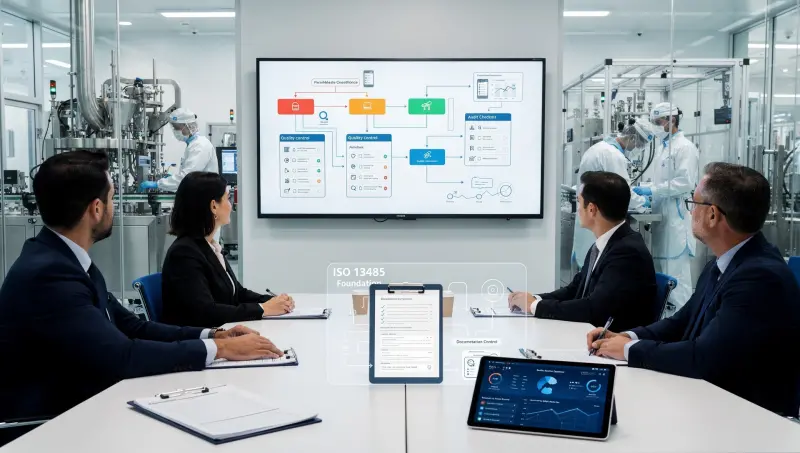
If your team keeps running into audits, certification requirements or supplier questionnaires that ask about "ISO compliance," building ISO Foundation skills is worth it for almost anyone who touches quality, safety or compliance work. It gives people a working map of how a management system standard is put together, what an auditor actually checks, and how to speak the same language as the specialists who run the system day to day. The people who benefit most are team leads, coordinators and new quality or compliance hires who need to get oriented quickly - not necessarily the senior specialists who already manage the system.
Without that grounding, a certification project tends to run on guesswork: people forward documents they hope are correct, brace for an audit instead of preparing for it, and rely on one or two specialists to answer every question. Foundation-level training closes that gap without turning every colleague into a certification expert.
What will you be able to do afterwards?
ISO Foundation training is deliberately narrow in scope. It does not try to turn you into a lead auditor or a systems architect. What it gives you is a practical starting toolkit that holds up across almost any management system standard:
- Read a standard's clause structure and know where to look for a specific requirement, instead of treating the document as a wall of text.
- Tell the difference between a policy, a procedure, a record and a form, and understand why an auditor asks for each one.
- Spot the most common gaps before an external auditor does, from missing document control to unclear process ownership.
- Follow an internal audit from planning through to the closing meeting, and judge what evidence is acceptable.
- Explain, in plain language to a colleague outside the quality function, why the organisation is pursuing certification and what changes for their day-to-day work.
- Support a certification project as it runs, without needing every term in the standard explained to you first.
None of this makes you the person who signs off the management system. It makes you someone who can work alongside that person without slowing the project down, and who can keep things moving when the specialist is not in the room.
Who is it for, and who is it not for?
Foundation-level training fits a specific gap in a team, rather than every role that touches quality or compliance. It tends to work well for:
- Team leads and supervisors who will be asked to maintain records, follow procedures or host an auditor in their area.
- HR, learning and development, and operations coordinators who are organising a certification project but are not specialists in the standard itself.
- New hires in quality, compliance, EHS or regulatory roles who need to get oriented quickly rather than learn everything on the job.
- Managers from other departments who need enough fluency to ask the right questions and avoid slowing a project down with uninformed objections.
It is a weaker fit for people who already lead certification projects, write management system documentation for a living, or carry out audits professionally. For that group, foundation material repeats what they already know, and the time is better spent on an implementer or lead auditor level course built for people who own the system, not just work alongside it.
Why does the same "Foundation" label cover so many industries?
Management system standards share a common backbone: context, leadership, planning, support, operation, performance evaluation and improvement. Once a person understands that structure in one standard, recognising it in another is far faster. That is why foundation training exists across so many sectors rather than only in manufacturing, and why the skill transfers more easily than people expect.
A quality team studies the ISO 9001 Foundation Training Course: Quality Management System (QMS) Certification to understand how a quality management system controls processes, documentation and continual improvement across almost any sector. A medical device manufacturer leans on the ISO 13485 Foundation Training Course Medical Device for the product lifecycle controls that regulators expect, from design through to post-market activity. A food producer or distributor works through the ISO 22000 Foundation Food Safety Certification Training Course to connect hazard analysis and operational controls across a supply chain. A school or training provider turns to the ISO 21001 Foundation Training for Educational Organizations to put learner satisfaction and governance into a single framework. A testing or calibration laboratory uses the ISO/IEC 17025 Foundation Certification Course to understand the technical records and competence requirements behind a defensible result.
The industries differ; the reasoning skill - read the clause, find the requirement, connect it to a real process - does not.
How do these skills play out on a typical workday?
Picture a quality coordinator who has just finished foundation training and is told an external audit is coming. Before the course, "getting ready" meant forwarding emails and hoping the right folders existed. Afterwards, the same person can map the standard's clauses against the department's actual documents, flag the areas where records are thin, and brief colleagues on what an auditor is likely to ask and why. None of that requires rewriting the management system; it requires recognising structure and gaps, which is exactly what foundation-level training targets.
The same pattern repeats in a laboratory preparing a competence file, a school documenting how it reviews learner feedback, or a food business tracing a control point back to its hazard analysis. The specific content changes from sector to sector; the habit of mapping a real process against a standard's requirements is the transferable part.
What should a team lead check before enrolling someone?
Before putting someone forward for ISO Foundation training, it helps to be clear about what the role actually needs:
- Will this person maintain documents and records, or host auditors, as part of their job? If yes, foundation training is a reasonable investment.
- Does the team already have a specialist who owns the management system? If so, foundation training is about giving other people enough fluency to support that person, not replace them.
- Is the goal to prepare someone for an auditing or implementer role later? If so, foundation training is a sensible first step, but plan for a more advanced course afterwards rather than treating foundation level as the finish line.
- Does the person need to understand one standard deeply, or several standards across different sites or product lines? The underlying structure is similar, which makes it realistic to build on a first foundation course rather than starting from zero each time.
Bottom line: building ISO Foundation skills is worth it when a role touches documentation, audits, supplier questionnaires or a certification project, and the person currently relies on guesswork to get through them. It is less useful for someone who already runs a management system professionally, where a more advanced course is the better investment. Check the course page for the full syllabus, upcoming dates and fees.
Frequently asked questions
Do I need a quality or compliance background to take ISO Foundation training?
No. Foundation courses are built for people who are new to the standard, including team leads, coordinators and new hires who need to get oriented quickly rather than learn everything on the job.
Does ISO Foundation training qualify someone to run audits on their own?
No. It builds understanding of a standard's structure and requirements; auditing roles typically call for dedicated internal or lead auditor training built specifically for that purpose.
Can one person cover several ISO standards, or should training stay industry-specific?
Because management system standards share a common structure, understanding one foundation course makes it faster to pick up another. Many teams start with the standard closest to their core risk and add others as the need arises.
What is the difference between ISO Foundation and implementer-level training?
Foundation training introduces a standard's structure and vocabulary. Implementer-level training goes further into building and maintaining the management system itself, which suits people who will own that responsibility.
How do I know if my team actually needs this training?
If people are already fielding audit, certification or supplier questions and relying on guesswork, that is usually the signal. If a specialist already owns the management system confidently, foundation training adds less value.