The verdict: reliability performance improves when teams manage the causes and consequences of failure, not simply the volume of maintenance work.
The greatest benefit goes to maintenance and reliability engineers, planners, supervisors, operations leaders and asset managers who share responsibility for equipment performance.
A busy maintenance team can still deliver weak reliability. Technicians may close many work orders while recurring defects continue, planners may build full schedules around low-consequence tasks, and managers may buy monitoring technology before deciding which failure modes matter. The result is effort without a clear link to asset risk.
Better performance starts with a common decision process. The team identifies critical assets, defines important failure modes, chooses a suitable maintenance response, prepares executable work and checks whether the response changed the outcome. This is less dramatic than launching a new initiative, but it creates repeatable control.
What will you be able to do afterwards?
- Separate symptoms from failure modes and underlying causes when reviewing recurring equipment problems.
- Rank assets by operational consequence instead of giving every item the same maintenance priority.
- Use condition information, work history and operating context to select preventive, predictive or corrective actions.
- Apply root cause analysis and failure mode thinking without turning every investigation into a long technical exercise.
- Improve job plans by defining scope, resources, parts, access needs and completion criteria before work begins.
- Discuss reliability indicators alongside safety, production, quality and lifecycle consequences.
- Challenge maintenance tasks that consume effort but do not address a credible failure mechanism.
- Build a review loop that compares expected results with actual equipment behaviour.
Who is it for, and who is it not for?
This subject fits engineers, maintenance planners, condition-monitoring specialists, supervisors and operational managers who influence asset decisions. It is especially relevant where failures repeat, planned work is often displaced by urgent work, or different departments disagree about priorities. It also helps leaders who need to turn technical findings into a practical improvement roadmap.
It is not only for people with reliability in their job title. Operators often see changing equipment behaviour first, stores teams influence part availability, and production planners shape the windows in which maintenance can be completed properly. A shared method helps these roles contribute evidence instead of opinion.
It is not a quick fix for an organisation that will not protect planned work, record useful failure information or act on known defects. Training cannot compensate for absent ownership. It is also more depth than needed for someone whose role has no connection to physical assets, maintenance processes or operational performance.
Why does reacting faster fail to solve recurring problems?
Consider a pump that repeatedly trips. The team restores it quickly each time and celebrates the short response. Yet the record only says that the pump stopped and was restarted. No one captures the operating condition, verifies the failure mode or checks whether an earlier repair introduced a defect. Response speed hides recurrence.
A stronger review starts by defining what happened, what should have happened and what evidence is available. The team distinguishes a failed component from the condition that caused it to fail. It then assigns an action that can be verified, such as correcting an operating practice, improving alignment, changing an inspection task or redesigning a weak point.
The Certified Reliability & Performance Professional (CRPP) supports professionals who need deeper analytical grounding across the asset lifecycle, including probability distributions, statistical analysis, Weibull and RAM analysis, replacement strategies and maintenance planning. That depth is useful when decisions depend on interpreting real failure data rather than applying generic checklists.
How does a team stop measuring activity instead of risk?
A common mistake is to treat high schedule completion, a large preventive maintenance programme or a low work-order backlog as proof of reliability. These measures describe work flow, but they do not show whether the right failure risks are being controlled. A team can complete every easy task while a critical defect waits for access or parts.
Begin with asset criticality and the consequences that matter. Then connect each important failure mode to a control: an operating standard, a condition check, a planned replacement, a redesign or an accepted run-to-failure decision. Measures should help managers see whether those controls are healthy and whether recurring losses are declining qualitatively.
Asset Reliability & Maintenance Technology Essentials is relevant when the need spans maintenance planning, predictive techniques, condition monitoring, reliability-centred maintenance, criticality, FMEA, root cause analysis and asset management technology. It suits teams seeking a practical link between daily work management and lifecycle performance.
What happens when technology comes before the failure strategy?
Imagine installing sensors across a plant because predictive maintenance is a stated goal. Data begins to arrive, but alert limits are unclear, ownership is uncertain and some monitored assets have little operational consequence. Analysts produce warnings that planners cannot convert into executable work. Trust in the system falls.
The fix is to start with the decision. Identify the failure mode, decide whether it develops in a detectable way, determine how much response time is needed and define who will act. Only then select the monitoring technique and integrate the alert with planning and scheduling. Technology should strengthen a defined process, not substitute for one.
The The Certified Maintenance & Reliability Professional CPD Training Course connects asset governance, failure-data modelling, reliability-centred methods, Weibull analysis, precision maintenance, work management and spare-parts optimisation. It is a better fit for practitioners who need to align reliability practices with wider business and operational goals.
How can managers make improvement stick?
Reliability work fails when actions live in a presentation rather than the work system. Every recommendation needs an owner, an executable task and evidence of completion. A modified inspection should appear in the maintenance plan. A design change should have technical approval and a clear acceptance test. A changed operating practice should be understood by the people who run the equipment.
Managers should review a small set of recurring losses and overdue risk actions with maintenance and operations together. The conversation should ask whether the failure mode is understood, whether the chosen control is working and what barrier prevents completion. This keeps attention on decisions rather than blame.
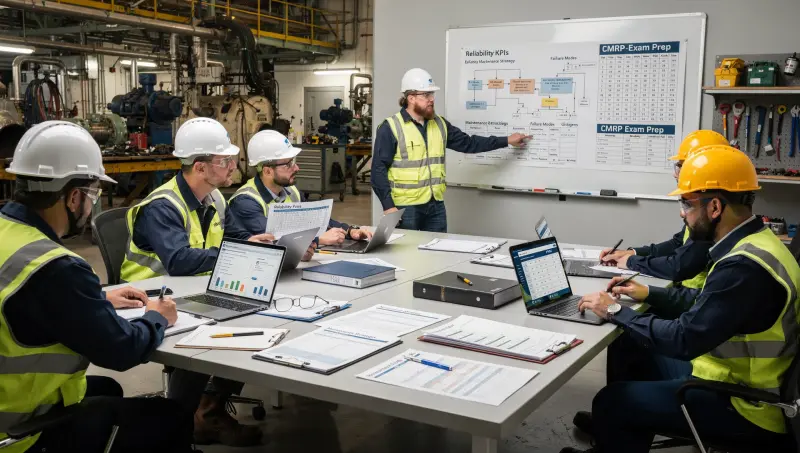
CMRP Exam Prep: Maintenance and Reliability Professional Training Course is appropriate for professionals who want structured coverage of business and management, manufacturing process reliability, equipment reliability, leadership and work management while connecting those areas to practical maintenance decisions.
Bottom line
Reliable assets come from sound priorities, usable data, disciplined work and a feedback loop shared by maintenance and operations. Fix the decision process before adding more tasks or technology. Check the course page for the full syllabus, upcoming dates and fees.
Frequently asked questions
What data should a reliability team improve first?
Start with asset identity, failure mode, operating context, work performed and the evidence that confirmed completion. Consistent, useful fields are more valuable than a large record filled with vague descriptions.
Is preventive maintenance always better than corrective maintenance?
No. The appropriate tactic depends on the failure mechanism, consequence, detectability and economics of intervention. Some items need condition monitoring, some need planned replacement, some need redesign and others can be allowed to fail.
How should maintenance and operations divide responsibility?
Maintenance owns work quality and technical execution, while operations controls much of the operating context and early defect detection. Reliability improves when both functions share asset priorities, evidence and follow-through.
When is root cause analysis worth the effort?
Use it for significant, recurring or poorly understood losses where learning can change a decision. A proportionate review is usually more useful than applying the same elaborate method to every minor event.
Can exam preparation also improve workplace performance?
It can when participants connect the knowledge areas to live asset decisions and work processes. Memorising concepts alone is not enough; managers should assign practical applications and review the results.