Every year, organisations spend serious money on training, yet few can say with confidence what changed as a result. Courses get booked, seats fill up, certificates get issued — and months later, nobody can point to a skill gap that actually closed. The problem is rarely a lack of effort. It is that training needs, competencies and delivery are usually managed as three separate activities instead of one connected system.
What does it mean to build workforce capability?
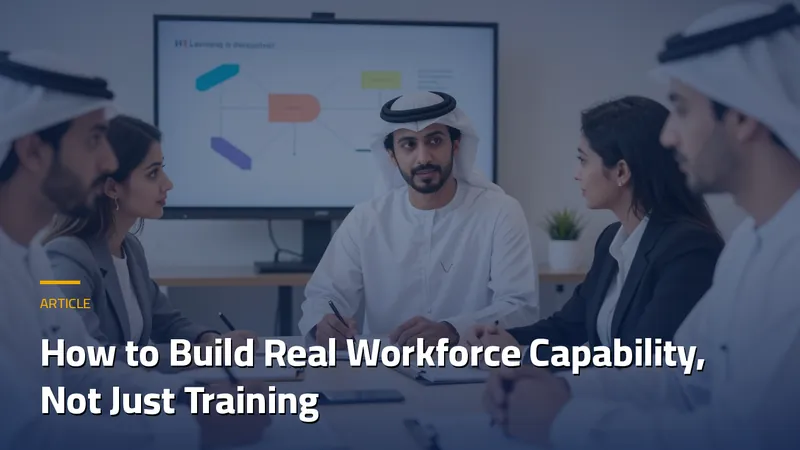
Workforce capability is not the same as a training calendar. It is the ability of your people, individually and collectively, to do the work your organisation actually needs done — now and as requirements shift. Building it means three things happening together: finding out where the real gaps are, defining what "good" looks like for each role, and turning that insight into development that is managed, resourced and measured like any other business initiative.
When these three pieces are handled separately, the usual result is a training plan built on assumptions, a competency framework nobody consults, and development activity that cannot be tied to any business outcome. When they are connected, HR stops reacting to requests and starts building capability on purpose.
What skills does a capability-building approach require?
Turning this from an idea into a repeatable practice draws on a specific set of skills:
- Training needs analysis – diagnosing performance gaps at individual, team and organisational level instead of relying on whoever asks loudest for a course.
- Competency framework design – describing the knowledge, skills and behaviours a role actually requires, so development has a target to aim at.
- Competency mapping – comparing current capability against that target to see where the gaps are largest and most urgent.
- Strategic HR planning – aligning workforce development with where the organisation is headed, not just where it has been.
- Workforce analytics – using data on performance, retention and engagement to test whether development is actually working, rather than assuming it is.
- Project management for HR initiatives – giving development work a scope, an owner, a timeline and a way to measure success, the same discipline applied to any other project.
None of these skills is exotic on its own. What is rare is finding them applied together, in sequence, by the same team.
Who should lead this work, and who shouldn't?
This work sits naturally with HR managers and HR business partners who are tired of running training that nobody can defend in a budget review, and with learning and development specialists who own the plan but not always the proof that it worked. It also suits line managers who want a clearer way to assess and grow their own team's skills, and HR project leads specifically tasked with a capability or reskilling initiative.
It is less useful for someone whose role is purely transactional HR administration, with no influence over what training gets commissioned or how it is evaluated. If you cannot act on what a needs analysis or a competency gap tells you, the analysis alone will not change much.
How does this play out in a real HR team?
Picture an HR business partner who has just been told that a business unit's customer complaints have risen and that "more training" is the requested fix. Instead of booking a generic course, a capability-building approach starts with a proper training needs analysis: is this a skills gap, a process problem, or a staffing issue? If it is a skills gap, the next step is checking it against a competency framework for that role — is the gap in product knowledge, in communication, or in problem-solving under pressure?
Only once that is clear does development get designed, and it gets managed as a project: a defined scope, a named owner, a start and end point, and a way to measure whether complaints actually fall afterwards. That is the difference between training as an event and capability as an outcome — and it is also where Workforce Capability: Training, Competencies & HR Projects is built to help, walking HR teams through needs analysis, competency design and project-based delivery as one connected method.
For HR teams whose responsibilities stretch beyond this core method, the surrounding skill set matters too. Strategic HR Management: Optimize Workforce through Planning and Audit focuses on aligning the wider HR function, including workforce planning and succession, with business strategy — useful once capability building needs to scale across an organisation rather than one business unit. SHRM HR Analytics: Strategic Workforce Decisions goes deeper into the measurement side, helping HR professionals use workforce data to test whether development initiatives are actually changing outcomes rather than just being delivered. And for teams working specifically in social and community service settings, Behavioral Competencies Development for Social Service Professionals (2 week) applies the same competency-mapping logic to the behavioural skills that role in particular depends on.
How do you know it is working?
The clearest sign that a capability-building approach is working is not attendance figures. It is whether you can point to a specific gap that existed some time ago and explain, with evidence, how it closed. That might be a competency that used to be missing across a team and is now consistently demonstrated, a role that used to need constant hand-holding and now runs independently, or a reskilling initiative that hit its scope and timeline the way any other project would be expected to.
If those answers are hard to produce today, that is usually not a sign that your people are the problem. It is a sign that needs analysis, competency design and project discipline are not yet working together as one system.
Bottom line
Capability building is not a bigger training budget; it is a tighter connection between diagnosing gaps, defining standards and managing development as work that gets finished and measured. Getting that connection right turns HR from a department that books courses into one that can show, gap by gap, what changed. Check the course pages linked above for the full syllabus, upcoming dates and fees.
Frequently asked questions
What is the difference between a training needs analysis and a normal training request?
A training request is usually one person's guess at a fix. A training needs analysis is a structured diagnosis of the actual performance gap, at individual, team or organisational level, before any development is designed.
How is a competency framework different from a job description?
A job description lists tasks and duties. A competency framework describes the knowledge, skills and behaviours needed to perform those tasks well, which makes it far more useful for assessing and developing people.
Do small HR teams need a formal capability-building process?
The scale can be smaller, but the logic still helps: even a light needs analysis and a simple way to track whether a gap closed will show more than running training on request alone.
How long does it take to see results from a capability-building approach?
It depends on the size of the gap and how it is managed as a project, but treating development as a project with a clear scope and end point is what makes the timeline visible in the first place.
Can line managers use these methods without HR leading the process?
Line managers can apply the same logic, needs analysis, a clear standard, and a time-bound plan, to their own team, though aligning it with a wider competency framework usually works best in partnership with HR.