Employee Experience Measurement and Improvement Training Course
Course Overview:
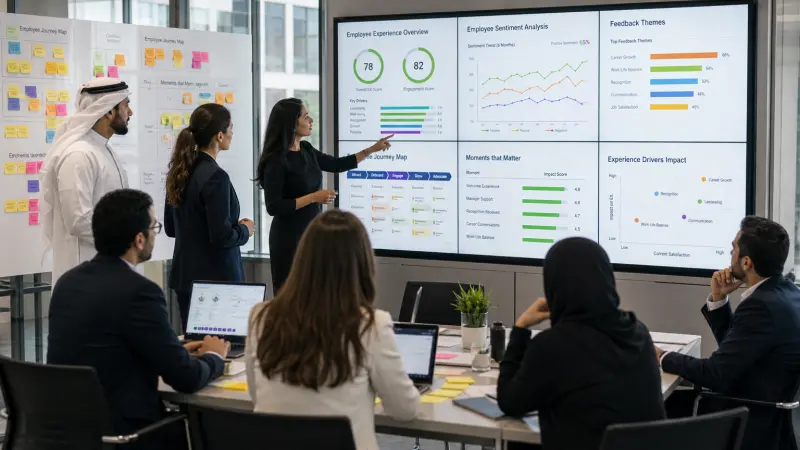
The Employee Experience Measurement and Improvement Training Course provides HR professionals and managers with practical methods for measuring, analysing, and improving employee experience across the full employee lifecycle. Participants will learn how to develop an Employee Experience Strategy, design an Employee Experience Survey, build an Employee Listening Strategy, and use Employee Experience Analytics to identify workplace strengths and experience gaps. The course covers Employee Journey Mapping, Employee Experience Metrics, Employee Feedback Analytics, Employee Sentiment Analysis, benchmarking, dashboards, and improvement planning.
The programme moves beyond annual engagement surveys by examining broader factors such as belonging, purpose, achievement, well-being, inclusion, leadership, recognition, growth, technology, and work-life balance. The Employee Experience Index framework includes belonging, purpose, achievement, happiness, and vigor. Through practical activities, participants will convert workforce feedback into clear priorities and Employee Experience Action Plans. The course supports organizations seeking a structured, data-driven approach to Continuous Employee Listening, Workplace Experience Improvement, and sustainable Employee Experience Management.
Target Audience:
- HR Directors and HR Managers
- Employee Experience Managers
- HR Business Partners
- People Analytics Professionals
- Employee Engagement Specialists
- Organizational Development Professionals
- Talent Management Managers
- Internal Communication Professionals
- Learning and Development Managers
- Department Heads and People Managers
Targeted Organizational Departments:
- Human Resources
- Employee Experience and Engagement
- People Analytics
- Organizational Development
- Talent Management
- Learning and Development
- Internal Communication
- Diversity and Inclusion
- Strategy and Performance
- Digital HR and Transformation
Targeted Industries:
- Banking and financial services
- Healthcare and pharmaceuticals
- Government and public services
- Energy and petrochemicals
- Technology and telecommunications
- Manufacturing and engineering
- Retail and hospitality
- Aviation and logistics
- Education
- Professional services
Course Offerings:
By the end of this course, participants will be able to:
- Distinguish employee experience from engagement and satisfaction.
- Develop an Employee Experience Strategy.
- Map the complete employee lifecycle.
- Identify employee moments that matter.
- Design an Employee Listening Strategy.
- Develop effective employee surveys and pulse surveys.
- Select relevant Employee Experience Metrics.
- Apply Employee Feedback Analytics.
- Interpret Employee Sentiment Analysis.
- Build an Employee Experience Index.
- Apply Employee Experience Benchmarking.
- Design an Employee Experience Dashboard.
Training Methodology:
The course uses short presentations, case studies, group exercises, discussions, and practical workplace scenarios. Participants will review survey questions, analyse employee feedback, develop employee journey maps, identify moments that matter, and select suitable listening channels. Group activities will cover Employee Experience Analytics, dashboard design, sentiment interpretation, experience-gap analysis, and action planning. Design-thinking exercises will help participants understand employee needs and develop practical workplace improvements. Daily feedback and review sessions will allow participants to refine their Employee Experience Strategy, measurement approach, and improvement priorities. The methodology follows a practical cycle of listening, understanding, acting, communicating, and reviewing results.
Course Toolbox:
Participants will receive insights and examples covering:
- Employee Experience Strategy framework
- Employee lifecycle map
- Employee Journey Mapping example
- Employee Listening Strategy framework
- Survey design checklist
- Listening-channel matrix
- Employee Experience Metrics guide
- Employee Experience Index example
- Feedback-analysis structure
Course Agenda:
Day 1: Employee Experience Strategy and Measurement
- Topic 1: Understanding employee experience, engagement, and satisfaction
- Topic 2: Business value of Employee Experience Improvement
- Topic 3: Employee Experience Management principles
- Topic 4: Building an Employee Experience Strategy
- Topic 5: Employee Experience Measurement frameworks
- Topic 6: Selecting Employee Experience Metrics
- Reflection & Review: Assessing the organization’s current employee experience approach
Day 2: Employee Listening and Feedback Collection
- Topic 1: Building an Employee Listening Strategy
- Topic 2: Continuous Employee Listening approaches
- Topic 3: Designing an Employee Experience Survey
- Topic 4: Pulse surveys, interviews, and focus groups
- Topic 5: Listening across the employee lifecycle
- Topic 6: Trust, confidentiality, and survey follow-up
- Reflection & Review: Developing an employee listening plan
Day 3: Employee Journey Mapping and Analytics
- Topic 1: Employee Lifecycle Management
- Topic 2: Employee Journey Mapping
- Topic 3: Identifying moments that matter
- Topic 4: Employee Feedback Analytics
- Topic 5: Employee Sentiment Analysis
- Topic 6: People Analytics for Employee Experience
- Reflection & Review: Analysing employee journey gaps and feedback themes
Day 4: Experience Index, Benchmarking, and Dashboards
- Topic 1: Building an Employee Experience Index
- Topic 2: Outcome measures and experience drivers
- Topic 3: Workforce Experience Analytics segmentation
- Topic 4: Employee Experience Benchmarking
- Topic 5: Employee Experience Dashboard design
- Topic 6: Communicating employee experience findings
- Reflection & Review: Creating a practical dashboard structure
Day 5: Employee Experience Improvement and Action Planning
- Topic 1: Diagnosing employee experience gaps
- Topic 2: Employee Experience Design principles
- Topic 3: Prioritizing workplace improvements
- Topic 4: Employee Experience Action Planning
- Topic 5: The manager’s role in Employee Experience Improvement
- Topic 6: Sustaining the Employee Experience Program
- Reflection & Review: Presenting an employee experience improvement plan
FAQ:
What specific qualifications or prerequisites are needed for participants before enrolling in the course?
No formal qualifications are required. Experience in HR, employee engagement, organizational development, people analytics, internal communication, or people management is helpful.
How long is each day's session, and is there a total number of hours required for the entire course?
Each day's session is generally structured to last around 4–5 hours, with breaks and interactive activities included. The total course duration spans five days, approximately 20–25 hours of instruction.
Is employee experience measurement the same as an annual engagement survey?
No. Engagement surveys measure one part of the workforce experience. Employee Experience Measurement also covers the employee lifecycle, expectations, well-being, inclusion, technology, leadership, development, recognition, and workplace processes.
How This Course is Different from Other Employee Experience Courses:
This course combines Employee Experience Measurement, Employee Journey Mapping, employee listening, analytics, dashboard design, and action planning in one practical programme. Rather than focusing only on engagement surveys, participants learn how to connect employee feedback with lifecycle touchpoints, workforce data, experience drivers, and organizational outcomes. The course also distinguishes employee experience from culture, satisfaction, and engagement. Participants practise converting survey data and employee comments into priorities, dashboards, and Employee Experience Action Plans. The result is a structured approach for listening to employees, identifying experience gaps, implementing improvements, and measuring progress.
credits: 5 credit per day
Course Mode: full-time
Provider: Agile Leaders Training Center
-
Events for this Course
-
Istanbul 21 - 25 Sep 2026
-
Abu Dhabi 21 - 25 Sep 2026
-
Kuala Lumpur 28 Sep - 02 Oct 2026
-
Amsterdam 05 - 09 Oct 2026
-
Casablanca 19 - 23 Oct 2026
-
Cairo 09 - 13 Nov 2026
-
Paris 16 - 20 Nov 2026
-
Abu Dhabi 16 - 20 Nov 2026
-
Dubai 23 - 27 Nov 2026
-
Kuala Lumpur 30 Nov - 04 Dec 2026
-
Seoul 30 Nov - 04 Dec 2026
-
Athens 07 - 11 Dec 2026
-
Milan 14 - 18 Dec 2026
-
Manama 20 - 24 Dec 2026
-
Barcelona 21 - 25 Dec 2026
-
Jakarta 29 Dec 2026 - 02 Jan 2027
-
Prague 26 - 30 Jan 2027
-
London 02 - 06 Feb 2027
-
Abu Dhabi 02 - 06 Feb 2027
-
Dubai 09 - 13 Feb 2027
-
Manama 22 - 26 Feb 2027
-
Istanbul 02 - 06 Mar 2027
-
Barcelona 16 - 20 Mar 2027
-
Baku 16 - 20 Mar 2027
-
Tokyo 23 - 27 Mar 2027
-
Vienna 30 Mar - 03 Apr 2027
-
Madrid 06 - 10 Apr 2027
-
Amsterdam 20 - 24 Apr 2027
-
Milan 20 - 24 Apr 2027
-
Cape town 26 - 30 Apr 2027
-
Zoom 27 Apr - 01 May 2027
-
Rome 04 - 08 May 2027
-
Sharm El-Sheikh 11 - 15 May 2027
-
Dubai 18 - 22 May 2027
-
Kuwait 24 - 28 May 2027
-
Johannesburg 07 - 11 Jun 2027
-
London 08 - 12 Jun 2027
-
Paris 15 - 19 Jun 2027
-
Amsterdam 22 - 26 Jun 2027
-
Madrid 22 - 26 Jun 2027
-
Doha 28 Jun - 02 Jul 2027
-
Tbilisi 29 Jun - 03 Jul 2027
-
Amman 12 - 16 Jul 2027
-
Abu Dhabi 27 - 31 Jul 2027
-
Dubai 10 - 14 Aug 2027
-
Muscat 16 - 20 Aug 2027
-
Vienna 17 - 21 Aug 2027
-
London 24 - 28 Aug 2027
-
Cairo 31 Aug - 04 Sep 2027
-
Rome 07 - 11 Sep 2027
