Gas Transmission Pipeline Design Training Course

At a glance
- Duration
- 1 Week
- Format
- Classroom
- Cities
- Sharm El-Sheikh, Abu Dhabi, London, Milan, Toronto, Madrid and more
- Next session
- 2 – 6 November 2026, Sharm El-Sheikh
- Average fee
- 7,500 €
Overview
Gas Transmission Pipeline Engineering and Network Design Course is a one-week professional course for engineers who plan, size and assure high-pressure gas transmission systems. Participants connect design basis, demand cases, hydraulic behaviour, route constraints, line-pipe selection, station interfaces, operability and integrity requirements. They leave with a Gas Transmission Network Design Basis and Assurance Package that records assumptions, calculations, interfaces and review evidence. Agile Leaders Training Center develops practical capability in gas transmission pipeline and network design.
Who Should Attend
- Pipeline engineers responsible for gas transmission system design
- Network designers and hydraulic modelling engineers
- Project engineers coordinating route, mechanical and station interfaces
- Integrity and corrosion engineers contributing to design decisions
- Technical managers reviewing pipeline design deliverables
The course assumes familiarity with engineering calculations and pipeline terminology. It excludes detailed compressor machinery design, construction supervision, distribution service networks and routine maintenance planning.
Departments and Industries
The course supports organisations that develop, expand or review high-pressure gas transmission infrastructure.
- Gas transmission and midstream operations
- Energy infrastructure development and engineering
- Engineering, procurement and construction organisations
- Independent design assurance and technical consulting
- Industrial gas supply and large energy-user networks
Learning Objectives
By the end of this course, participants will be able to:
- Develop a traceable design basis and code applicability matrix
- Build demand, flow and pressure cases for pipeline hydraulic analysis
- Evaluate route corridors, crossings, class locations and geohazards
- Select diameter, line-pipe grade and wall thickness for defined cases
- Integrate compressor, metering, regulation and isolation requirements
- Apply integrity-by-design, operability and design assurance reviews
Course Agenda
Day 1: Design Basis and System Definition
- Gas Transmission System Boundary and Functional Map
- Applicable Codes, Standards and Project Requirements Matrix
- Supply, Demand and Operating Scenario Register
- Design Pressure, Temperature and Gas Property Basis
- Design Assurance Roles and Deliverable Register
Day 2: Hydraulic Analysis and Network Configuration
- Steady-State Flow and Pressure Case Definition
- Gas Property and Compressibility Inputs
- Diameter, Velocity and Pressure-Loss Assessment
- Looping, Branching and Network Configuration Comparison
- Hydraulic Model Assumption and Sensitivity Register
Day 3: Route, Materials and Mechanical Design
- Route Corridor, Crossing and Constraint Register
- Class Location and Design Factor Assessment
- Line-Pipe Grade and Product Specification Selection
- Wall-Thickness, Corrosion Allowance and Pressure Check
- Fracture Control, Stability and Geohazard Design Inputs
Day 4: Stations, Operability and Integrity by Design
- Compressor, Metering and Regulation Station Interface Map
- Valve Spacing, Isolation and Emergency Segmentation Review
- Pigging, Venting, Blowdown and Maintenance Access Provisions
- Corrosion Control and Integrity Threat Register
- Safety Studies, Safeguards and Operability Review Checklist
Day 5: Integrated Design Assurance Practice
- Exercise: Reconcile Demand Cases with Hydraulic Capacity
- Exercise: Review Route, Class Location and Crossing Decisions
- Exercise: Check Pipe Selection and Wall-Thickness Evidence
- Exercise: Resolve Station and Operability Interfaces
- Capstone: Gas Transmission Network Design Basis and Assurance Package
Practical Exercises
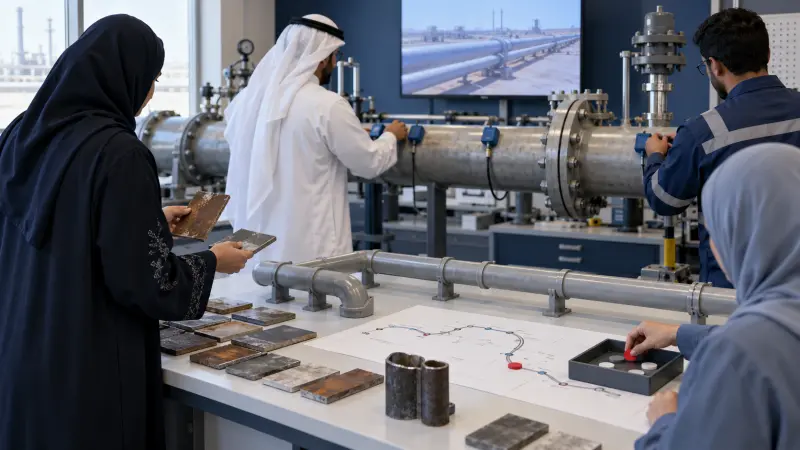
Suggested activities use a high-pressure transmission network connecting supply, compressor, metering and delivery nodes.
- Suggested activity: establish normal, peak, minimum and contingency flow cases
- Suggested activity: compare network configurations using pressure and velocity criteria
- Suggested activity: document a route and mechanical design decision with assumptions
- Suggested activity: conduct a multidisciplinary design assurance review
FAQs
Who should take gas transmission pipeline design training?
Gas transmission pipeline design training suits engineers and technical managers who develop or review high-pressure pipeline networks and need to connect hydraulic, mechanical, routing, station and integrity decisions.
How does gas transmission network design differ from gas distribution design?
Gas transmission network design addresses high-pressure, long-distance capacity, compression, major isolation and delivery interfaces. Distribution design focuses on lower-pressure local networks, service connections and end-user supply.
What does pipeline hydraulic analysis cover in this course?
Pipeline hydraulic analysis covers gas properties, flow and pressure cases, pressure loss, velocity, diameter selection, network configuration, compressor interfaces, sensitivity checks and model-result review.
How are engineering standards used during the course?
Participants learn to build an applicability matrix, identify governing project requirements and trace design decisions to the contractually applicable code edition. The course does not replace licensed standards or project-specific engineering approval.
Conclusion
Participants take back a Gas Transmission Network Design Basis and Assurance Package containing system boundaries, demand cases, hydraulic results, route constraints, material and wall-thickness decisions, station interfaces, integrity provisions and review actions. The package helps multidisciplinary teams make assumptions visible and maintain a traceable basis for subsequent design development.
credits: 5 credit per day
Course Mode: full-time
Provider: Agile Leaders Training Center
-
Events for this Course
-
Sharm El-Sheikh 2 – 6 November 2026
-
Abu Dhabi 2 – 6 November 2026
-
London 9 – 13 November 2026
-
Milan 16 – 20 November 2026
-
Toronto 22 – 26 November 2026
-
Madrid 30 November – 4 December 2026
-
Jakarta 7 – 11 December 2026
-
Dubai 14 – 18 December 2026
-
Berlin 14 – 18 December 2026
-
Istanbul 21 – 25 December 2026
-
Frankfurt 21 – 25 December 2026
-
Muscat 27 – 31 December 2026
-
Tbilisi 28 December 2026 – 1 January 2027
-
Athens 11 – 15 January 2027
-
Nice 11 – 15 January 2027
-
Amman 17 – 21 January 2027
-
Phuket 24 – 28 January 2027
-
Trabzon 7 – 11 February 2027
-
Marbella 7 – 11 February 2027
-
London 22 – 26 February 2027
-
Accra 28 February – 4 March 2027
-
Lagos 28 February – 4 March 2027
-
Vienna 8 – 12 March 2027
-
Bali 14 – 18 March 2027
-
Zanzibar 28 March – 1 April 2027
-
Prague 5 – 9 April 2027
-
Casablanca 12 – 16 April 2027
-
Chicago 18 – 22 April 2027
-
Nairobi 2 – 6 May 2027
-
Langkawi 9 – 13 May 2027
-
Cape town 16 – 20 May 2027
-
Seoul 24 – 28 May 2027
-
Rome 31 May – 4 June 2027
-
Munich 7 – 11 June 2027
-
Montreux 14 – 18 June 2027
-
Kuwait 20 – 24 June 2027
-
Zoom 21 – 25 June 2027
-
Doha 27 June – 1 July 2027
-
Singapore 5 – 9 July 2027
-
Tokyo 12 – 16 July 2027
-
San Diego 19 – 23 July 2027
-
Tashkent 25 – 29 July 2027
-
Cairo 26 – 30 July 2027
-
Barcelona 2 – 6 August 2027
-
Manama 8 – 12 August 2027
-
Baku 16 – 20 August 2027
-
Abu Dhabi 16 – 20 August 2027
-
Amsterdam 23 – 27 August 2027
-
Porto 23 – 27 August 2027
-
Dubai 6 – 10 September 2027
-
Kuala Lumpur 13 – 17 September 2027
-
Johannesburg 19 – 23 September 2027
-
Bangkok 26 – 30 September 2027
-
Lisbon 27 September – 1 October 2027
-
Paris 11 – 15 October 2027
-
New York 11 – 15 October 2027
-
Addis Ababa 18 – 22 October 2027
-
Geneva 31 October – 4 November 2027
| Image | Location | Dates | Duration | Mode | Price | Actions |
|---|---|---|---|---|---|---|

|
Accra |
Week 08, 2027 28 February – 4 March 2027 |
1 Week | Onsite | €6,000 | |

|
Lagos |
Week 08, 2027 28 February – 4 March 2027 |
1 Week | Onsite | €6,000 | |

|
Vienna |
Week 10, 2027 8 – 12 March 2027 |
1 Week | Onsite | €7,500 | |

|
Bali |
Week 10, 2027 14 – 18 March 2027 |
1 Week | Onsite | €6,500 | |

|
Zanzibar |
Week 12, 2027 28 March – 1 April 2027 |
1 Week | Onsite | €6,000 | |

|
Prague |
Week 14, 2027 5 – 9 April 2027 |
1 Week | Onsite | €7,500 | |

|
Casablanca |
Week 15, 2027 12 – 16 April 2027 |
1 Week | Onsite | €6,000 | |

|
Chicago |
Week 15, 2027 18 – 22 April 2027 |
1 Week | Onsite | €16,000 | |

|
Nairobi |
Week 17, 2027 2 – 6 May 2027 |
1 Week | Onsite | €6,000 | |

|
Langkawi |
Week 18, 2027 9 – 13 May 2027 |
1 Week | Onsite | €8,000 | |

|
Cape town |
Week 19, 2027 16 – 20 May 2027 |
1 Week | Onsite | €6,000 | |

|
Seoul |
Week 21, 2027 24 – 28 May 2027 |
1 Week | Onsite | €12,000 | |

|
Rome |
Week 22, 2027 31 May – 4 June 2027 |
1 Week | Onsite | €6,500 | |

|
Munich |
Week 23, 2027 7 – 11 June 2027 |
1 Week | Onsite | €6,500 | |

|
Montreux |
Week 24, 2027 14 – 18 June 2027 |
1 Week | Onsite | €8,000 | |

|
Kuwait |
Week 24, 2027 20 – 24 June 2027 |
1 Week | Onsite | €7,000 | |

|
Zoom |
Week 25, 2027 21 – 25 June 2027 |
1 Week | Online | €3,000 | |

|
Doha |
Week 25, 2027 27 June – 1 July 2027 |
1 Week | Onsite | €7,000 | |

|
Singapore |
Week 27, 2027 5 – 9 July 2027 |
1 Week | Onsite | €6,500 | |

|
Tokyo |
Week 28, 2027 12 – 16 July 2027 |
1 Week | Onsite | €12,000 |
Frequently asked questions
What does this course cover?
OverviewGas Transmission Pipeline Engineering and Network Design Course is a one-week professional course for engineers who plan, size and assure high-pressure gas transmission systems. Participants connect design basis, demand cases, hydraulic behaviour, route constraints, line-pipe selection, station interfaces, operability and integrity requirements. T…
Are training dates available?
Yes. Available dates and destinations are listed in the course dates section on this page.
How can I register?
Choose an available date on this page and complete the registration form, or send a programme enquiry.
Can I download the course brochure?
Yes. Use the brochure download link provided on this page.
This course by city
- Maintenance Training and Engineering Training Courses in Abu Dhabi
- Maintenance Training and Engineering Training Courses in Accra
- Maintenance Training and Engineering Training Courses in Addis Ababa
- Maintenance Training and Engineering Training Courses in Amman
- Maintenance Training and Engineering Training Courses in Amsterdam
- Maintenance Training and Engineering Training Courses in Athens
- Maintenance Training and Engineering Training Courses in Baku
- Maintenance Training and Engineering Training Courses in Bali
- Maintenance Training and Engineering Training Courses in Bangkok
- Maintenance Training and Engineering Training Courses in Barcelona
- Maintenance Training and Engineering Training Courses in Berlin
- Maintenance Training and Engineering Training Courses in Cairo
- Maintenance Training and Engineering Training Courses in Cape town
- Maintenance Training and Engineering Training Courses in Casablanca
- Maintenance Training and Engineering Training Courses in Chicago
- Maintenance Training and Engineering Training Courses in Doha
- Maintenance Training and Engineering Training Courses in Dubai
- Maintenance Training and Engineering Training Courses in Frankfurt
- Maintenance Training and Engineering Training Courses in Geneva
- Maintenance Training and Engineering Training Courses in Istanbul
- Maintenance Training and Engineering Training Courses in Jakarta
- Maintenance Training and Engineering Training Courses in Johannesburg
- Maintenance Training and Engineering Training Courses in Kuala Lumpur
- Maintenance Training and Engineering Training Courses in Kuwait
- Maintenance Training and Engineering Training Courses in Lagos
- Maintenance Training and Engineering Training Courses in Langkawi
- Maintenance Training and Engineering Training Courses in Lisbon
- Maintenance Training and Engineering Training Courses in London
- Maintenance Training and Engineering Training Courses in Madrid
- Maintenance Training and Engineering Training Courses in Manama
- Maintenance Training and Engineering Training Courses in Marbella
- Maintenance Training and Engineering Training Courses in Milan
- Maintenance Training and Engineering Training Courses in Montreux
- Maintenance Training and Engineering Training Courses in Munich
- Maintenance Training and Engineering Training Courses in Muscat
- Maintenance Training and Engineering Training Courses in Nairobi
- Maintenance Training and Engineering Training Courses in New York
- Maintenance Training and Engineering Training Courses in Nice
- Maintenance Training and Engineering Training Courses in Paris
- Maintenance Training and Engineering Training Courses in Phuket
- Maintenance Training and Engineering Training Courses in Porto
- Maintenance Training and Engineering Training Courses in Prague
- Maintenance Training and Engineering Training Courses in Rome
- Maintenance Training and Engineering Training Courses in San Diego
- Maintenance Training and Engineering Training Courses in Seoul
- Maintenance Training and Engineering Training Courses in Sharm El-Sheikh
- Maintenance Training and Engineering Training Courses in Singapore
- Maintenance Training and Engineering Training Courses in Tashkent
- Maintenance Training and Engineering Training Courses in Tbilisi
- Maintenance Training and Engineering Training Courses in Tokyo
- Maintenance Training and Engineering Training Courses in Toronto
- Maintenance Training and Engineering Training Courses in Trabzon
- Maintenance Training and Engineering Training Courses in Vienna
- Maintenance Training and Engineering Training Courses in Zanzibar
- Maintenance Training and Engineering Training Courses in Zoom