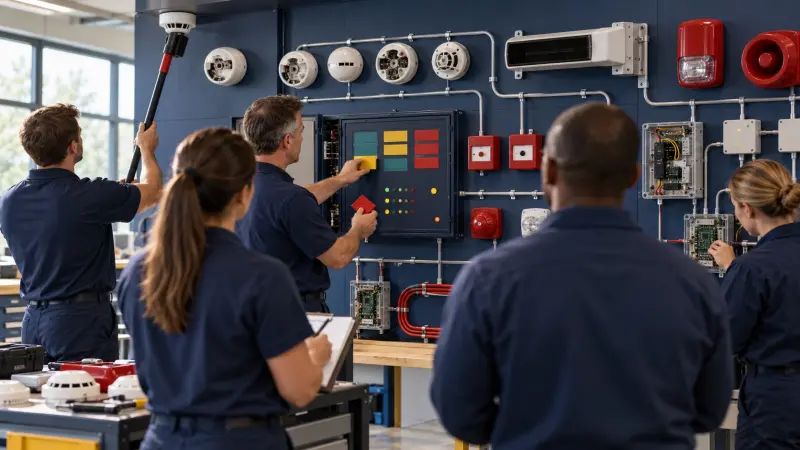
Industrial Alarm Management Training Course

At a glance
- Duration
- 1 Week
- Format
- Classroom
- Cities
- Langkawi, Cairo, Istanbul, Prague, Bali, Madrid and more
- Next session
- 15 – 19 November 2026, Langkawi
- Average fee
- 7,500 €
Overview
Industrial Alarm Management and Rationalisation Training Course is a one-week professional programme for control and instrumentation engineers, process engineers, operations supervisors, control-room leaders, safety professionals and automation specialists. Participants learn to manage alarms as a lifecycle rather than a configuration task, linking alarm philosophy, identification, rationalisation, detailed design, operation, maintenance, monitoring, management of change and audit. The course uses current concepts from IEC 62682:2022, the ISA-18 series and EEMUA 191 without claiming certification. Participants leave with an Alarm Management Improvement File. Agile Leaders Training Center develops practical industrial alarm governance and performance capability.
Who Should Attend
- Control, instrumentation and automation engineers
- Process engineers and operations technologists
- Control-room supervisors and operator-training leaders
- Process-safety and functional-safety professionals
- Maintenance, reliability and management-of-change coordinators
Participants should understand process operations and control-system terminology. The course does not authorise safety-system changes, replace site risk assessment or confer standards certification.
Departments and Industries
The course supports operations, process engineering, control and instrumentation, automation, maintenance, reliability, process safety and technical assurance teams in oil and gas, chemicals, power, water, manufacturing, mining, pharmaceuticals and other process industries.
Learning Objectives
- Explain the alarm-management lifecycle and governance roles
- Build an alarm philosophy with practical decision rules
- Conduct alarm identification and rationalisation workshops
- Assign priorities, setpoints, deadbands and delays consistently
- Control nuisance, chattering, standing and stale alarms
- Analyse floods, bad actors and performance metrics
- Structure management of change, audit and continuous improvement
Course Methodology
The programme uses standards mapping, philosophy templates, rationalisation scenarios, priority matrices, alarm records, trend data, flood timelines, bad-actor analysis and improvement workshops. Daily outputs combine into an Alarm Management Improvement File containing governance, rationalisation, design, monitoring and assurance tools.
Day 1: Alarm Lifecycle, Philosophy and Governance
- Purpose of an alarm and the required operator response
- Alarm lifecycle stages and interfaces with control and safety systems
- Roles, responsibilities, ownership and decision authority
- Alarm philosophy structure, definitions and design principles
- Building the site alarm-management baseline
Day 2: Identification, Rationalisation and Prioritisation
- Determining whether an alarm is necessary and actionable
- Documenting cause, consequence, response and available time
- Using consequence and time-to-respond in priority decisions
- Classifying alarms and identifying safeguards and dependencies
- Running and recording a rationalisation workshop
Day 3: Detailed Alarm Design and Human Factors
- Alarm messages, presentation and operator decision support
- Setpoints, deadbands, on-delays, off-delays and debounce logic
- Shelving, suppression, out-of-service states and dynamic alarming
- Startup, shutdown, batch and operating-mode considerations
- Designing alarms for clarity, consistency and maintainability
Day 4: Performance Monitoring and Bad-Actor Analysis
- Alarm rate, priority distribution and standing-alarm measures
- Detecting chattering, fleeting, stale and frequently occurring alarms
- Reconstructing alarm floods and operator workload
- Using historian data to rank bad actors and recurring patterns
- Building a performance dashboard and action backlog
Day 5: Maintenance, Change, Audit and Improvement
- Testing, repair, documentation and alarm-system maintenance
- Management of change for settings, logic and operating context
- Periodic assessment, formal audit and evidence requirements
- Governance of packaged-system and vendor alarms
- Completing a prioritised alarm improvement roadmap
Practical Outputs
- Alarm philosophy outline
- Rationalisation decision worksheet
- Alarm priority matrix
- Detailed design and shelving checklist
- Alarm performance dashboard
- Audit and improvement roadmap
Frequently Asked Questions
Does the course provide certification to IEC or ISA standards?
No. It uses recognised lifecycle terminology for professional development and does not confer certification.
Is this a PLC programming course?
No. It focuses on operator alarms, governance, rationalisation, design quality and performance.
Will participants rationalise alarms?
Yes. They practise necessity, consequence, response, priority and documentation decisions using scenarios.
Does the course cover alarm floods?
Yes. Participants reconstruct floods, assess workload and identify bad actors and improvement actions.
What is the main workplace output?
Participants complete an Alarm Management Improvement File and implementation roadmap.
credits: 5 credit per day
Course Mode: full-time
Provider: Agile Leaders Training Center
-
Events for this Course
-
Langkawi 15 – 19 November 2026
-
Cairo 16 – 20 November 2026
-
Istanbul 23 – 27 November 2026
-
Prague 23 – 27 November 2026
-
Bali 29 November – 3 December 2026
-
Madrid 7 – 11 December 2026
-
Milan 14 – 18 December 2026
-
Zoom 21 – 25 December 2026
-
Athens 21 – 25 December 2026
-
Amman 27 – 31 December 2026
-
London 28 December 2026 – 1 January 2027
-
Tashkent 3 – 7 January 2027
-
Tokyo 4 – 8 January 2027
-
Tbilisi 11 – 15 January 2027
-
Johannesburg 17 – 21 January 2027
-
Bangkok 24 – 28 January 2027
-
Barcelona 1 – 5 February 2027
-
Nice 8 – 12 February 2027
-
Casablanca 15 – 19 February 2027
-
Lisbon 15 – 19 February 2027
-
Munich 22 – 26 February 2027
-
Lagos 28 February – 4 March 2027
-
Singapore 8 – 12 March 2027
-
Abu Dhabi 15 – 19 March 2027
-
Zanzibar 21 – 25 March 2027
-
Porto 29 March – 2 April 2027
-
Jakarta 5 – 9 April 2027
-
Dubai 12 – 16 April 2027
-
Berlin 19 – 23 April 2027
-
New York 26 – 30 April 2027
-
Manama 2 – 6 May 2027
-
Montreux 10 – 14 May 2027
-
Chicago 16 – 20 May 2027
-
Trabzon 23 – 27 May 2027
-
Kuala Lumpur 24 – 28 May 2027
-
Addis Ababa 31 May – 4 June 2027
-
Kuwait 13 – 17 June 2027
-
Cape town 27 June – 1 July 2027
-
Muscat 11 – 15 July 2027
-
Rome 19 – 23 July 2027
-
San Diego 19 – 23 July 2027
-
Marbella 25 – 29 July 2027
-
Seoul 9 – 13 August 2027
-
Frankfurt 23 – 27 August 2027
-
Doha 29 August – 2 September 2027
-
Geneva 5 – 9 September 2027
-
Paris 13 – 17 September 2027
-
Dubai 20 – 24 September 2027
-
Abu Dhabi 20 – 24 September 2027
-
London 27 September – 1 October 2027
-
Baku 27 September – 1 October 2027
-
Nairobi 3 – 7 October 2027
-
Sharm El-Sheikh 4 – 8 October 2027
-
Toronto 17 – 21 October 2027
-
Amsterdam 18 – 22 October 2027
-
Accra 24 – 28 October 2027
-
Phuket 31 October – 4 November 2027
-
Vienna 8 – 12 November 2027
| Image | Location | Dates | Duration | Mode | Price | Actions |
|---|---|---|---|---|---|---|

|
Langkawi |
Week 46, 2026 15 – 19 November 2026 |
1 Week | Onsite | €8,000 | |

|
Cairo |
Week 47, 2026 16 – 20 November 2026 |
1 Week | Onsite | €5,200 | |

|
Istanbul |
Week 48, 2026 23 – 27 November 2026 |
1 Week | Onsite | €6,000 | |

|
Prague |
Week 48, 2026 23 – 27 November 2026 |
1 Week | Onsite | €7,500 | |

|
Bali |
Week 48, 2026 29 November – 3 December 2026 |
1 Week | Onsite | €6,500 | |

|
Madrid |
Week 50, 2026 7 – 11 December 2026 |
1 Week | Onsite | €6,500 | |

|
Milan |
Week 51, 2026 14 – 18 December 2026 |
1 Week | Onsite | €7,000 | |

|
Zoom |
Week 52, 2026 21 – 25 December 2026 |
1 Week | Online | €3,000 | |

|
Athens |
Week 52, 2026 21 – 25 December 2026 |
1 Week | Onsite | €7,500 | |

|
Amman |
Week 52, 2026 27 – 31 December 2026 |
1 Week | Onsite | €6,000 | |

|
London |
Week 53, 2026 28 December 2026 – 1 January 2027 |
1 Week | Onsite | €6,500 | |

|
Tashkent |
Week 53, 2027 3 – 7 January 2027 |
1 Week | Onsite | €8,000 | |

|
Tokyo |
Week 01, 2027 4 – 8 January 2027 |
1 Week | Onsite | €12,000 | |

|
Tbilisi |
Week 02, 2027 11 – 15 January 2027 |
1 Week | Onsite | €5,700 | |

|
Johannesburg |
Week 02, 2027 17 – 21 January 2027 |
1 Week | Onsite | €6,000 | |

|
Bangkok |
Week 03, 2027 24 – 28 January 2027 |
1 Week | Onsite | €8,000 | |

|
Barcelona |
Week 05, 2027 1 – 5 February 2027 |
1 Week | Onsite | €6,500 | |

|
Nice |
Week 06, 2027 8 – 12 February 2027 |
1 Week | Onsite | €8,000 | |

|
Casablanca |
Week 07, 2027 15 – 19 February 2027 |
1 Week | Onsite | €6,000 | |

|
Lisbon |
Week 07, 2027 15 – 19 February 2027 |
1 Week | Onsite | €6,500 |
Frequently asked questions
What does this course cover?
OverviewIndustrial Alarm Management and Rationalisation Training Course is a one-week professional programme for control and instrumentation engineers, process engineers, operations supervisors, control-room leaders, safety professionals and automation specialists. Participants learn to manage alarms as a lifecycle rather than a configuration task, linkin…
Are training dates available?
Yes. Available dates and destinations are listed in the course dates section on this page.
How can I register?
Choose an available date on this page and complete the registration form, or send a programme enquiry.
Can I download the course brochure?
Yes. Use the brochure download link provided on this page.
This course by city
- Oil & Gas Training and Other Technical Courses in Abu Dhabi
- Oil & Gas Training and Other Technical Courses in Accra
- Oil & Gas Training and Other Technical Courses in Addis Ababa
- Oil & Gas Training and Other Technical Courses in Amman
- Oil & Gas Training and Other Technical Courses in Amsterdam
- Oil & Gas Training and Other Technical Courses in Athens
- Oil & Gas Training and Other Technical Courses in Baku
- Oil & Gas Training and Other Technical Courses in Bali
- Oil & Gas Training and Other Technical Courses in Bangkok
- Oil & Gas Training and Other Technical Courses in Barcelona
- Oil & Gas Training and Other Technical Courses in Berlin
- Oil & Gas Training and Other Technical Courses in Cairo
- Oil & Gas Training and Other Technical Courses in Cape town
- Oil & Gas Training and Other Technical Courses in Casablanca
- Oil & Gas Training and Other Technical Courses in Chicago
- Oil & Gas Training and Other Technical Courses in Doha
- Oil & Gas Training and Other Technical Courses in Dubai
- Oil & Gas Training and Other Technical Courses in Frankfurt
- Oil & Gas Training and Other Technical Courses in Geneva
- Oil & Gas Training and Other Technical Courses in Istanbul
- Oil & Gas Training and Other Technical Courses in Jakarta
- Oil & Gas Training and Other Technical Courses in Johannesburg
- Oil & Gas Training and Other Technical Courses in Kuala Lumpur
- Oil & Gas Training and Other Technical Courses in Kuwait
- Oil & Gas Training and Other Technical Courses in Lagos
- Oil & Gas Training and Other Technical Courses in Langkawi
- Oil & Gas Training and Other Technical Courses in Lisbon
- Oil & Gas Training and Other Technical Courses in London
- Oil & Gas Training and Other Technical Courses in Madrid
- Oil & Gas Training and Other Technical Courses in Manama
- Oil & Gas Training and Other Technical Courses in Marbella
- Oil & Gas Training and Other Technical Courses in Milan
- Oil & Gas Training and Other Technical Courses in Montreux
- Oil & Gas Training and Other Technical Courses in Munich
- Oil & Gas Training and Other Technical Courses in Muscat
- Oil & Gas Training and Other Technical Courses in Nairobi
- Oil & Gas Training and Other Technical Courses in New York
- Oil & Gas Training and Other Technical Courses in Nice
- Oil & Gas Training and Other Technical Courses in Paris
- Oil & Gas Training and Other Technical Courses in Phuket
- Oil & Gas Training and Other Technical Courses in Porto
- Oil & Gas Training and Other Technical Courses in Prague
- Oil & Gas Training and Other Technical Courses in Rome
- Oil & Gas Training and Other Technical Courses in San Diego
- Oil & Gas Training and Other Technical Courses in Seoul
- Oil & Gas Training and Other Technical Courses in Sharm El-Sheikh
- Oil & Gas Training and Other Technical Courses in Singapore
- Oil & Gas Training and Other Technical Courses in Tashkent
- Oil & Gas Training and Other Technical Courses in Tbilisi
- Oil & Gas Training and Other Technical Courses in Tokyo
- Oil & Gas Training and Other Technical Courses in Toronto
- Oil & Gas Training and Other Technical Courses in Trabzon
- Oil & Gas Training and Other Technical Courses in Vienna
- Oil & Gas Training and Other Technical Courses in Zanzibar
- Oil & Gas Training and Other Technical Courses in Zoom