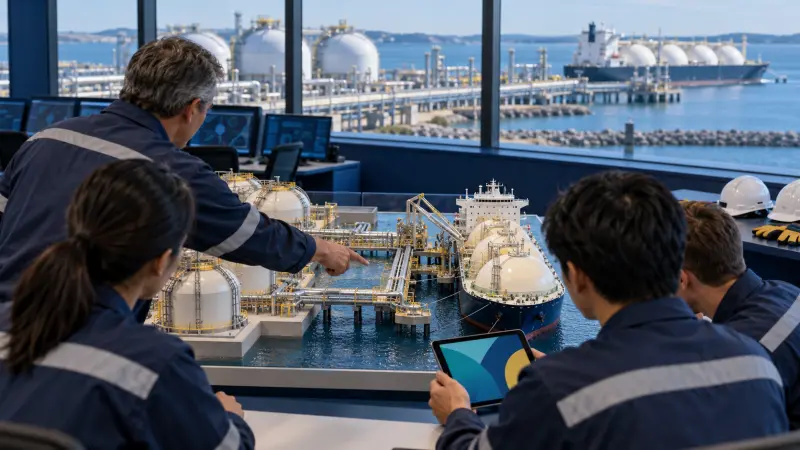
LNG Transportation and Marine Logistics Course

At a glance
- Duration
- 1 Week
- Format
- Classroom
- Cities
- Montreux, Doha, Lagos, London, Barcelona, Jakarta and more
- Next session
- 9 – 13 November 2026, Montreux
- Average fee
- 7,500 €
Overview
LNG Transportation and Marine Logistics Training Course is a one-week intermediate course for professionals who coordinate liquefied natural gas movement from cargo nomination through voyage completion. Participants connect LNG carrier voyage planning, chartering and commercial interfaces, ship-shore transfer coordination, LNG custody transfer, boil-off gas management, and LNG marine logistics. The course replaces isolated handoffs with a controlled transport-chain cadence and produces an LNG Transportation Voyage and Transfer Plan. Agile Leaders Training Center presents applied LNG transport practice.
Who Should Attend
- LNG shipping and marine logistics professionals coordinating cargo movements
- Carrier and terminal operations teams managing berth and transfer readiness
- Chartering, commercial, scheduling, and contract-administration functions
- Cargo measurement and custody-transfer professionals
- Marine HSE, assurance, and emergency-response teams
The course assumes participants work with LNG cargoes, vessels, terminals, contracts, schedules, or marine risk controls. It leaves out liquefaction-plant operations, detailed naval architecture, seafarer certification, and general tanker induction.
Departments and Industries
The course supports departments and industries that plan, control, measure, and assure LNG transportation.
- LNG producers, portfolio companies, traders, and shipping organizations
- Gas carriers, marine terminals, ports, and logistics providers
- Chartering, scheduling, commercial, operations, and cargo-control teams
- Marine assurance, HSE, emergency response, and risk functions
- Measurement, inspection, contract, finance, and claims departments
Learning Objectives
By the end of this course, participants will be able to:
- Build an LNG voyage and cargo-interface plan
- Analyze carrier, containment, cargo, and terminal compatibility
- Apply chartering, nomination, documentation, and scheduling controls
- Use loading, unloading, heel, and vapor-management procedures
- Evaluate custody-transfer evidence and quantity reconciliation
- Prioritize transport risks, emergency actions, and performance improvements
Course Agenda
Day 1: Map the LNG Transport Chain
- IGC Code Safe-Carriage Framework Map
- LNG Cargo Property and Hazard Profile
- Carrier Type and Containment-System Comparison Matrix
- Transport-Chain Stakeholder and Responsibility Map
- Cargo Nomination and Delivery-Window Workflow
Day 2: Plan Voyage and Commercial Interfaces
- Charter-Party Responsibility and Notice Checklist
- LNG Carrier Voyage Planning Worksheet
- Weather, Routing, Speed, and Fuel Decision Table
- Berth Compatibility and Terminal-Readiness Matrix
- Voyage Documentation and Communication Register
Day 3: Control Cargo and Transfer Operations
- LNG Cargo Conditioning and Heel Plan
- Boil-Off Gas Management Decision Tree
- Ship-Shore Transfer Coordination Sequence
- Emergency Shutdown Link and Communication Checklist
- Loading and Unloading Readiness Gate
Day 4: Measure and Assure Delivery
- LNG Custody Transfer Measurement Chain
- Tank Gauging and Temperature Data Review Sheet
- Cargo Quantity and Energy Reconciliation Model
- Transport Loss, Deviation, and Claim Evidence Log
- Voyage Performance and Terminal Interface Dashboard
Day 5: Practice LNG Transport Decisions
- Suggested Exercise: Match a Carrier to a Terminal
- Suggested Exercise: Resolve a Voyage and Berth Conflict
- Suggested Exercise: Review a Transfer Readiness Package
- Suggested Exercise: Reconcile a Cargo Delivery Difference
- Capstone Exercise: Complete the LNG Transportation Voyage and Transfer Plan
Practical Exercises
The course uses suggested activities to convert commercial, marine, cargo, and safety evidence into transport decisions.
- Suggested activity: compare carrier containment, terminal restrictions, cargo conditions, and berth compatibility.
- Suggested activity: build a voyage plan with delivery windows, weather choices, notices, and contingency actions.
- Suggested activity: audit a ship-shore transfer package and emergency communication chain.
- Suggested activity: reconcile custody-transfer quantities, losses, deviations, and supporting records.
FAQs
Who suits LNG transportation training, and what does it assume?
LNG shipping, terminal, chartering, scheduling, commercial, measurement, logistics, and HSE professionals suit the course. It assumes participants work with cargoes, vessels, terminals, contracts, schedules, measurements, or marine controls.
How does LNG transportation differ from LNG terminal operations training?
LNG transportation connects nomination, chartering, carrier compatibility, voyage decisions, cargo management, ship-shore transfer, custody transfer, and delivery performance. Terminal operations training concentrates on the facilities and procedures within the terminal boundary.
What controls boil-off gas during LNG transportation?
Boil-off gas is controlled through voyage planning, cargo pressure and temperature monitoring, containment performance, heel strategy, reliquefaction or consumption arrangements where fitted, and coordinated operating limits.
How is LNG custody transfer reconciled?
LNG custody transfer is reconciled through calibrated tank measurements, temperature and pressure records, composition and energy data, agreed calculation methods, opening and closing inventories, documentation, and investigation of deviations.
Why is the ship-shore interface critical in LNG shipping?
The ship-shore interface aligns compatibility, communications, responsibilities, transfer limits, emergency shutdown links, weather restrictions, readiness checks, and stop-work decisions before and during cargo movement.
Conclusion
Participants take back an LNG Transportation Voyage and Transfer Plan linking commercial commitments, voyage choices, carrier and terminal interfaces, cargo control, measurement, risk, and performance. It changes disconnected handoffs into a traceable transport workflow. Teams can update the plan as cargo conditions, delivery windows, weather, terminal readiness, and commercial requirements change.
credits: 5 credit per day
Course Mode: full-time
Provider: Agile Leaders Training Center
-
Events for this Course
-
Montreux 9 – 13 November 2026
-
Doha 15 – 19 November 2026
-
Lagos 15 – 19 November 2026
-
London 23 – 27 November 2026
-
Barcelona 30 November – 4 December 2026
-
Jakarta 7 – 11 December 2026
-
Casablanca 14 – 18 December 2026
-
Porto 21 – 25 December 2026
-
Sharm El-Sheikh 28 December 2026 – 1 January 2027
-
Toronto 3 – 7 January 2027
-
Prague 4 – 8 January 2027
-
Bangkok 10 – 14 January 2027
-
Dubai 18 – 22 January 2027
-
Athens 25 – 29 January 2027
-
Trabzon 31 January – 4 February 2027
-
Amsterdam 8 – 12 February 2027
-
Rome 15 – 19 February 2027
-
Madrid 22 – 26 February 2027
-
Manama 28 February – 4 March 2027
-
Abu Dhabi 1 – 5 March 2027
-
New York 8 – 12 March 2027
-
Nairobi 14 – 18 March 2027
-
Singapore 15 – 19 March 2027
-
Nice 22 – 26 March 2027
-
Phuket 28 March – 1 April 2027
-
Dubai 12 – 16 April 2027
-
Vienna 19 – 23 April 2027
-
Geneva 25 – 29 April 2027
-
Seoul 3 – 7 May 2027
-
Tokyo 10 – 14 May 2027
-
Amman 16 – 20 May 2027
-
Muscat 23 – 27 May 2027
-
Baku 31 May – 4 June 2027
-
Cairo 7 – 11 June 2027
-
Berlin 7 – 11 June 2027
-
Tbilisi 14 – 18 June 2027
-
Accra 20 – 24 June 2027
-
Bali 27 June – 1 July 2027
-
Johannesburg 4 – 8 July 2027
-
Munich 12 – 16 July 2027
-
Zanzibar 18 – 22 July 2027
-
Chicago 25 – 29 July 2027
-
Cape town 1 – 5 August 2027
-
Frankfurt 2 – 6 August 2027
-
London 16 – 20 August 2027
-
Abu Dhabi 16 – 20 August 2027
-
Marbella 22 – 26 August 2027
-
Zoom 30 August – 3 September 2027
-
Kuwait 5 – 9 September 2027
-
Paris 20 – 24 September 2027
-
Tashkent 26 – 30 September 2027
-
Lisbon 27 September – 1 October 2027
-
Kuala Lumpur 4 – 8 October 2027
-
Addis Ababa 4 – 8 October 2027
-
Langkawi 10 – 14 October 2027
-
Milan 18 – 22 October 2027
-
San Diego 25 – 29 October 2027
-
Istanbul 1 – 5 November 2027
| Image | Location | Dates | Duration | Mode | Price | Actions |
|---|---|---|---|---|---|---|

|
New York |
Week 10, 2027 8 – 12 March 2027 |
1 Week | Onsite | €16,000 | |

|
Nairobi |
Week 10, 2027 14 – 18 March 2027 |
1 Week | Onsite | €6,000 | |

|
Singapore |
Week 11, 2027 15 – 19 March 2027 |
1 Week | Onsite | €6,500 | |

|
Nice |
Week 12, 2027 22 – 26 March 2027 |
1 Week | Onsite | €8,000 | |

|
Phuket |
Week 12, 2027 28 March – 1 April 2027 |
1 Week | Onsite | €8,000 | |

|
Dubai |
Week 15, 2027 12 – 16 April 2027 |
1 Week | Onsite | €6,500 | |

|
Vienna |
Week 16, 2027 19 – 23 April 2027 |
1 Week | Onsite | €7,500 | |

|
Geneva |
Week 16, 2027 25 – 29 April 2027 |
1 Week | Onsite | €8,000 | |

|
Seoul |
Week 18, 2027 3 – 7 May 2027 |
1 Week | Onsite | €12,000 | |

|
Tokyo |
Week 19, 2027 10 – 14 May 2027 |
1 Week | Onsite | €12,000 | |

|
Amman |
Week 19, 2027 16 – 20 May 2027 |
1 Week | Onsite | €6,000 | |

|
Muscat |
Week 20, 2027 23 – 27 May 2027 |
1 Week | Onsite | €6,500 | |

|
Baku |
Week 22, 2027 31 May – 4 June 2027 |
1 Week | Onsite | €8,000 | |

|
Cairo |
Week 23, 2027 7 – 11 June 2027 |
1 Week | Onsite | €5,200 | |

|
Berlin |
Week 23, 2027 7 – 11 June 2027 |
1 Week | Onsite | €6,500 | |

|
Tbilisi |
Week 24, 2027 14 – 18 June 2027 |
1 Week | Onsite | €5,700 | |

|
Accra |
Week 24, 2027 20 – 24 June 2027 |
1 Week | Onsite | €6,000 | |

|
Bali |
Week 25, 2027 27 June – 1 July 2027 |
1 Week | Onsite | €6,500 | |

|
Johannesburg |
Week 26, 2027 4 – 8 July 2027 |
1 Week | Onsite | €6,000 | |

|
Munich |
Week 28, 2027 12 – 16 July 2027 |
1 Week | Onsite | €6,500 |
Frequently asked questions
What does this course cover?
OverviewLNG Transportation and Marine Logistics Training Course is a one-week intermediate course for professionals who coordinate liquefied natural gas movement from cargo nomination through voyage completion. Participants connect LNG carrier voyage planning, chartering and commercial interfaces, ship-shore transfer coordination, LNG custody transfer, bo…
Are training dates available?
Yes. Available dates and destinations are listed in the course dates section on this page.
How can I register?
Choose an available date on this page and complete the registration form, or send a programme enquiry.
Can I download the course brochure?
Yes. Use the brochure download link provided on this page.
This course by city
- Shipping, Maritime and Ports Training Courses in Abu Dhabi
- Shipping, Maritime and Ports Training Courses in Accra
- Shipping, Maritime and Ports Training Courses in Addis Ababa
- Shipping, Maritime and Ports Training Courses in Amman
- Shipping, Maritime and Ports Training Courses in Amsterdam
- Shipping, Maritime and Ports Training Courses in Athens
- Shipping, Maritime and Ports Training Courses in Baku
- Shipping, Maritime and Ports Training Courses in Bali
- Shipping, Maritime and Ports Training Courses in Bangkok
- Shipping, Maritime and Ports Training Courses in Barcelona
- Shipping, Maritime and Ports Training Courses in Berlin
- Shipping, Maritime and Ports Training Courses in Cairo
- Shipping, Maritime and Ports Training Courses in Cape town
- Shipping, Maritime and Ports Training Courses in Casablanca
- Shipping, Maritime and Ports Training Courses in Chicago
- Shipping, Maritime and Ports Training Courses in Doha
- Shipping, Maritime and Ports Training Courses in Dubai
- Shipping, Maritime and Ports Training Courses in Frankfurt
- Shipping, Maritime and Ports Training Courses in Geneva
- Shipping, Maritime and Ports Training Courses in Istanbul
- Shipping, Maritime and Ports Training Courses in Jakarta
- Shipping, Maritime and Ports Training Courses in Johannesburg
- Shipping, Maritime and Ports Training Courses in Kuala Lumpur
- Shipping, Maritime and Ports Training Courses in Kuwait
- Shipping, Maritime and Ports Training Courses in Lagos
- Shipping, Maritime and Ports Training Courses in Langkawi
- Shipping, Maritime and Ports Training Courses in Lisbon
- Shipping, Maritime and Ports Training Courses in London
- Shipping, Maritime and Ports Training Courses in Madrid
- Shipping, Maritime and Ports Training Courses in Manama
- Shipping, Maritime and Ports Training Courses in Marbella
- Shipping, Maritime and Ports Training Courses in Milan
- Shipping, Maritime and Ports Training Courses in Montreux
- Shipping, Maritime and Ports Training Courses in Munich
- Shipping, Maritime and Ports Training Courses in Muscat
- Shipping, Maritime and Ports Training Courses in Nairobi
- Shipping, Maritime and Ports Training Courses in New York
- Shipping, Maritime and Ports Training Courses in Nice
- Shipping, Maritime and Ports Training Courses in Paris
- Shipping, Maritime and Ports Training Courses in Phuket
- Shipping, Maritime and Ports Training Courses in Porto
- Shipping, Maritime and Ports Training Courses in Prague
- Shipping, Maritime and Ports Training Courses in Rome
- Shipping, Maritime and Ports Training Courses in San Diego
- Shipping, Maritime and Ports Training Courses in Seoul
- Shipping, Maritime and Ports Training Courses in Sharm El-Sheikh
- Shipping, Maritime and Ports Training Courses in Singapore
- Shipping, Maritime and Ports Training Courses in Tashkent
- Shipping, Maritime and Ports Training Courses in Tbilisi
- Shipping, Maritime and Ports Training Courses in Tokyo
- Shipping, Maritime and Ports Training Courses in Toronto
- Shipping, Maritime and Ports Training Courses in Trabzon
- Shipping, Maritime and Ports Training Courses in Vienna
- Shipping, Maritime and Ports Training Courses in Zanzibar
- Shipping, Maritime and Ports Training Courses in Zoom