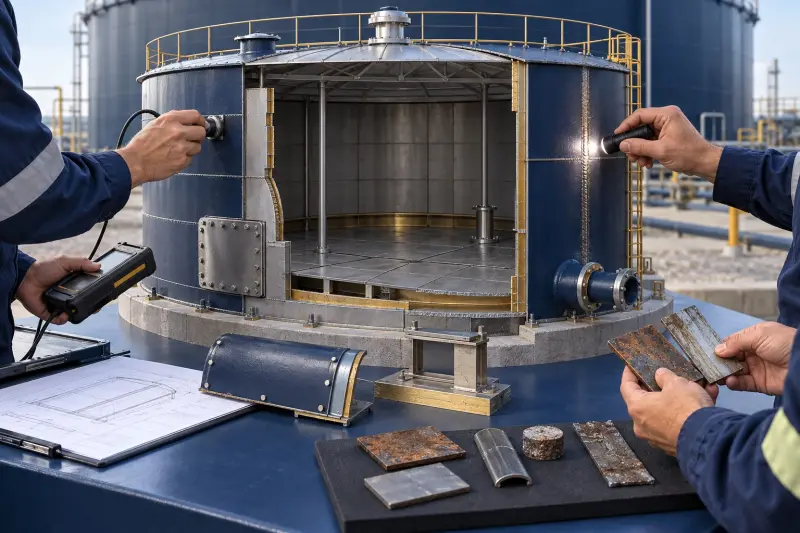
Oil Movement and Tank Farm Operations Course

At a glance
- Duration
- 1 Week
- Format
- Classroom
- Cities
- Cairo, Addis Ababa, Johannesburg, Paris, Baku, Abu Dhabi and more
- Next session
- 16 – 20 November 2026, Cairo
- Average fee
- 7,500 €
Overview
Advanced Oil Movement and Tank Farm Operations Training Course is a one-week advanced course for terminal, storage, loading, inventory, engineering, maintenance, and HSE functions who leave with an Oil Movement and Tank Farm Operations Control Book. Participants integrate oil movement and tank farm operations, petroleum terminal operations, tank transfer planning, inventory reconciliation controls, and an overfill prevention system. The course connects receipts, routing, storage limits, loading, product quality, loss control, handovers, and emergency decisions. Agile Leaders Training Center presents terminal operating-control practice.
Who Should Attend
- Tank-farm operations functions responsible for receipts, storage, transfers, and operating limits
- Terminal supervision functions responsible for shift plans, line-ups, permits, and handovers
- Oil-movement functions responsible for routing, nominations, blending, and transfer execution
- Loading functions responsible for road, rail, pipeline, or marine delivery interfaces
- Inventory-control functions responsible for gauging, measurement evidence, reconciliation, and loss review
- Engineering, maintenance, and HSE functions responsible for availability, safeguards, and emergency readiness
The course assumes participants already operate or support petroleum terminals and interpret procedures, line diagrams, tank data, and shift records, and it leaves out tank-inspection certification, tank cleaning, commodity trading, and rotating-equipment design.
Departments and Industries
The course supports departments and industries that receive, store, transfer, load, measure, or safeguard liquid petroleum products.
- Refining, terminals, bulk storage, and product distribution
- Pipelines, jetties, ports, and marine cargo operations
- Fuel supply, aviation storage, and industrial energy facilities
- Operations, scheduling, inventory control, and commercial measurement
- Maintenance, integrity, engineering, and automation support
- HSE, emergency response, quality, and loss-control functions
Learning Objectives
By the end of this course, participants will be able to:
- Analyze receipt, storage, transfer, blending, and loading constraints
- Build verified line-ups and tank operating-envelope decisions
- Apply gauging, sampling, measurement, and reconciliation controls
- Evaluate contamination, static, overfill, loss, and interface risks
- Use shift handovers, alarms, permits, and emergency procedures
- Prioritize terminal performance and operating-discipline improvements
Course Agenda
Day 1: Map Terminal Movements
- Petroleum Terminal Process and Product Flow Map
- Receipt, Storage, Transfer, Blending, and Loading Sequence Matrix
- Tank Farm Roles, Interfaces, and Decision-Authority Chart
- Pipeline, Manifold, Valve, and Transfer-Path Line-Up Method
- Oil Movement Schedule and Operating Constraint Register
Day 2: Control Tanks and Transfers
- Tank Capacity, Working Volume, and Operating-Envelope Sheet
- Transfer Rate, Pressure, Level, and Completion-Point Calculation
- API 2350 Overfill Prevention System and Response-Time Review
- Product Segregation, Compatibility, and Contamination-Control Matrix
- Transfer Start-Up, Monitoring, Changeover, and Shutdown Checklist
Day 3: Measure and Reconcile Inventory
- Tank Gauging, Temperature, Sampling, and Data-Quality Checklist
- Custody-Transfer Metering and Proving Evidence Map
- Observed Volume, Corrected Quantity, and Stock-Movement Worksheet
- Book Stock, Physical Stock, and Inventory Reconciliation Ledger
- Measurement Uncertainty, Variance, Loss, and Investigation Decision Tree
Day 4: Safeguard Loading and Shifts
- Road, Rail, Pipeline, and Marine Loading Interface Plan
- Bonding, Grounding, Static-Control, and Ignition-Source Checklist
- Alarm, Interlock, Emergency Shutdown, and Escalation Matrix
- Leak, Spill, Fire, Overfill, and Wrong-Route Response Card
- Shift Handover, Permit, Isolation, and Outstanding-Work Log
Day 5: Practice Terminal Control
- Suggested Exercise: Build a Receipt-to-Tank Transfer Plan
- Suggested Exercise: Verify a Manifold and Valve Line-Up
- Suggested Exercise: Reconcile Inventory and Investigate a Variance
- Suggested Exercise: Respond to an Overfill Alarm and Transfer Deviation
- Capstone Exercise: Complete the Oil Movement and Tank Farm Operations Control Book
Practical Exercises
The course uses suggested activities to convert terminal diagrams, tank data, procedures, alarms, and measurement records into traceable operating decisions.
- Suggested activity: select tanks, routes, rates, limits, checkpoints, and contingencies for a receipt and transfer.
- Suggested activity: verify valves, manifolds, product compatibility, loading interfaces, and contamination controls before movement.
- Suggested activity: reconcile book and physical stocks, test measurement evidence, and classify a variance for investigation.
- Suggested activity: coordinate alarm response, shutdown, communication, emergency action, and shift handover after a deviation.
FAQs
Who suits advanced oil movement and tank farm operations training, and what does it assume?
Advanced oil movement and tank farm operations training suits terminal, storage, transfer, loading, inventory, engineering, maintenance, and HSE functions. It assumes practical familiarity with procedures, line diagrams, tank data, shift records, and petroleum-product hazards.
How do oil movement and tank farm operations differ from tank inspection training?
Oil movement and tank farm operations govern receipts, routing, storage limits, transfers, loading, inventory, alarms, and handovers. Tank inspection training focuses on condition assessment, inspection intervals, damage mechanisms, repairs, and integrity decisions.
How is an oil transfer line-up verified in tank farm operations?
An oil transfer line-up is verified by confirming source, destination, product, capacity, route, valve position, manifold status, isolation, drainage, instrumentation, communication, rate, limits, alarms, and independent checks before flow begins.
How are inventory losses investigated in petroleum terminal operations?
Inventory losses are investigated by reconciling receipts, deliveries, transfers, tank gauges, meter totals, temperature corrections, samples, drains, line contents, timing, measurement uncertainty, known losses, and abnormal-event evidence.
How does an overfill prevention system support tank farm operations?
An overfill prevention system supports tank farm operations through defined capacity, independent level evidence, alarms, response time, shutdown action, communication, testing, maintenance, procedures, competence, and review of deviations.
Conclusion
Participants take back an Oil Movement and Tank Farm Operations Control Book linking movement plans, line-ups, tank limits, loading, measurement, inventory, safeguards, and handovers. It changes separate logs and procedures into one traceable control path. The book supports disciplined transfers, variance review, loss control, emergency decisions, terminal performance, and cross-shift continuity.
credits: 5 credit per day
Course Mode: full-time
Provider: Agile Leaders Training Center
-
Events for this Course
-
Cairo 16 – 20 November 2026
-
Addis Ababa 16 – 20 November 2026
-
Johannesburg 22 – 26 November 2026
-
Paris 30 November – 4 December 2026
-
Baku 7 – 11 December 2026
-
Abu Dhabi 7 – 11 December 2026
-
Marbella 13 – 17 December 2026
-
London 14 – 18 December 2026
-
Sharm El-Sheikh 21 – 25 December 2026
-
Barcelona 4 – 8 January 2027
-
Seoul 11 – 15 January 2027
-
Frankfurt 18 – 22 January 2027
-
Nairobi 24 – 28 January 2027
-
Istanbul 1 – 5 February 2027
-
Trabzon 7 – 11 February 2027
-
Dubai 8 – 12 February 2027
-
Lisbon 1 – 5 March 2027
-
Athens 8 – 12 March 2027
-
Langkawi 14 – 18 March 2027
-
Singapore 15 – 19 March 2027
-
Amman 21 – 25 March 2027
-
Berlin 22 – 26 March 2027
-
Vienna 29 March – 2 April 2027
-
Montreux 5 – 9 April 2027
-
Prague 12 – 16 April 2027
-
Cape town 18 – 22 April 2027
-
Madrid 19 – 23 April 2027
-
Porto 26 – 30 April 2027
-
Rome 24 – 28 May 2027
-
San Diego 31 May – 4 June 2027
-
Casablanca 7 – 11 June 2027
-
Abu Dhabi 7 – 11 June 2027
-
Bangkok 20 – 24 June 2027
-
Nice 21 – 25 June 2027
-
Geneva 27 June – 1 July 2027
-
Amsterdam 5 – 9 July 2027
-
Zoom 12 – 16 July 2027
-
Phuket 18 – 22 July 2027
-
Kuwait 18 – 22 July 2027
-
Toronto 25 – 29 July 2027
-
London 26 – 30 July 2027
-
Kuala Lumpur 2 – 6 August 2027
-
Munich 2 – 6 August 2027
-
Accra 8 – 12 August 2027
-
Manama 22 – 26 August 2027
-
Bali 22 – 26 August 2027
-
Muscat 29 August – 2 September 2027
-
Chicago 12 – 16 September 2027
-
Jakarta 13 – 17 September 2027
-
Zanzibar 19 – 23 September 2027
-
Milan 27 September – 1 October 2027
-
Tashkent 10 – 14 October 2027
-
Dubai 11 – 15 October 2027
-
Tbilisi 18 – 22 October 2027
-
New York 18 – 22 October 2027
-
Tokyo 25 – 29 October 2027
-
Lagos 31 October – 4 November 2027
-
Doha 7 – 11 November 2027
| Image | Location | Dates | Duration | Mode | Price | Actions |
|---|---|---|---|---|---|---|

|
London |
Week 30, 2027 26 – 30 July 2027 |
1 Week | Onsite | €6,500 | |

|
Kuala Lumpur |
Week 31, 2027 2 – 6 August 2027 |
1 Week | Onsite | €6,500 | |

|
Munich |
Week 31, 2027 2 – 6 August 2027 |
1 Week | Onsite | €6,500 | |

|
Accra |
Week 31, 2027 8 – 12 August 2027 |
1 Week | Onsite | €6,000 | |

|
Manama |
Week 33, 2027 22 – 26 August 2027 |
1 Week | Onsite | €6,500 | |

|
Bali |
Week 33, 2027 22 – 26 August 2027 |
1 Week | Onsite | €6,500 | |

|
Muscat |
Week 34, 2027 29 August – 2 September 2027 |
1 Week | Onsite | €6,500 | |

|
Chicago |
Week 36, 2027 12 – 16 September 2027 |
1 Week | Onsite | €16,000 | |

|
Jakarta |
Week 37, 2027 13 – 17 September 2027 |
1 Week | Onsite | €8,000 | |

|
Zanzibar |
Week 37, 2027 19 – 23 September 2027 |
1 Week | Onsite | €6,000 | |

|
Milan |
Week 39, 2027 27 September – 1 October 2027 |
1 Week | Onsite | €7,000 | |

|
Tashkent |
Week 40, 2027 10 – 14 October 2027 |
1 Week | Onsite | €8,000 | |

|
Dubai |
Week 41, 2027 11 – 15 October 2027 |
1 Week | Onsite | €6,500 | |

|
Tbilisi |
Week 42, 2027 18 – 22 October 2027 |
1 Week | Onsite | €5,700 | |

|
New York |
Week 42, 2027 18 – 22 October 2027 |
1 Week | Onsite | €16,000 | |

|
Tokyo |
Week 43, 2027 25 – 29 October 2027 |
1 Week | Onsite | €12,000 | |

|
Lagos |
Week 43, 2027 31 October – 4 November 2027 |
1 Week | Onsite | €6,000 | |

|
Doha |
Week 44, 2027 7 – 11 November 2027 |
1 Week | Onsite | €7,000 |
Frequently asked questions
What does this course cover?
OverviewAdvanced Oil Movement and Tank Farm Operations Training Course is a one-week advanced course for terminal, storage, loading, inventory, engineering, maintenance, and HSE functions who leave with an Oil Movement and Tank Farm Operations Control Book. Participants integrate oil movement and tank farm operations, petroleum terminal operations, tank t…
Are training dates available?
Yes. Available dates and destinations are listed in the course dates section on this page.
How can I register?
Choose an available date on this page and complete the registration form, or send a programme enquiry.
Can I download the course brochure?
Yes. Use the brochure download link provided on this page.
This course by city
- Oil & Gas Training and Other Technical Courses in Abu Dhabi
- Oil & Gas Training and Other Technical Courses in Accra
- Oil & Gas Training and Other Technical Courses in Addis Ababa
- Oil & Gas Training and Other Technical Courses in Amman
- Oil & Gas Training and Other Technical Courses in Amsterdam
- Oil & Gas Training and Other Technical Courses in Athens
- Oil & Gas Training and Other Technical Courses in Baku
- Oil & Gas Training and Other Technical Courses in Bali
- Oil & Gas Training and Other Technical Courses in Bangkok
- Oil & Gas Training and Other Technical Courses in Barcelona
- Oil & Gas Training and Other Technical Courses in Berlin
- Oil & Gas Training and Other Technical Courses in Cairo
- Oil & Gas Training and Other Technical Courses in Cape town
- Oil & Gas Training and Other Technical Courses in Casablanca
- Oil & Gas Training and Other Technical Courses in Chicago
- Oil & Gas Training and Other Technical Courses in Doha
- Oil & Gas Training and Other Technical Courses in Dubai
- Oil & Gas Training and Other Technical Courses in Frankfurt
- Oil & Gas Training and Other Technical Courses in Geneva
- Oil & Gas Training and Other Technical Courses in Istanbul
- Oil & Gas Training and Other Technical Courses in Jakarta
- Oil & Gas Training and Other Technical Courses in Johannesburg
- Oil & Gas Training and Other Technical Courses in Kuala Lumpur
- Oil & Gas Training and Other Technical Courses in Kuwait
- Oil & Gas Training and Other Technical Courses in Lagos
- Oil & Gas Training and Other Technical Courses in Langkawi
- Oil & Gas Training and Other Technical Courses in Lisbon
- Oil & Gas Training and Other Technical Courses in London
- Oil & Gas Training and Other Technical Courses in Madrid
- Oil & Gas Training and Other Technical Courses in Manama
- Oil & Gas Training and Other Technical Courses in Marbella
- Oil & Gas Training and Other Technical Courses in Milan
- Oil & Gas Training and Other Technical Courses in Montreux
- Oil & Gas Training and Other Technical Courses in Munich
- Oil & Gas Training and Other Technical Courses in Muscat
- Oil & Gas Training and Other Technical Courses in Nairobi
- Oil & Gas Training and Other Technical Courses in New York
- Oil & Gas Training and Other Technical Courses in Nice
- Oil & Gas Training and Other Technical Courses in Paris
- Oil & Gas Training and Other Technical Courses in Phuket
- Oil & Gas Training and Other Technical Courses in Porto
- Oil & Gas Training and Other Technical Courses in Prague
- Oil & Gas Training and Other Technical Courses in Rome
- Oil & Gas Training and Other Technical Courses in San Diego
- Oil & Gas Training and Other Technical Courses in Seoul
- Oil & Gas Training and Other Technical Courses in Sharm El-Sheikh
- Oil & Gas Training and Other Technical Courses in Singapore
- Oil & Gas Training and Other Technical Courses in Tashkent
- Oil & Gas Training and Other Technical Courses in Tbilisi
- Oil & Gas Training and Other Technical Courses in Tokyo
- Oil & Gas Training and Other Technical Courses in Toronto
- Oil & Gas Training and Other Technical Courses in Trabzon
- Oil & Gas Training and Other Technical Courses in Vienna
- Oil & Gas Training and Other Technical Courses in Zanzibar
- Oil & Gas Training and Other Technical Courses in Zoom