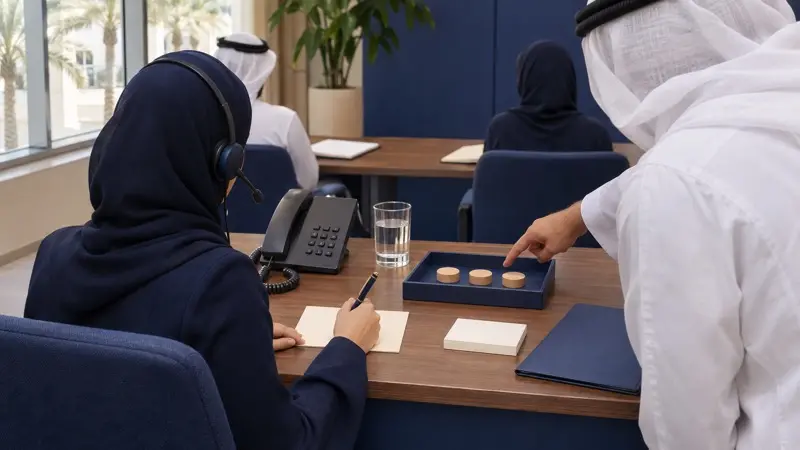
Telephone and Front Desk Communication Course
This 1-week course has 76 dates from November 2026 to November 2027 in 54 cities and live online. The next date runs 23 – 27 November 2026, live online. Fees per participant run from €4,100 (Casablanca) to €14,000 (San Diego) in a classroom, and from €1,500 live online.

- Duration
- 1 Week5 days
- Scheduled dates
- 76
- Classroom cities
- 54Dubai, Tbilisi, Zanzibar, Paris and more
- Format
- Classroom and live online
- Fee per participant
- €1,500–€14,000Average €5,750
What does this course cover?
Overview
Telephone and Front Desk Communication Skills Training Course is a one-week foundation course for receptionists, switchboard staff, front-desk coordinators, administrative assistants, and office-support staff who leave with a Telephone and Front Desk Communication Toolkit. Participants practice professional call handling, message taking, visitor reception, call transfers, privacy boundaries, difficult caller responses, and coordination between telephone and walk-in inquiries. The course converts improvised responses into consistent communication routines. Agile Leaders Training Center develops telephone and front desk communication skills.
Who Should Attend
- Staff responsible for answering, screening, and routing incoming calls
- Teams responsible for greeting and directing walk-in visitors
- Coordinators responsible for messages, transfers, and front-desk explanations
- Administrative support staff who cover telephone and reception duties
- Supervisors responsible for call and visitor communication standards
The course assumes participants handle calls or in-person inquiries and leaves out reception workflow and time control, office administration, hospitality guest operations, contact-center management, and advanced public speaking.
Departments and Industries
The course supports departments and industries where callers and visitors form an immediate impression of service quality.
- Corporate reception and administrative services
- Healthcare clinics and professional practices
- Education and training services
- Retail, property, and business centers
- Finance and professional-service offices
Learning Objectives
By the end of this course, participants will be able to:
- Apply professional call opening and closing structures
- Use questioning and listening methods to clarify needs
- Build accurate messages and transfer records
- Apply visitor greeting and explanation routines
- Analyze difficult interactions for de-escalation and escalation
- Prioritize simultaneous calls and walk-in inquiries
Course Agenda
Day 1: Telephone Communication Foundations
- Professional Call Opening Structure
- Caller Identification and Purpose Check
- Voice Tone, Pace, and Wording Guide
- Active Listening and Clarifying Question Sequence
- Professional Call Closing Checklist
Day 2: Call Control and Message Accuracy
- Incoming Call Control Flow
- Hold Permission and Return Script
- Warm Transfer Handover Procedure
- Accurate Message Capture Template
- Call-Back Commitment Record
Day 3: Front Desk Visitor Communication
- Visitor Greeting and Acknowledgement Routine
- Visit Purpose Clarification Guide
- Front-Desk Explanation Frame
- Waiting-Time Update Wording
- Personal Information Boundary Checklist
Day 4: Difficult Contacts and Coordination
- Difficult Caller De-escalation Sequence
- Impatient Visitor Response Model
- Communication Escalation Decision Map
- Call-and-Visitor Priority Matrix
- Front-Desk Communication Handover Sheet
Day 5: Telephone and Front Desk Practice
- Exercise: Open, Clarify, and Close a Call
- Exercise: Hold, Transfer, and Record a Message
- Exercise: Greet and Explain to a Visitor
- Exercise: Coordinate a Difficult Caller and Waiting Visitor
- Capstone: Telephone and Front Desk Communication Toolkit
Practical Exercises
The course uses suggested activities drawn from clinics, education services, business centers, and professional offices.
- Suggested activity: answer a call, identify its purpose, clarify the request, and close with confirmed next steps.
- Suggested activity: place a caller on hold, complete a warm transfer, and capture an accurate message when transfer fails.
- Suggested activity: greet a visitor, explain a delay, and protect personal information.
- Suggested activity: prioritize a difficult caller and a waiting walk-in while preparing an escalation handover.
FAQs
Who suits telephone and front desk communication training, and what does it assume?
Receptionists, switchboard staff, front-desk coordinators, administrative assistants, office-support staff, and their supervisors suit the training; it assumes routine responsibility for calls or in-person inquiries.
How does telephone and front desk communication differ from reception workflow training?
Telephone and front desk communication focuses on words, tone, listening, messages, transfers, visitor explanations, privacy, and difficult interactions rather than schedules, task priorities, workspace controls, and administrative workflow.
What information should accurate telephone message taking capture?
Accurate telephone message taking should capture the caller's identity, organization when relevant, contact route, intended recipient, purpose, urgency, promised action, and the time the message was received.
How should front desk staff manage a difficult caller while a visitor waits?
Front desk staff should acknowledge both people, assess urgency and risk, explain the next step, protect private information, use calm wording, and escalate when authority or specialist support is required.
Conclusion
Participants take back a Telephone and Front Desk Communication Toolkit containing call structures, listening sequences, hold and transfer procedures, message templates, visitor routines, privacy checks, priority matrices, and handover sheets. It changes improvised contact handling into consistent communication routines. The toolkit supports clear coordination when callers and visitors require attention at the same time.
credits: 5 credit per day
Course Mode: full-time
Provider: Agile Leaders Training Center
-
Events for this Course
-
Zoom 23 – 27 November 2026
-
Dubai 30 November – 4 December 2026
-
Tbilisi 30 November – 4 December 2026
-
Zanzibar 6 – 10 December 2026
-
Paris 7 – 11 December 2026
-
Prague 14 – 18 December 2026
-
Rome 21 – 25 December 2026
-
Abu Dhabi 21 – 25 December 2026
-
Kuwait 27 – 31 December 2026
-
Langkawi 3 – 7 January 2027
-
Munich 11 – 15 January 2027
-
London 18 – 22 January 2027
-
Vienna 18 – 22 January 2027
-
Geneva 24 – 28 January 2027
-
Dubai 25 – 29 January 2027
-
Casablanca 1 – 5 February 2027
-
Abu Dhabi 1 – 5 February 2027
-
Bali 7 – 11 February 2027
-
Singapore 15 – 19 February 2027
-
Seoul 22 – 26 February 2027
-
Sharm El-Sheikh 1 – 5 March 2027
-
Amsterdam 1 – 5 March 2027
-
Lagos 7 – 11 March 2027
-
Rome 8 – 12 March 2027
-
Trabzon 14 – 18 March 2027
-
London 15 – 19 March 2027
-
Lisbon 22 – 26 March 2027
-
Amman 28 March – 1 April 2027
-
Istanbul 29 March – 2 April 2027
-
Kuala Lumpur 5 – 9 April 2027
-
Tokyo 5 – 9 April 2027
-
Dubai 12 – 16 April 2027
-
Montreux 12 – 16 April 2027
-
Madrid 19 – 23 April 2027
-
Johannesburg 25 – 29 April 2027
-
Doha 2 – 6 May 2027
-
Chicago 9 – 13 May 2027
-
Vienna 17 – 21 May 2027
-
Milan 24 – 28 May 2027
-
London 31 May – 4 June 2027
-
Nice 31 May – 4 June 2027
-
Manama 6 – 10 June 2027
-
Jakarta 14 – 18 June 2027
-
Addis Ababa 14 – 18 June 2027
-
Abu Dhabi 21 – 25 June 2027
-
Marbella 27 June – 1 July 2027
-
Dubai 28 June – 2 July 2027
-
Muscat 4 – 8 July 2027
-
Kuala Lumpur 5 – 9 July 2027
-
Phuket 11 – 15 July 2027
-
Paris 12 – 16 July 2027
-
Baku 19 – 23 July 2027
-
Barcelona 26 – 30 July 2027
-
Amsterdam 26 – 30 July 2027
-
San Diego 2 – 6 August 2027
-
Cairo 9 – 13 August 2027
-
Accra 9 – 13 August 2027
-
Manama 15 – 19 August 2027
-
Toronto 22 – 26 August 2027
-
Istanbul 30 August – 3 September 2027
-
Madrid 30 August – 3 September 2027
-
Berlin 6 – 10 September 2027
-
Frankfurt 13 – 17 September 2027
-
Nairobi 19 – 23 September 2027
-
Tashkent 26 – 30 September 2027
-
Athens 4 – 8 October 2027
-
Abu Dhabi 11 – 15 October 2027
-
Barcelona 18 – 22 October 2027
-
Milan 18 – 22 October 2027
-
Cape town 24 – 28 October 2027
-
Cairo 1 – 5 November 2027
-
Amsterdam 1 – 5 November 2027
-
Porto 8 – 12 November 2027
-
London 15 – 19 November 2027
-
New York 15 – 19 November 2027
-
Bangkok 21 – 25 November 2027
When and where does this course run?
| Image | Location | Dates | Duration | Mode | Price | Actions |
|---|---|---|---|---|---|---|

|
Zoom |
Week 48, 2026 23 – 27 November 2026 |
1 Week | Online | €1,500 | |

|
Dubai |
Week 49, 2026 30 November – 4 December 2026 |
1 Week | Onsite | €4,500 | |

|
Tbilisi |
Week 49, 2026 30 November – 4 December 2026 |
1 Week | Onsite | €5,000 | |

|
Zanzibar |
Week 49, 2026 6 – 10 December 2026 |
1 Week | Onsite | €5,500 | |

|
Paris |
Week 50, 2026 7 – 11 December 2026 |
1 Week | Onsite | €5,700 | |

|
Prague |
Week 51, 2026 14 – 18 December 2026 |
1 Week | Onsite | €6,000 | |

|
Rome |
Week 52, 2026 21 – 25 December 2026 |
1 Week | Onsite | €5,700 | |

|
Abu Dhabi |
Week 52, 2026 21 – 25 December 2026 |
1 Week | Onsite | €4,700 | |

|
Kuwait |
Week 52, 2026 27 – 31 December 2026 |
1 Week | Onsite | €5,500 | |

|
Langkawi |
Week 53, 2027 3 – 7 January 2027 |
1 Week | Onsite | €6,000 | |

|
Munich |
Week 02, 2027 11 – 15 January 2027 |
1 Week | Onsite | €5,700 | |

|
London |
Week 03, 2027 18 – 22 January 2027 |
1 Week | Onsite | €5,700 | |

|
Vienna |
Week 03, 2027 18 – 22 January 2027 |
1 Week | Onsite | €5,700 | |

|
Geneva |
Week 03, 2027 24 – 28 January 2027 |
1 Week | Onsite | €6,200 | |
|
|
Dubai |
Week 04, 2027 25 – 29 January 2027 |
1 Week | Onsite | €4,500 | |

|
Casablanca |
Week 05, 2027 1 – 5 February 2027 |
1 Week | Onsite | €4,100 | |
|
|
Abu Dhabi |
Week 05, 2027 1 – 5 February 2027 |
1 Week | Onsite | €4,700 | |

|
Bali |
Week 05, 2027 7 – 11 February 2027 |
1 Week | Onsite | €5,700 | |

|
Singapore |
Week 07, 2027 15 – 19 February 2027 |
1 Week | Onsite | €6,580 | |

|
Seoul |
Week 08, 2027 22 – 26 February 2027 |
1 Week | Onsite | €10,000 |
Frequently asked questions
When does this course next run?
The next date runs 23 – 27 November 2026, live online. It is one of 76 dates scheduled up to November 2027.
Where is this course held?
In a classroom in 54 cities: Dubai, Tbilisi, Zanzibar, Paris, Prague, Rome, Abu Dhabi, Kuwait, and more. It is also scheduled as live online sessions.
Can I attend this course online?
Yes. One date is scheduled as a live online session: 23 – 27 November 2026, from €1,500 per participant.
How long is the course?
1 Week. Each date shows its start and end dates.
How much does the course cost?
Fees per participant run from €4,100 (Casablanca) to €14,000 (San Diego) in a classroom, and from €1,500 live online. Each date shows its own fee.
What does this course cover?
OverviewTelephone and Front Desk Communication Skills Training Course is a one-week foundation course for receptionists, switchboard staff, front-desk coordinators, administrative assistants, and office-support staff who leave with a Telephone and Front Desk Communication Toolkit. Participants practice professional call handling, message taking, visitor r…
Are training dates available?
Yes. Available dates and destinations are listed in the course dates section on this page.
How can I register?
Choose an available date on this page and complete the registration form, or send a programme enquiry.
Can I download the course brochure?
Yes. Use the brochure download link provided on this page.
Can this course be run for our team?
Yes. Tell us the number of participants and your preferred dates and city through our training request form.
This course by city
- Secretarial and Administration Training Courses in Abu Dhabi
- Secretarial and Administration Training Courses in Accra
- Secretarial and Administration Training Courses in Addis Ababa
- Secretarial and Administration Training Courses in Amman
- Secretarial and Administration Training Courses in Amsterdam
- Secretarial and Administration Training Courses in Athens
- Secretarial and Administration Training Courses in Baku
- Secretarial and Administration Training Courses in Bali
- Secretarial and Administration Training Courses in Bangkok
- Secretarial and Administration Training Courses in Barcelona
- Secretarial and Administration Training Courses in Berlin
- Secretarial and Administration Training Courses in Cairo
- Secretarial and Administration Training Courses in Cape town
- Secretarial and Administration Training Courses in Casablanca
- Secretarial and Administration Training Courses in Chicago
- Secretarial and Administration Training Courses in Doha
- Secretarial and Administration Training Courses in Dubai
- Secretarial and Administration Training Courses in Frankfurt
- Secretarial and Administration Training Courses in Geneva
- Secretarial and Administration Training Courses in Istanbul
- Secretarial and Administration Training Courses in Jakarta
- Secretarial and Administration Training Courses in Johannesburg
- Secretarial and Administration Training Courses in Kuala Lumpur
- Secretarial and Administration Training Courses in Kuwait
- Secretarial and Administration Training Courses in Lagos
- Secretarial and Administration Training Courses in Langkawi
- Secretarial and Administration Training Courses in Lisbon
- Secretarial and Administration Training Courses in London
- Secretarial and Administration Training Courses in Madrid
- Secretarial and Administration Training Courses in Manama
- Secretarial and Administration Training Courses in Marbella
- Secretarial and Administration Training Courses in Milan
- Secretarial and Administration Training Courses in Montreux
- Secretarial and Administration Training Courses in Munich
- Secretarial and Administration Training Courses in Muscat
- Secretarial and Administration Training Courses in Nairobi
- Secretarial and Administration Training Courses in New York
- Secretarial and Administration Training Courses in Nice
- Secretarial and Administration Training Courses in Paris
- Secretarial and Administration Training Courses in Phuket
- Secretarial and Administration Training Courses in Porto
- Secretarial and Administration Training Courses in Prague
- Secretarial and Administration Training Courses in Rome
- Secretarial and Administration Training Courses in San Diego
- Secretarial and Administration Training Courses in Seoul
- Secretarial and Administration Training Courses in Sharm El-Sheikh
- Secretarial and Administration Training Courses in Singapore
- Secretarial and Administration Training Courses in Tashkent
- Secretarial and Administration Training Courses in Tbilisi
- Secretarial and Administration Training Courses in Tokyo
- Secretarial and Administration Training Courses in Toronto
- Secretarial and Administration Training Courses in Trabzon
- Secretarial and Administration Training Courses in Vienna
- Secretarial and Administration Training Courses in Zanzibar
- Secretarial and Administration Training Courses in Zoom
More ways to train
- Every date of this courseAll cities and months, with fees
- Secretarial and Administration Training CoursesEvery course in this subject
- Live online coursesTrain from wherever you are
- Training citiesCourses in each city
- All upcoming datesThe course calendar by month
- Training for your teamTell us the course, the number of participants and your dates
- Contact usAsk us about this course