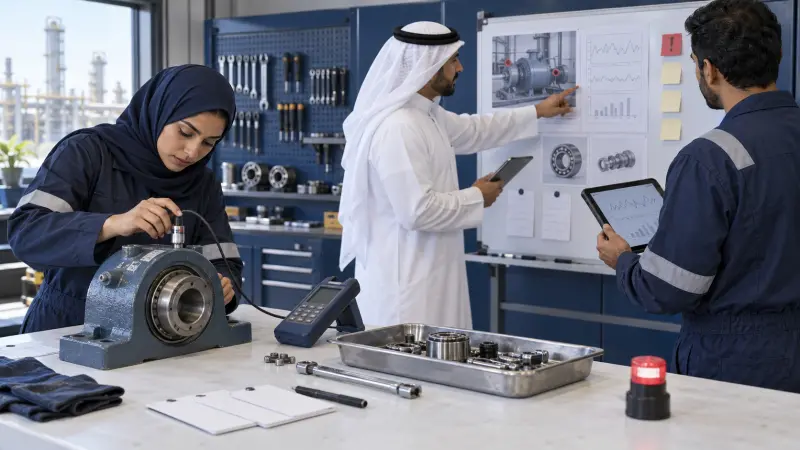
Turbine Condition Monitoring and Planning Course

At a glance
- Duration
- 1 Week
- Format
- Classroom
- Cities
- Doha, Trabzon, Johannesburg, Langkawi, Montreux, Manama and more
- Next session
- 8 – 12 November 2026, Doha
- Average fee
- 7,500 €
Overview
Turbine Condition Monitoring and Maintenance Planning Training Course is a one-week advanced course for turbine maintenance, reliability, vibration, and planning teams who leave with a Turbine Condition-to-Maintenance Decision Pack. The course connects turbine vibration severity, rotor dynamic evidence, bearing condition, lube-oil analysis, thermal inspection, performance trend analysis, failure-mode diagnosis, condition-based work scope, outage planning, and return-to-service evidence. Agile Leaders Training Center delivers this course on turbine condition monitoring and maintenance planning.
Who Should Attend
- Teams responsible for gas and steam turbine condition monitoring and diagnostic evidence
- Functions responsible for vibration acquisition, analysis, alarms, trends, and machinery protection
- Teams responsible for turbine maintenance strategy, work scope, outage planning, and execution readiness
- Functions responsible for lubrication evidence, thermal inspection, performance monitoring, and reliability
- Teams responsible for inspection findings, failure risk, corrective actions, and return-to-service decisions
The course assumes participants already work with turbine operating data, vibration measurements, inspection records, or maintenance plans and leaves out introductory turbine thermodynamics, sensor installation authorization, and live intrusive work.
Departments and Industries
The course supports turbine condition and maintenance decisions across power and process operations.
- Mechanical maintenance, reliability, condition monitoring, and outage planning
- Power generation, utilities, industrial energy, and cogeneration operations
- Oil and gas, petrochemical, refining, mining, and metals facilities
- Marine propulsion, pipeline compression, manufacturing, and process industries
- Engineering services, technical assurance, inspection, and asset management
Learning Objectives
By the end of this course, participants will be able to:
- Build a turbine condition-monitoring evidence plan.
- Analyze vibration, rotor, bearing, oil, thermal, and performance evidence.
- Diagnose turbine failure modes from correlated symptoms.
- Evaluate risk, confidence, urgency, and operating boundaries.
- Prioritize condition-based work scope and outage actions.
- Build a return-to-service decision pack.
Course Agenda
Day 1: Establish Turbine Evidence
- Turbine Train, Rotor, Bearing, Coupling, Seal, Casing, and Support-System Map
- Operating Mode, Load, Speed, Temperature, Pressure, and Baseline Condition Register
- Sensor Location, Measurement Direction, Sampling, Quality, and Data-Lineage Plan
- ISO 20816-4 Scope, Applicability, Exclusion, and Vibration Evaluation Map
- Condition Indicator, Alert, Alarm, Trip, Trend, and Escalation Matrix
Day 2: Interpret Vibration Behavior
- Shaft Relative, Casing Absolute, Radial, Axial, and Thrust Vibration Evidence Sheet
- Time Waveform, Spectrum, Phase, Orbit, Centerline, and Waterfall Interpretation Method
- Run-Up, Coast-Down, Critical-Speed, Load-Change, and Transient Response Plot
- Unbalance, Misalignment, Rub, Looseness, Oil Whirl, and Oil Whip Symptom Matrix
- Bearing Clearance, Support Stiffness, Thermal Growth, Coupling, and Rotor-Dynamic Fault Tree
Day 3: Correlate Condition Sources
- Lube-Oil Particle, Wear-Metal, Viscosity, Moisture, and Contamination Evidence Table
- Thermography, Bearing-Metal Temperature, Exhaust Spread, and Hot-Spot Review
- Performance Trend, Heat Rate, Pressure Ratio, Flow, Efficiency, and Degradation Chart
- Alarm Sequence, Event Log, Startup Curve, Shutdown Curve, and Operating-Context Timeline
- Borescope, Clearance, Seal, Blade, Combustion, and Inspection-Finding Correlation Matrix
Day 4: Plan Maintenance Actions
- Failure Mode, Consequence, Condition Indicator, Confidence, and Risk-Priority Register
- Continue, Monitor, Load-Restrict, Inspect, Repair, or Stop Decision Tree
- Condition-Based Work Scope, Task, Skill, Tool, Material, Access, and Hold-Point Plan
- Outage Window, Opportunity Work, Dependency, Critical Path, and Contingency Map
- Post-Maintenance Test, Acceptance Criterion, Baseline Reset, and Return-to-Service Checklist
Day 5: Practice Turbine Decisions
- Exercise: Build the Turbine Train, Baseline, Sensor, and Evidence Map
- Exercise: Diagnose Vibration, Rotor-Dynamic, Bearing, and Support Symptoms
- Exercise: Correlate Oil, Thermal, Performance, Alarm, and Inspection Evidence
- Exercise: Prioritize Risk, Work Scope, Outage Timing, and Acceptance Actions
- Capstone Exercise: Build the Turbine Condition-to-Maintenance Decision Pack
Practical Exercises
The course uses suggested activities to connect turbine evidence with controlled maintenance plans.
- Suggested activity: compare baselines, spectra, waveforms, phases, orbits, trends, and transient plots.
- Suggested activity: correlate vibration symptoms with oil, thermal, performance, alarm, and inspection evidence.
- Suggested activity: build a risk-based work scope with tasks, resources, dependencies, hold points, and contingencies.
- Suggested activity: define post-maintenance tests, acceptance evidence, baseline reset, and return-to-service controls.
FAQs
Who should attend turbine condition monitoring and maintenance planning training?
Turbine condition monitoring and maintenance planning training suits experienced maintenance, reliability, vibration, inspection, performance, and planning teams and assumes familiarity with turbine operating data, machinery measurements, or maintenance records.
How does turbine condition monitoring differ from general predictive maintenance training?
Turbine condition monitoring focuses on turbine trains, rotor dynamics, bearings, transients, performance, inspection findings, outage scope, and return-to-service evidence, while general predictive maintenance addresses a wider equipment population and technique selection.
How are turbine vibration findings converted into maintenance actions?
Turbine vibration findings become maintenance actions by confirming data quality and operating context, correlating symptoms across sources, identifying plausible failure modes, assessing risk and confidence, and defining a condition-based work scope.
What evidence supports turbine return-to-service decisions?
Turbine return-to-service decisions use completed work records, post-maintenance tests, acceptable vibration and performance behavior, resolved alarms, verified clearances and inspections, updated baselines, and authorized acceptance criteria.
Conclusion
Participants take back a Turbine Condition-to-Maintenance Decision Pack. The pack connects operating context, vibration, oil, thermal, performance, alarms, inspections, failure modes, risk, work scope, outage timing, and acceptance evidence. It changes separate condition signals into a traceable basis for maintenance planning and return-to-service decisions.
credits: 5 credit per day
Course Mode: full-time
Provider: Agile Leaders Training Center
-
Events for this Course
-
Doha 8 – 12 November 2026
-
Trabzon 8 – 12 November 2026
-
Johannesburg 15 – 19 November 2026
-
Langkawi 22 – 26 November 2026
-
Montreux 23 – 27 November 2026
-
Manama 29 November – 3 December 2026
-
Berlin 7 – 11 December 2026
-
Sharm El-Sheikh 14 – 18 December 2026
-
Kuwait 20 – 24 December 2026
-
Tokyo 21 – 25 December 2026
-
New York 4 – 8 January 2027
-
San Diego 18 – 22 January 2027
-
Baku 25 – 29 January 2027
-
Abu Dhabi 25 – 29 January 2027
-
Geneva 31 January – 4 February 2027
-
Chicago 7 – 11 February 2027
-
Dubai 8 – 12 February 2027
-
Cairo 15 – 19 February 2027
-
Amman 21 – 25 February 2027
-
Toronto 21 – 25 February 2027
-
Frankfurt 8 – 12 March 2027
-
Kuala Lumpur 15 – 19 March 2027
-
Lisbon 15 – 19 March 2027
-
Nairobi 4 – 8 April 2027
-
Cape town 11 – 15 April 2027
-
Athens 19 – 23 April 2027
-
Tbilisi 3 – 7 May 2027
-
Bali 9 – 13 May 2027
-
Seoul 10 – 14 May 2027
-
Amsterdam 17 – 21 May 2027
-
Singapore 17 – 21 May 2027
-
Accra 30 May – 3 June 2027
-
Prague 7 – 11 June 2027
-
Vienna 14 – 18 June 2027
-
London 21 – 25 June 2027
-
Muscat 27 June – 1 July 2027
-
Rome 28 June – 2 July 2027
-
Casablanca 5 – 9 July 2027
-
Abu Dhabi 5 – 9 July 2027
-
Nice 12 – 16 July 2027
-
Dubai 19 – 23 July 2027
-
Lagos 1 – 5 August 2027
-
Jakarta 2 – 6 August 2027
-
Addis Ababa 9 – 13 August 2027
-
Istanbul 16 – 20 August 2027
-
Porto 16 – 20 August 2027
-
Milan 23 – 27 August 2027
-
Zoom 30 August – 3 September 2027
-
Paris 13 – 17 September 2027
-
Zanzibar 26 – 30 September 2027
-
Munich 4 – 8 October 2027
-
London 11 – 15 October 2027
-
Phuket 17 – 21 October 2027
-
Marbella 24 – 28 October 2027
-
Madrid 25 – 29 October 2027
-
Barcelona 1 – 5 November 2027
-
Bangkok 7 – 11 November 2027
-
Tashkent 7 – 11 November 2027
| Image | Location | Dates | Duration | Mode | Price | Actions |
|---|---|---|---|---|---|---|

|
Doha |
Week 45, 2026 8 – 12 November 2026 |
1 Week | Onsite | €7,000 | |

|
Trabzon |
Week 45, 2026 8 – 12 November 2026 |
1 Week | Onsite | €8,000 | |

|
Johannesburg |
Week 46, 2026 15 – 19 November 2026 |
1 Week | Onsite | €6,000 | |

|
Langkawi |
Week 47, 2026 22 – 26 November 2026 |
1 Week | Onsite | €8,000 | |

|
Montreux |
Week 48, 2026 23 – 27 November 2026 |
1 Week | Onsite | €8,000 | |

|
Manama |
Week 48, 2026 29 November – 3 December 2026 |
1 Week | Onsite | €6,500 | |

|
Berlin |
Week 50, 2026 7 – 11 December 2026 |
1 Week | Onsite | €6,500 | |

|
Sharm El-Sheikh |
Week 51, 2026 14 – 18 December 2026 |
1 Week | Onsite | €5,200 | |

|
Kuwait |
Week 51, 2026 20 – 24 December 2026 |
1 Week | Onsite | €7,000 | |

|
Tokyo |
Week 52, 2026 21 – 25 December 2026 |
1 Week | Onsite | €12,000 | |

|
New York |
Week 01, 2027 4 – 8 January 2027 |
1 Week | Onsite | €16,000 | |

|
San Diego |
Week 03, 2027 18 – 22 January 2027 |
1 Week | Onsite | €16,000 | |

|
Baku |
Week 04, 2027 25 – 29 January 2027 |
1 Week | Onsite | €8,000 | |

|
Abu Dhabi |
Week 04, 2027 25 – 29 January 2027 |
1 Week | Onsite | €6,500 | |

|
Geneva |
Week 04, 2027 31 January – 4 February 2027 |
1 Week | Onsite | €8,000 | |

|
Chicago |
Week 05, 2027 7 – 11 February 2027 |
1 Week | Onsite | €16,000 | |

|
Dubai |
Week 06, 2027 8 – 12 February 2027 |
1 Week | Onsite | €6,500 | |

|
Cairo |
Week 07, 2027 15 – 19 February 2027 |
1 Week | Onsite | €5,200 | |

|
Amman |
Week 07, 2027 21 – 25 February 2027 |
1 Week | Onsite | €6,000 | |

|
Toronto |
Week 07, 2027 21 – 25 February 2027 |
1 Week | Onsite | €16,000 |
Frequently asked questions
What does this course cover?
OverviewTurbine Condition Monitoring and Maintenance Planning Training Course is a one-week advanced course for turbine maintenance, reliability, vibration, and planning teams who leave with a Turbine Condition-to-Maintenance Decision Pack. The course connects turbine vibration severity, rotor dynamic evidence, bearing condition, lube-oil analysis, therma…
Are training dates available?
Yes. Available dates and destinations are listed in the course dates section on this page.
How can I register?
Choose an available date on this page and complete the registration form, or send a programme enquiry.
Can I download the course brochure?
Yes. Use the brochure download link provided on this page.
This course by city
- Maintenance Training and Engineering Training Courses in Abu Dhabi
- Maintenance Training and Engineering Training Courses in Accra
- Maintenance Training and Engineering Training Courses in Addis Ababa
- Maintenance Training and Engineering Training Courses in Amman
- Maintenance Training and Engineering Training Courses in Amsterdam
- Maintenance Training and Engineering Training Courses in Athens
- Maintenance Training and Engineering Training Courses in Baku
- Maintenance Training and Engineering Training Courses in Bali
- Maintenance Training and Engineering Training Courses in Bangkok
- Maintenance Training and Engineering Training Courses in Barcelona
- Maintenance Training and Engineering Training Courses in Berlin
- Maintenance Training and Engineering Training Courses in Cairo
- Maintenance Training and Engineering Training Courses in Cape town
- Maintenance Training and Engineering Training Courses in Casablanca
- Maintenance Training and Engineering Training Courses in Chicago
- Maintenance Training and Engineering Training Courses in Doha
- Maintenance Training and Engineering Training Courses in Dubai
- Maintenance Training and Engineering Training Courses in Frankfurt
- Maintenance Training and Engineering Training Courses in Geneva
- Maintenance Training and Engineering Training Courses in Istanbul
- Maintenance Training and Engineering Training Courses in Jakarta
- Maintenance Training and Engineering Training Courses in Johannesburg
- Maintenance Training and Engineering Training Courses in Kuala Lumpur
- Maintenance Training and Engineering Training Courses in Kuwait
- Maintenance Training and Engineering Training Courses in Lagos
- Maintenance Training and Engineering Training Courses in Langkawi
- Maintenance Training and Engineering Training Courses in Lisbon
- Maintenance Training and Engineering Training Courses in London
- Maintenance Training and Engineering Training Courses in Madrid
- Maintenance Training and Engineering Training Courses in Manama
- Maintenance Training and Engineering Training Courses in Marbella
- Maintenance Training and Engineering Training Courses in Milan
- Maintenance Training and Engineering Training Courses in Montreux
- Maintenance Training and Engineering Training Courses in Munich
- Maintenance Training and Engineering Training Courses in Muscat
- Maintenance Training and Engineering Training Courses in Nairobi
- Maintenance Training and Engineering Training Courses in New York
- Maintenance Training and Engineering Training Courses in Nice
- Maintenance Training and Engineering Training Courses in Paris
- Maintenance Training and Engineering Training Courses in Phuket
- Maintenance Training and Engineering Training Courses in Porto
- Maintenance Training and Engineering Training Courses in Prague
- Maintenance Training and Engineering Training Courses in Rome
- Maintenance Training and Engineering Training Courses in San Diego
- Maintenance Training and Engineering Training Courses in Seoul
- Maintenance Training and Engineering Training Courses in Sharm El-Sheikh
- Maintenance Training and Engineering Training Courses in Singapore
- Maintenance Training and Engineering Training Courses in Tashkent
- Maintenance Training and Engineering Training Courses in Tbilisi
- Maintenance Training and Engineering Training Courses in Tokyo
- Maintenance Training and Engineering Training Courses in Toronto
- Maintenance Training and Engineering Training Courses in Trabzon
- Maintenance Training and Engineering Training Courses in Vienna
- Maintenance Training and Engineering Training Courses in Zanzibar
- Maintenance Training and Engineering Training Courses in Zoom