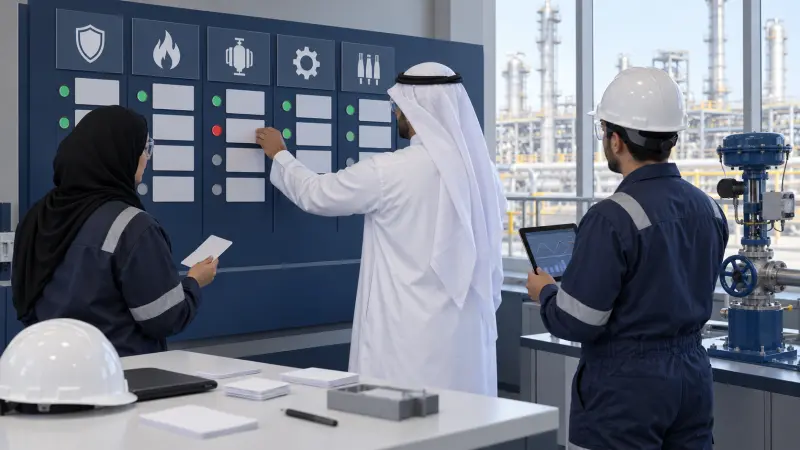
Process Safety Management in High-Risk Industries Course

Course Details
-
# 103600352_101110
-
11 – 15 October 2027 15.Oct.2027
-
Munich
-
5700 €
Overview
Major hazard installations handle volatile chemicals and high pressures where mechanical breaches or unexpected process deviations can trigger catastrophic damage. The Process Safety Management in High-Risk Industries Course equips plant engineers and technical specialists with disciplined containment methodologies to safeguard facility uptime. Participants explore technical barrier integrity, safe operating limits, and asset reliability protocols designed to prevent unplanned releases, toxic clouds, and vapor cloud explosions. By evaluating the mechanical envelope, instrumentation thresholds, and critical plant safeguards, technical personnel maintain effective barriers against major accident hazards. This course is delivered by Agile Leaders Training Center.
Who Should Attend
- HSE supervisors directing loss prevention and technical containment programs.
- Chemical and mechanical engineers conducting process hazard evaluations.
- Plant uptime managers and maintenance superintendents overseeing mechanical integrity.
- Technical advisors inspecting pressure vessels, isolation valves, and relief devices.
- Site loss prevention coordinators monitoring barrier health and operating envelopes.
Departments and Industries
This program supports technical teams responsible for pressure containment, plant reliability, and asset integrity across volatile operating environments.
- Loss Prevention and Asset Integrity Units
- Petrochemical Refining and Bulk Chemical Processing Facilities
- Oil and Gas Extraction and Pipeline Terminals
- Pharmaceutical Synthesis and Specialty Chemical Plants
- Thermal Power Generation and Utility Processing Stations
Learning Objectives
By the end of this course, participants will be able to:
- Apply loss of containment prevention principles across complex chemical processing units.
- Execute process hazard evaluations using HAZOP, Bowtie analysis, and failure mode reviews.
- Verify protective barrier integrity utilizing the FARSI model across equipment lifecycles.
- Determine safe operating envelopes to prevent thermal runaways and overpressurization.
- Formulate secondary containment safeguards for bulk chemical storage tanks and transfer manifolds.
- Coordinate site emergency mitigation drills to respond swiftly to hazardous chemical releases.
- Establish leading barrier health metrics to monitor safety-critical equipment availability.
Course Agenda
Day 1: Major Hazard Governance and Containment Principles
- Process containment fundamentals versus personnel injury prevention
- Technical barrier integrity frameworks and defense-in-depth principles
- Safe operating envelopes and parameter threshold definitions
- Root cause mechanisms behind severe loss of containment events
- Management of change controls for plant piping and instrumentation alterations
- Human factor influences on procedural adherence and valve line-up accuracy
Day 2: Barrier Integrity and Hazard Identification Methods
- HAZOP methodology application for continuous chemical flow schemes
- Bowtie analysis mapping for loss of containment scenarios
- ALARP principles application for plant modification justification
- Safe isolation of plant equipment and energy blanking verifications
- Shift handover protocols for communicating unresolved process upsets
- Permit-to-work integration with asset isolation procedures
Day 3: Safety-Critical Equipment and Plant State Controls
- Safety-critical equipment classification and performance standards
- FARSI model evaluation: Functionality, Availability, Reliability, Survivability, and Interdependency
- Transient state governance during plant startup, turnaround, and emergency shutdowns
- Instrumented protective systems, trip alarms, and interlock overrides
- Static electricity accumulation mitigation and bonding circuit verification
- Preventive maintenance regimes for emergency depressuring valves
Day 4: Chemical Containment and Reaction Energetics
- Bulk chemical storage tank integrity and bunded containment design
- Reaction energetics, thermal runaway identification, and venting calculations
- Toxic vapor dispersion mechanics and atmospheric release mitigation
- Flammable chemical storage segregation and warehouse fire separation
- Corrosion monitoring programs and ultrasonic wall-thickness inspections
- Rupture disk integration with pressure relief valve assemblies
Day 5: Thermal Runaway, Fire Dynamics, and Emergency Mitigations
- Combustion dynamics: BLEVE events, jet fires, and pool fire radiation
- Deluge water spray design and foam containment systems for tank farms
- Combustible dust cloud suppression and venting panel placement
- Facility emergency response planning and community alerting protocols
- Leading barrier health metrics and safety-critical dashboard design
- Action plan development for addressing asset integrity vulnerabilities
Practical Exercises
Participants apply containment principles and asset integrity techniques to realistic processing plant scenarios.
- Build a Bowtie analysis diagram mapping prevention and mitigation barriers for a hydrocarbon release scenario.
- Complete a FARSI model evaluation matrix for high-pressure safety-critical equipment.
- Review an engineering piping modification using structured management of change protocols.
- Construct a plant barrier health dashboard tracking pressure relief valve testing intervals.
FAQs
Do participants need any prior qualifications before attending?
No formal prerequisites are mandatory to attend this course. However, participants benefit most if they possess a baseline familiarity with plant machinery, piping diagrams, or processing plant environments.
How long is the course, and what is the daily schedule?
The course runs for 5 instructional days. Each daily session spans approximately 4 to 5 hours of guided technical presentations and applied scenario exercises, providing 20 to 25 contact hours.
What is the FARSI model and how is it applied?
The FARSI model evaluates protective equipment against five criteria: Functionality, Availability, Reliability, Survivability, and Interdependency. Technical teams use it to verify that vital process barriers withstand abnormal thermal and pressure conditions.
Conclusion
Maintaining asset integrity in high-hazard environments demands continuous discipline and rigorous technical barriers. By mastering containment engineering, equipment reliability verification, and structured hazard evaluations, technical specialists protect plant personnel, surrounding communities, and critical processing infrastructure from catastrophic releases.
Occupational Health, Safety and Security Training Courses
Process Safety Management in High-Risk Industries Course (103600352_101110)
Course Details
# 103600352_101110
11 – 15 October 2027
Munich
Fees : 5700 €
Process Safety Management in High-Risk Industries Course runs in Munich over 5 days, with 1 upcoming date in Munich. The course fee is 5,700 €.
All dates in Munich
| Dates | Price | Actions |
|---|---|---|
| 11 – 15 October 2027 | 5,700 € | Register |
Training in Munich
Experience our top-notch training courses in Munich. Join one of our training courses in Austria Today!
All courses in MunichThis course in other cities
- Abu Dhabi
- Accra
- Amman
- Amsterdam
- Athens
- Baku
- Bali
- Bangkok
- Barcelona
- Berlin
- Cairo
- Cape town
- Casablanca
- Chicago
- Doha
- Dubai
- Frankfurt
- Geneva
- Istanbul
- Jakarta
- Johannesburg
- Kuala Lumpur
- Kuwait
- Langkawi
- Lisbon
- London
- Madrid
- Manama
- Marbella
- Milan
- Montreux
- Muscat
- Nairobi
- New York
- Nice
- Paris
- Phuket
- Porto
- Prague
- Rome
- San Diego
- Seoul
- Sharm El-Sheikh
- Singapore
- Tashkent
- Tbilisi
- Tokyo
- Toronto
- Trabzon
- Vienna
- Zanzibar
- Zoom