Metaverse Experience Design and Prototyping Course
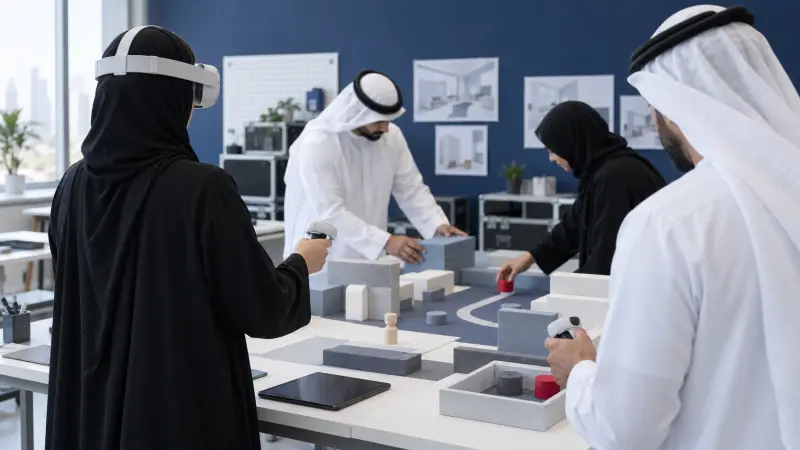
Course Details
-
# 316_126540
-
11 – 15 January 2027 15.Jan.2027
-
Amsterdam
-
5700 €
Overview
Metaverse Experience Design and Prototyping Course is a one-week intermediate course for software developers, immersive experience designers, digital product teams, innovation professionals, and technical project teams, who leave with a Metaverse Prototype Design Pack. Participants structure immersive experiences across virtual and augmented reality, spatial interaction, 3D assets, digital identity, blockchain concepts, AI-enabled features, trust controls, and prototype testing. Agile Leaders Training Center provides training in metaverse experience design and prototyping.
Who Should Attend
- Teams responsible for immersive product concepts and experience architecture
- Teams responsible for software prototypes and platform integration
- Teams responsible for 3D assets, spatial interfaces, and interaction design
- Teams responsible for digital identity, virtual assets, and trust controls
- Teams responsible for innovation portfolios and technical implementation planning
The course assumes participants contribute to digital product design or development and leaves out production coding, smart-contract deployment, token issuance, hardware engineering, and commercial launch.
Departments and Industries
The course supports metaverse prototyping across technology, entertainment, education, retail, property, healthcare, and industrial operations.
- Software engineering and digital product development
- Experience design, media, and entertainment
- Learning technology and simulation teams
- Retail, property, and customer experience
- Healthcare training and visualization
- Industrial operations and digital innovation
Learning Objectives
By the end of this course, participants will be able to:
- Analyze metaverse use cases, users, devices, and constraints
- Compare OpenXR, WebXR, and engine-based delivery choices
- Build spatial interaction, locomotion, and 3D asset plans
- Evaluate digital identity, blockchain, and AI feature options
- Apply privacy, safety, trust, accessibility, and moderation controls
- Build and test a Metaverse Prototype Design Pack
Course Agenda
Day 1: Experience Architecture and Platforms
- Metaverse Use Case and Value Proposition Canvas
- Virtual, Augmented, Mixed, and Extended Reality Map
- OpenXR Cross-Platform Capability Review
- WebXR Immersive Web Delivery Profile
- Device, Audience, and Context Selection Matrix
Day 2: Spatial Interaction and Content
- Three-Dimensional World and Scene Architecture
- Unity XR Interaction Toolkit Component Map
- Spatial Interaction and Input Flow Diagram
- Locomotion, Comfort, and Orientation Checklist
- Three-Dimensional Asset Budget and Production Plan
Day 3: Identity, Blockchain, and AI
- Avatar and Digital Identity Journey Map
- Virtual Asset Ownership Decision Canvas
- Blockchain and Smart-Contract Suitability Check
- AI-Enabled Character and Assistance Design
- Content Moderation and Behavior Response Matrix
Day 4: Trust, Testing, and Roadmap
- Privacy and Personal Data Flow Review
- Safety, Accessibility, and Inclusion Control Checklist
- Performance and Device Compatibility Test Plan
- Immersive Usability Observation Protocol
- Prototype Architecture and Implementation Roadmap
Day 5: Metaverse Prototype Practice
- Suggested Exercise: Frame an Immersive Use Case
- Suggested Exercise: Map Spatial Interaction and Locomotion
- Suggested Exercise: Review Identity, Asset, and AI Choices
- Suggested Exercise: Run a Trust and Usability Review
- Capstone Exercise: Metaverse Prototype Design Pack
Practical Exercises
The course uses suggested activities to connect metaverse design decisions with a testable prototype concept.
- Suggested activity: define target users, setting, devices, value, exclusions, and success criteria for an immersive use case
- Suggested activity: map a scene, user journey, interaction inputs, movement choices, content assets, and comfort controls
- Suggested activity: evaluate whether identity, virtual assets, blockchain, and AI features serve the intended experience
- Suggested activity: assemble architecture, trust controls, test criteria, responsibilities, and an implementation roadmap
FAQs
Who suits metaverse experience design and prototyping training, and what does it assume?
The course suits technical and design teams contributing to immersive products. It assumes experience with digital products, user journeys, design, or software delivery, but does not require production XR coding or blockchain deployment.
How does metaverse experience prototyping differ from virtual reality development training?
Metaverse experience prototyping combines VR and AR delivery choices with spatial interaction, identity, virtual assets, AI features, trust controls, testing, and implementation planning. Virtual reality development training typically concentrates on building applications for a specific engine or device.
What role do OpenXR and WebXR play in metaverse prototype design?
OpenXR supports cross-platform access to AR and VR devices, while WebXR supports immersive experiences delivered through compatible web environments. The course uses both to compare delivery architecture rather than teach full API implementation.
When should a metaverse prototype use blockchain or AI?
A metaverse prototype should use blockchain or AI only when a defined experience need justifies the added complexity. Participants evaluate ownership, identity, automation, virtual characters, moderation, data, risk, and operational responsibility before including either technology.
How is a metaverse prototype tested before implementation?
A metaverse prototype is tested through task flows, interaction observations, comfort checks, device compatibility, performance criteria, accessibility review, trust controls, and evidence-based decisions about what to change before implementation.
Conclusion
Participants take back a Metaverse Prototype Design Pack connecting experience architecture, platforms, spatial interaction, 3D assets, identity, blockchain, AI, trust controls, tests, and an implementation roadmap. It turns an immersive concept into a reviewable technical plan. It keeps technology choices tied to user needs and accountable decisions.
IT Security Training & IT Training Courses
Metaverse Experience Design and Prototyping Course (316_126540)
Course Details
# 316_126540
11 – 15 January 2027
Amsterdam
Fees : 5700 €