Electronic Systems Troubleshooting and Repair Training Course

Course Details
-
# 946_172249
-
11 – 15 April 2027 15.Apr.2027
-
Nairobi
-
6000 €
Overview
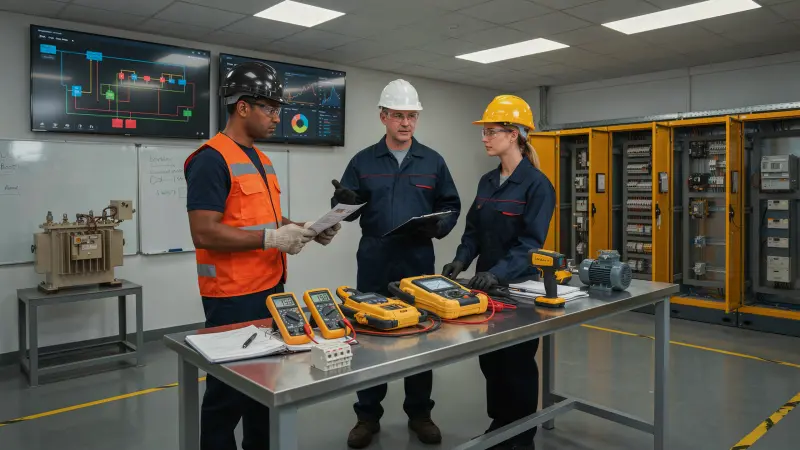
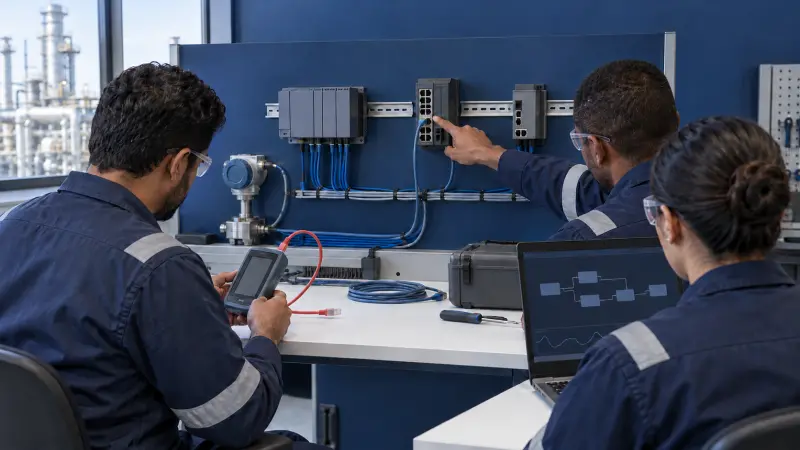
Electronic Systems Troubleshooting and Repair Training Course is a 1-week course for electronics engineers, maintenance technicians, instrumentation specialists, service engineers, and technical support professionals who leave with an Electronic Fault Isolation and Repair Evidence Portfolio. Participants connect safe measurement, functional decomposition, power-rail checks, signal tracing, analog and digital diagnosis, component testing, controlled board repair, and post-repair verification. The course replaces trial-and-error substitution with evidence-led fault isolation. Agile Leaders Training Center provides this course on electronic systems troubleshooting and repair.
Who Should Attend
Teams responsible for diagnosing electronic equipment and assemblies.
Functions responsible for instrumentation and control electronics maintenance.
Service groups responsible for board-level fault isolation and repair decisions.
Technical support teams responsible for reproducing intermittent failures.
Quality functions responsible for repair evidence and return-to-service checks.
The course assumes participants can read circuit diagrams and use basic electrical measurements, and leaves out electronic product design and introductory soldering instruction.
Departments and Industries
The course supports electronic maintenance decisions across industrial systems and equipment-service environments.
Industrial automation and process instrumentation
Manufacturing and electronic assembly services
Facilities, transport, and energy equipment maintenance
Medical and laboratory equipment support
Field service and technical repair centers
Learning Objectives
By the end of this course, participants will be able to:
Analyze electronic systems through functional blocks and signal paths.
Apply safe measurement plans to power, analog, and digital circuits.
Diagnose static, dynamic, intermittent, and interface faults.
Evaluate components and printed circuit assemblies using evidence.
Use controlled rework and repair decision criteria.
Build post-repair verification and fault documentation records.
Course Agenda
Day 1: Fault Isolation Foundations
Electronic System Functional Block Map
Symptom Reproduction and Boundary Definition
Expected-versus-Measured Evidence Table
Fault Hypothesis and Elimination Tree
Measurement Safety and ESD Control Checklist
Day 2: Power and Analog Diagnosis
Power-Rail Sequence and Loading Test Plan
Continuity and Resistance Isolation Method
Analog Signal-Path Tracing Map
Oscilloscope Probe and Trigger Selection Matrix
Noise, Distortion, and Instability Evidence Sheet
Day 3: Digital and Embedded Faults
Digital Logic State and Timing Assessment
Clock, Reset, and Boot Sequence Checklist
Serial Interface Signal Verification Plan
Intermittent Event Capture Strategy
Firmware-versus-Hardware Isolation Record
Day 4: Components, Boards, and Repair
In-Circuit and Out-of-Circuit Component Test Matrix
Thermal and Visual Inspection Evidence Map
IPC-7711/21D Repair Procedure Selection
Pad, Track, Connector, and Solder-Joint Assessment
Repair Risk and Authorization Decision Log
Day 5: Verification and Integrated Practice
Suggested Exercise: Power-Rail Fault Isolation
Suggested Exercise: Analog and Digital Signal Diagnosis
Suggested Exercise: Intermittent Failure Capture
Suggested Exercise: Repair and Return-to-Service Verification
Capstone Exercise: Electronic Fault Isolation and Repair Evidence Portfolio
Practical Exercises
The course uses suggested activities to integrate electronic troubleshooting and repair decisions.
Suggested activity: convert a reported symptom into functional boundaries, hypotheses, and measurement points.
Suggested activity: trace power, analog, and digital evidence to isolate a faulty stage or interface.
Suggested activity: compare component, thermal, waveform, and inspection evidence before authorizing repair.
Suggested activity: verify repaired function and document residual risks and return-to-service evidence.
FAQs
Who suits electronic systems troubleshooting and repair and what does it assume?
Electronics engineers, technicians, instrumentation specialists, service engineers, and support professionals suit the course. It assumes participants can read circuit diagrams and use basic measurements and excludes product design and introductory soldering.
How does electronic systems troubleshooting differ from general electrical maintenance?
Electronic systems troubleshooting follows component-level power, analog, digital, embedded, and signal evidence rather than concentrating on cables, motors, switchgear, and other power equipment.
How is an electronic fault isolated without replacing parts at random?
An electronic fault is isolated by reproducing the symptom, defining functional boundaries, predicting expected values, selecting test points, comparing measurements, and eliminating hypotheses before component removal.
Which instruments support electronic systems troubleshooting?
Electronic troubleshooting commonly uses digital multimeters, oscilloscopes, logic and interface observations, current-limited supplies, thermal inspection, and purpose-specific component tests selected for the fault hypothesis.
How is an electronic repair verified?
An electronic repair is verified through inspection, continuity and isolation checks, controlled energization, functional tests, signal and thermal observations, repeated operating conditions, and documented acceptance evidence.
Conclusion
Participants take back an Electronic Fault Isolation and Repair Evidence Portfolio linking symptoms, functional blocks, measurements, hypotheses, repair decisions, and verification. The portfolio creates traceable evidence for technical review and return-to-service approval. It reduces repeated substitutions and improves coordination among maintenance, engineering, service, quality, and operations functions.
Maintenance Training and Engineering Training Courses
Electronic Systems Troubleshooting and Repair Course (946_172249)
Course Details
# 946_172249
11 – 15 April 2027
Nairobi
Fees : 6000 €
Electronic Systems Troubleshooting and Repair Training Course runs in Nairobi over 5 days, with 1 upcoming date in Nairobi. The course fee is 6,000 €.
All dates in Nairobi
| Dates | Price | Actions |
|---|---|---|
| 11 – 15 April 2027 | 6,000 € | Register |
Training in Nairobi
Experience our top-notch training course programs in the vibrant city of Nairobi, Kenya.
All courses in NairobiThis course in other cities
- Abu Dhabi
- Accra
- Amman
- Amsterdam
- Athens
- Baku
- Bali
- Bangkok
- Barcelona
- Berlin
- Cairo
- Cape town
- Casablanca
- Chicago
- Doha
- Dubai
- Frankfurt
- Geneva
- Istanbul
- Jakarta
- Johannesburg
- Kuala Lumpur
- Kuwait
- Lagos
- Langkawi
- Lisbon
- London
- Madrid
- Manama
- Marbella
- Milan
- Montreux
- Munich
- Muscat
- New York
- Nice
- Paris
- Phuket
- Porto
- Prague
- Rome
- San Diego
- Seoul
- Sharm El-Sheikh
- Singapore
- Tashkent
- Tbilisi
- Tokyo
- Toronto
- Trabzon
- Vienna
- Zanzibar
- Zoom