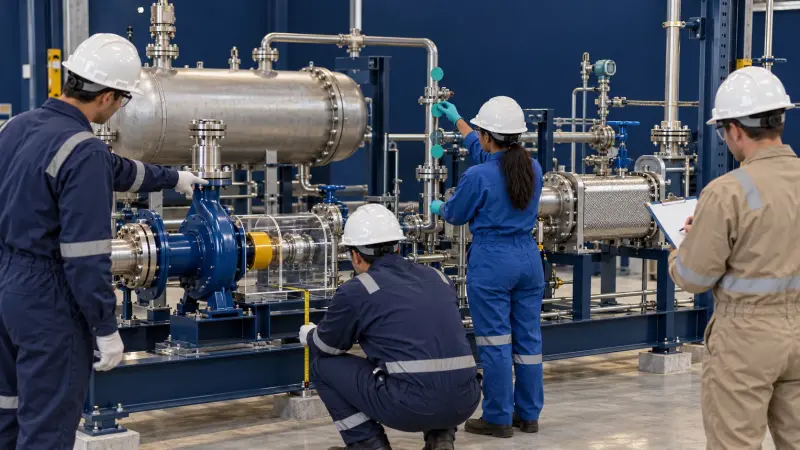
Chemical Process Modelling and Simulation Training Course

Course Details
-
# 1884_240490
-
15 – 19 February 2027 19.Feb.2027
-
Barcelona
-
6500 €
Overview
Chemical Process Modelling and Simulation Training Course is a one-week intermediate programme for chemical and process engineers, operations engineers, analysts, and project personnel who leave with a Process Model Validation Pack. Participants translate process intent and flow diagrams into components, streams, thermodynamic methods, unit-operation models, specifications, recycles, and solved steady-state flowsheets. The course emphasizes assumptions, balance closure, convergence, sensitivity, validation, uncertainty, and traceable communication rather than software-specific certification or detailed equipment design. Agile Leaders Training Center delivers this software-neutral process simulation course.
Who Should Attend
- Chemical and process engineers who build or review steady-state models
- Operations engineers who use simulation evidence for troubleshooting and studies
- Technical analysts responsible for data, cases, and model documentation
- Project personnel who review process concepts and simulation deliverables
- Graduate engineers seeking structured process-modelling practice
Participants should understand material and energy balances, basic thermodynamics, and common unit operations. The course does not authorize equipment design, relief-system sizing, operating changes, or decisions outside approved engineering governance.
Departments and Industries
The course supports oil and gas, petrochemicals, chemicals, refining, utilities, water, energy, food processing, and industrial manufacturing.
- Process engineering and technical services
- Operations support and production optimisation
- Projects, design review, and commissioning support
- Research, development, and process improvement
- Energy, sustainability, and performance analysis
Learning Objectives
By the end of this course, participants will be able to:
- Define a model purpose, boundary, assumptions, and required evidence
- Build components, streams, balances, and unit-operation connections
- Select and justify thermodynamic and physical-property methods
- Manage specifications, degrees of freedom, recycles, and convergence
- Run sensitivity cases and interpret model response
- Validate, document, and communicate model uncertainty and limitations
Course Agenda
Day 1: Model Purpose, Boundaries, and Balance Basis
- Decision Question and Model-Fidelity Definition
- Process Flow Diagram to Model Boundary Map
- Component, Stream, Phase, and Basis Register
- Material and Energy Balance Closure Worksheet
- Assumption, Data Source, and Limitation Log
Day 2: Thermodynamics and Stream Definition
- Property Requirement and Phase-Behaviour Map
- Equation-of-State and Activity-Coefficient Method Comparison
- Pure-Component, Interaction, and Pseudo-Component Data Review
- Flash Calculation and Stream-State Interpretation
- Property-Method Selection and Validation Record
Day 3: Unit Operations and Flowsheet Construction
- Mixer, Splitter, Valve, Pump, and Compressor Model Setup
- Heater, Cooler, and Heat-Exchanger Model Boundaries
- Separator, Reactor, and Column Model Inputs
- Specification, Variable, Constraint, and Degree-of-Freedom Check
- Connected Flowsheet Build and Intermediate Result Review
Day 4: Recycles, Convergence, and Sensitivity
- Recycle Loop Identification and Tear-Stream Selection
- Initial Estimate and Convergence Control Strategy
- Numerical Failure, Infeasibility, and Warning Diagnosis
- Case Study, Sensitivity Variable, and Response Matrix
- Result Trend, Constraint, and Unexpected-Behaviour Review
Day 5: Validation, Uncertainty, and Decision Communication
- Plant, Vendor, Literature, and Reference-Case Comparison
- Residual, Bias, Calibration, and Reconciliation Review
- Input Uncertainty and Output Sensitivity Register
- Model Version, Scenario, Assumption, and Audit Trail
- Capstone Exercise: Process Model Validation Pack
Practical Exercises
Guided exercises develop disciplined model construction and review without depending on one commercial simulator.
- Convert a process flow diagram into model objects and streams
- Close material and energy balances for a defined case
- Compare property methods against stated phase behaviour
- Resolve a recycle convergence problem and run a sensitivity study
- Validate a model and present a bounded engineering recommendation
FAQs
Is the course tied to one simulation package?
No. It teaches transferable process-modelling principles and workflow. Demonstrations or exercises may use an available environment, but no software certification is claimed.
Does the course cover dynamic simulation?
The principal scope is steady-state modelling. Dynamic concepts may be distinguished for context, but building dynamic control models is outside the course outcome.
Which unit operations are included?
Examples include mixers, splitters, valves, pumps, compressors, heat exchangers, separators, reactors, and columns at an intermediate modelling level.
How is model quality assessed?
Participants check balance closure, data provenance, thermodynamic suitability, convergence, residuals, trends, sensitivity, uncertainty, assumptions, and limits.
What will participants take back to work?
A Process Model Validation Pack containing the model basis, property review, flowsheet checks, convergence record, sensitivity matrix, validation evidence, and audit trail.
Conclusion
Participants return able to build and review steady-state chemical process models, diagnose simulation behaviour, and communicate conclusions with explicit evidence and boundaries.
Oil & Gas Training and Other Technical Courses
Chemical Process Modelling and Simulation Course (1884_240490)
Course Details
# 1884_240490
15 – 19 February 2027
Barcelona
Fees : 6500 €
Chemical Process Modelling and Simulation Training Course runs in Barcelona over 5 days, with 1 upcoming date in Barcelona. The course fee is 6,500 €.
All dates in Barcelona
| Dates | Price | Actions |
|---|---|---|
| 15 – 19 February 2027 | 6,500 € | Register |
Training in Barcelona
Immerse yourself in the vibrant city of Barcelona, Spain, and elevate your professional skills through our comprehensive training courses in Spain Barcelona.
All courses in BarcelonaThis course in other cities
- Abu Dhabi
- Accra
- Addis Ababa
- Amman
- Amsterdam
- Athens
- Baku
- Bali
- Bangkok
- Berlin
- Cairo
- Cape town
- Casablanca
- Chicago
- Doha
- Dubai
- Frankfurt
- Geneva
- Istanbul
- Jakarta
- Johannesburg
- Kuala Lumpur
- Kuwait
- Lagos
- Langkawi
- Lisbon
- London
- Madrid
- Manama
- Marbella
- Milan
- Montreux
- Munich
- Muscat
- Nairobi
- New York
- Nice
- Paris
- Phuket
- Porto
- Prague
- Rome
- San Diego
- Seoul
- Sharm El-Sheikh
- Singapore
- Tashkent
- Tbilisi
- Tokyo
- Toronto
- Trabzon
- Vienna
- Zanzibar
- Zoom