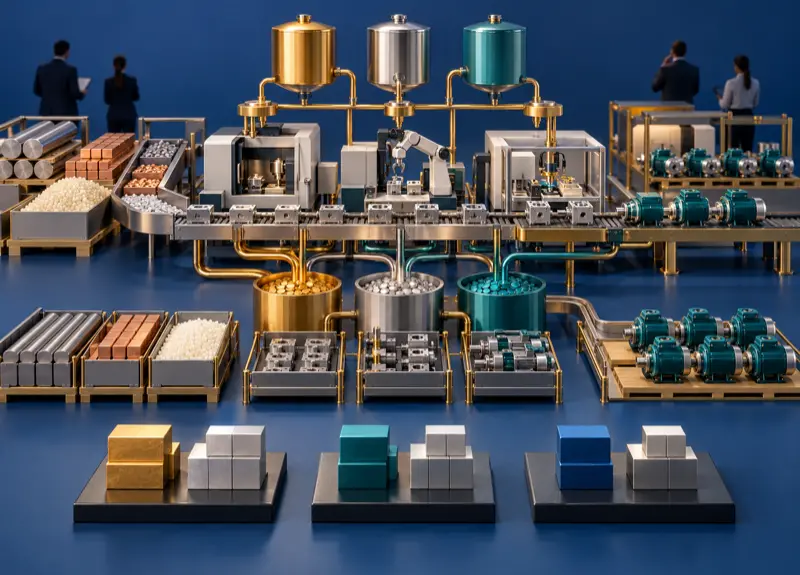
Petrochemical Product Costing and Profitability Training Course

Course Details
-
# 1896_241259
-
21 – 25 June 2027 25.Jun.2027
-
Kuala Lumpur
-
6500 €
Overview
Petrochemical Product Costing and Profitability Training Course is a one-week course for cost accountants, finance analysts, controllers, product managers, and operations analysts who need a defensible product cost model and profitability report. Participants connect continuous process costing with feedstock, utilities, labor, maintenance, overhead, yield, loss, and joint production data. The course resolves inconsistent allocation and margin interpretation through structured calculations and operational evidence. Agile Leaders Training Center delivers this petrochemical product costing course.
Who Should Attend
- Cost accounting teams responsible for conversion cost, inventory cost, and unit-cost calculations
- Financial analysis teams responsible for product margins, variances, and management reporting
- Controlling teams responsible for standard cost governance and cost-center reconciliation
- Product management teams responsible for product-mix and profitability analysis
- Operations analysis teams responsible for connecting production yields and resource consumption to cost
The course assumes participants can interpret manufacturing records and basic management accounts; it leaves out capital-project appraisal, accounting-policy approval, and pricing authorization.
Departments and Industries
The course supports cost and performance decisions across process manufacturing and asset-intensive operations.
- Petrochemical and polymer manufacturing
- Refining and industrial chemicals
- Fertilizer and specialty materials production
- Management accounting and financial control
- Operations planning and performance analysis
Learning Objectives
By the end of this course, participants will be able to:
- Build a continuous process cost model from operational and financial data
- Apply rational methods for joint cost and byproduct allocation
- Analyze yield, loss, price, volume, and usage variances
- Compare standard costing and activity-based costing results
- Evaluate contribution margin, gross margin, and break-even results
- Prioritize product-mix actions through profitability reporting
Course Agenda
Day 1: Cost Structure and Process Flow
- Petrochemical Value-Flow Map and Cost Object Definition
- Direct and Indirect Cost Classification Matrix
- Fixed and Variable Production Overhead Framework
- Continuous Process Costing Ledger and Equivalent Unit Method
- Feedstock, Utilities, Labor, and Maintenance Cost Driver Register
Day 2: Allocation and Unit Cost
- Cost Center Mapping and Shared-Service Allocation Ladder
- Normal Capacity Method for Fixed Overhead Allocation
- Joint Cost Allocation by Physical Measure and Relative Sales Value
- Byproduct Net Realizable Value Credit Method
- Unit Cost Build-Up Sheet and Cost Reconciliation
Day 3: Costing Methods and Variance
- Standard Cost Card for Materials, Energy, and Conversion Resources
- Activity-Based Costing Driver Pool Design
- Actual-to-Standard Cost Bridge
- Price, Usage, Volume, and Mix Variance Tree
- Yield and Abnormal Loss Reconciliation
Day 4: Margin and Product Profitability
- Contribution Margin and Gross Margin Waterfall
- Cost-Volume-Profit and Break-Even Model
- Product Profitability Matrix by Grade and Customer Segment
- Constraint-Based Product Mix Evaluation
- Profitability Dashboard and Management Commentary Template
Day 5: Product Costing Practice and Capstone
- Exercise: Trace Production Data into a Process Cost Ledger
- Exercise: Allocate Joint, Byproduct, and Shared-Service Costs
- Exercise: Diagnose Yield and Cost Variances with a Variance Tree
- Exercise: Compare Product Margins and Product-Mix Alternatives
- Capstone Exercise: Build a Petrochemical Product Cost and Profitability Report
Practical Exercises
Suggested activities convert production and accounting records into traceable product-cost and margin outputs.
- Suggested activity: reconcile material flow, normal loss, abnormal loss, and equivalent units in a continuous process cost model
- Suggested activity: test alternative joint-cost allocation bases and explain their effect on unit cost
- Suggested activity: construct a cost variance bridge linking operational drivers to financial results
- Suggested activity: prepare a profitability dashboard with margin, break-even, and product-mix findings
FAQs
Who suits the Petrochemical Product Costing and Profitability Training Course and what does it assume?
It suits professionals responsible for cost, margin, product, and operations analysis. Participants should already interpret production records and basic management accounts; the course does not authorize accounting policy, capital investment, or selling prices.
How does petrochemical product costing differ from process economic evaluation training?
Petrochemical product costing measures conversion resources, unit cost, variances, and product margins from operating data, while process economic evaluation typically assesses investment alternatives and project cash flows.
How are joint costs handled in petrochemical product costing?
Joint costs are assigned on a rational, consistent basis such as physical measures or relative sales value, then reconciled to the common process cost and the selected reporting purpose.
What does activity-based costing add to petrochemical product profitability analysis?
Activity-based costing assigns shared resources through activity pools and cost drivers, helping analysts test whether conventional allocation masks resource consumption differences among products, grades, or production routes.
How do yield losses affect a petrochemical product cost model?
Yield losses change saleable output and unit cost. A product cost model distinguishes expected and abnormal losses, reconciles quantities, and links yield variance to feedstock, operating conditions, and recorded conversion cost.
Conclusion
Participants take back a Petrochemical Product Cost and Profitability Report linking process quantities, allocated resources, unit cost, variances, and margins. The report creates a traceable basis for discussing cost drivers and product performance across finance and operations. It supports consistent product-mix review without replacing accounting-policy or commercial authority.
Maintenance Training and Engineering Training Courses
Petrochemical Product Costing and Profitability Course (1896_241259)
Course Details
# 1896_241259
21 – 25 June 2027
Kuala Lumpur
Fees : 6500 €
Petrochemical Product Costing and Profitability Training Course runs in Kuala Lumpur over 5 days, with 1 upcoming date in Kuala Lumpur. The course fee is 6,500 €.
All dates in Kuala Lumpur
| Dates | Price | Actions |
|---|---|---|
| 21 – 25 June 2027 | 6,500 € | Register |
Training in Kuala Lumpur
Experience our high-quality training courses in Kuala Lumpur, Malaysia's bustling capital Training courses in Malaysia.
All courses in Kuala LumpurThis course in other cities
- Abu Dhabi
- Accra
- Addis Ababa
- Amman
- Amsterdam
- Athens
- Baku
- Bali
- Bangkok
- Barcelona
- Berlin
- Cairo
- Cape town
- Casablanca
- Chicago
- Doha
- Dubai
- Frankfurt
- Geneva
- Istanbul
- Jakarta
- Johannesburg
- Kuwait
- Lagos
- Langkawi
- Lisbon
- London
- Madrid
- Manama
- Marbella
- Milan
- Montreux
- Munich
- Muscat
- Nairobi
- New York
- Nice
- Paris
- Phuket
- Porto
- Prague
- Rome
- San Diego
- Seoul
- Sharm El-Sheikh
- Singapore
- Tashkent
- Tbilisi
- Tokyo
- Toronto
- Trabzon
- Vienna
- Zanzibar
- Zoom