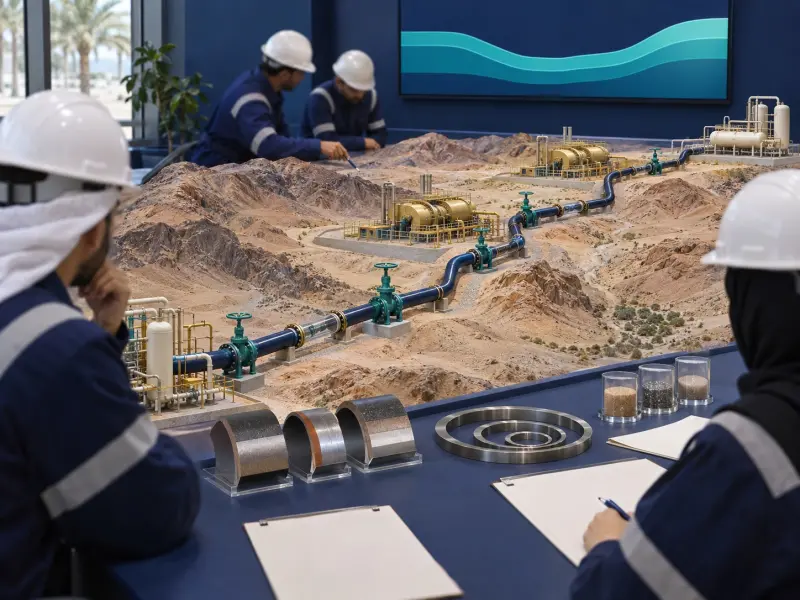
Fundamentals of Offshore Pipeline Engineering Course

Course Details
-
# 1992_247017
-
6 – 10 June 2027 10.Jun.2027
-
Johannesburg
-
6000 €
Overview
Fundamentals of Offshore Pipeline Engineering Course is a one-week foundation course for early-career offshore, subsea, pipeline, mechanical, and project engineers who leave with an Offshore Pipeline Basis and Screening Workbook. Participants connect offshore pipeline engineering fundamentals, submarine pipeline design basis, wall thickness screening, on-bottom stability assessment, free span and VIV screening, and offshore pipeline installation methods through traceable engineering artifacts. Agile Leaders Training Center presents offshore pipeline design and installation.
Who Should Attend
- Engineering functions responsible for pipeline concepts, design inputs, and multidisciplinary interfaces
- Project functions responsible for technical scopes, deliverables, schedules, and design reviews
- Marine and installation functions responsible for route constraints, vessel methods, and field interfaces
- Operations support functions responsible for commissioning handover and design documentation
- Quality and assurance functions responsible for checking assumptions, records, and verification points
The course assumes participants can read basic engineering drawings and data sheets, and it leaves out detailed finite-element analysis, advanced fatigue calculations, integrity-management planning, and detailed cathodic-protection design.
Departments and Industries
The course supports departments and industries that plan, design, install, or interface with offshore pipeline systems.
- Offshore oil and gas field development
- Carbon dioxide transport and offshore storage projects
- Offshore wind export and inter-array infrastructure
- Engineering, procurement, construction, and installation contractors
- Marine surveying, fabrication, inspection, and assurance services
Learning Objectives
By the end of this course, participants will be able to:
- Build a submarine pipeline design basis from route, fluid, environmental, and soil inputs
- Apply foundation checks for pressure containment, collapse, buckling, and wall thickness
- Analyze hydrodynamic loads, on-bottom stability, free spans, and VIV concerns
- Compare S-lay, J-lay, and reel-lay installation methods
- Evaluate protection, tie-in, pre-commissioning, and assurance interfaces
- Prioritize design actions in a screening workbook
Course Agenda
Day 1: Establish the Pipeline Design Basis
- Submarine Pipeline Lifecycle and System Boundary Map
- Route Survey, Bathymetry, and Geohazard Input Register
- Met-ocean, Seabed Soil, and Environmental Data Matrix
- Fluid, Pressure, Temperature, and Operating Case Sheet
- DNV-ST-F101 Design Basis and Safety-Class Checklist
Day 2: Screen Pipe Strength and Materials
- Linepipe Material, Grade, and Fabrication Selection Matrix
- Corrosion Allowance, Coating, and Insulation Interface Sheet
- Pressure Containment and Burst Screening Calculation
- External Pressure Collapse and Ovality Screening Method
- Local Buckling, Propagation Buckling, and Arrestor Decision Map
Day 3: Assess Seabed Response and Stability
- Wave and Current Hydrodynamic Load Input Sheet
- DNV-RP-F109 Lateral and Vertical Stability Screening
- Pipe-Soil Interaction and Embedment Assumption Register
- Free Span Geometry and VIV Screening Checklist
- Thermal Expansion, Global Buckling, and Walking Concept Map
Day 4: Plan Installation and Readiness
- S-Lay, J-Lay, and Reel-Lay Method Selection Matrix
- Shore Approach, Riser, Spool, and Tie-In Interface Diagram
- Trenching, Rock Placement, Mattresses, and Protection Register
- Flooding, Cleaning, Gauging, Testing, and Dewatering Sequence
- Design Review, Verification, and Pre-Commissioning Evidence Plan
Day 5: Practice Offshore Pipeline Decisions
- Suggested Exercise: Build a Route and Design Input Register
- Suggested Exercise: Complete a Wall Thickness Screening Sheet
- Suggested Exercise: Rank Stability and Free Span Concerns
- Suggested Exercise: Select an Installation and Protection Concept
- Capstone Exercise: Complete the Offshore Pipeline Basis and Screening Workbook
Practical Exercises
The course uses suggested activities to connect design inputs, screening checks, installation choices, and assurance evidence.
- Suggested activity: convert route, met-ocean, soil, fluid, pressure, and temperature information into a controlled design-input register.
- Suggested activity: screen pressure containment, collapse, buckling, stability, and free-span concerns using stated assumptions.
- Suggested activity: compare installation methods and protection measures against water depth, pipe condition, route, and vessel constraints.
- Suggested activity: assemble decision points, interfaces, uncertainties, and verification needs in the course workbook.
FAQs
Who suits offshore pipeline engineering fundamentals training, and what does it assume?
Offshore pipeline engineering fundamentals training suits early-career engineering, project, marine, assurance, and operations-support functions. It assumes participants can read basic engineering drawings and data sheets.
How does offshore pipeline engineering training differ from pipeline integrity management training?
Offshore pipeline engineering training focuses on design inputs, structural screening, seabed response, installation, and pre-commissioning. Pipeline integrity management training focuses on in-service threats, inspection data, anomaly assessment, risk-based planning, and intervention decisions.
What is an offshore pipeline design basis?
An offshore pipeline design basis records system boundaries, codes, fluids, pressures, temperatures, route conditions, environmental loads, soil data, materials, operating cases, safety assumptions, and verification requirements.
Why does on-bottom stability matter in submarine pipeline design?
On-bottom stability matters because waves and currents can move an exposed pipeline laterally or vertically. Screening connects hydrodynamic demand, submerged weight, seabed resistance, embedment, and allowable movement.
How are S-lay, J-lay, and reel-lay methods compared?
S-lay, J-lay, and reel-lay methods are compared through water depth, pipe size, material behavior, vessel capability, installation tension, route constraints, production rate, and required field joints.
Conclusion
Participants take back an Offshore Pipeline Basis and Screening Workbook containing design inputs, structural checks, seabed concerns, installation choices, interfaces, and assurance evidence. The workbook changes disconnected assumptions into a traceable early-stage engineering record. It supports concept reviews, contractor discussions, design handoffs, and decisions about specialist analysis.
Oil & Gas Training and Other Technical Courses
Offshore Pipeline Engineering Fundamentals Course (1992_247017)
Course Details
# 1992_247017
6 – 10 June 2027
Johannesburg
Fees : 6000 €
Fundamentals of Offshore Pipeline Engineering Course runs in Johannesburg over 5 days, with 1 upcoming date in Johannesburg. The course fee is 6,000 €.
All dates in Johannesburg
| Dates | Price | Actions |
|---|---|---|
| 6 – 10 June 2027 | 6,000 € | Register |
Training in Johannesburg
Aerial view of Johannesburg skyline featuring modern skyscrapers, vibrant urban energy, and a dynamic cityscape under clear blue skies.
All courses in JohannesburgThis course in other cities
- Abu Dhabi
- Accra
- Addis Ababa
- Amman
- Amsterdam
- Athens
- Baku
- Bali
- Bangkok
- Barcelona
- Berlin
- Cairo
- Cape town
- Casablanca
- Chicago
- Doha
- Dubai
- Frankfurt
- Geneva
- Istanbul
- Jakarta
- Kuala Lumpur
- Kuwait
- Lagos
- Langkawi
- Lisbon
- London
- Madrid
- Manama
- Marbella
- Milan
- Montreux
- Munich
- Muscat
- Nairobi
- New York
- Nice
- Paris
- Phuket
- Porto
- Prague
- Rome
- San Diego
- Seoul
- Sharm El-Sheikh
- Singapore
- Tashkent
- Tbilisi
- Tokyo
- Toronto
- Trabzon
- Vienna
- Zanzibar
- Zoom