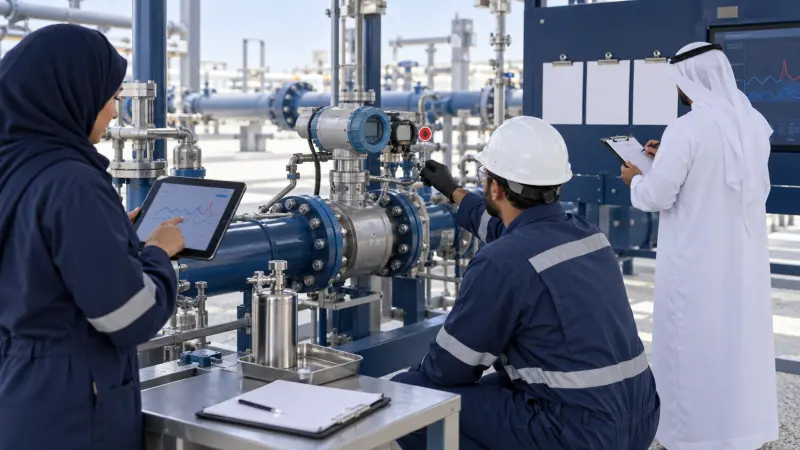
Oil and Gas Tariff, Metering and Billing Assurance Training Course

Course Details
-
# 2018_248619
-
21 – 25 March 2027 25.Mar.2027
-
Nairobi
-
6000 €
Overview
Oil and Gas Tariff, Metering and Billing Assurance Training Course is a one-week intermediate course for commercial, metering, billing, customer service, operations, and revenue-assurance professionals who leave with a Meter-to-Bill Assurance Pack. Participants connect tariff rules, measurement equipment, service configurations, consumption records, and charge calculations to find discrepancies and protect billable revenue. The course uses equipment maps, data-lineage checks, reconciliation methods, exception analysis, and control design. Agile Leaders Training Center presents this course on oil and gas tariff, metering, and billing assurance.
Who Should Attend
- Teams responsible for interpreting commercial tariffs and service agreements
- Functions responsible for meter selection, configuration, reading, and validation
- Professionals responsible for bill calculation, adjustment, and customer queries
- Operations teams responsible for field equipment and service continuity
- Analysts responsible for revenue leakage, reconciliation, and control monitoring
- Managers responsible for measurement-to-cash performance
The course assumes participants can work with basic consumption, billing, or operating records; it leaves out legal advice, jurisdiction-specific tariff rulings, and meter repair.
Departments and Industries
The course supports departments and industries that convert measured consumption into commercial charges.
- Oil and gas production, processing, pipeline, and distribution organizations
- Refining, terminals, storage, and petroleum-product operations
- Gas utilities and industrial energy-service providers
- Commercial, contracts, pricing, and customer-service departments
- Metering, instrumentation, operations, and maintenance functions
- Finance, billing, audit, and revenue-assurance teams
Learning Objectives
By the end of this course, participants will be able to:
- Analyze tariff structures and billing determinants
- Compare metering equipment and service configurations
- Build meter-to-bill data lineage
- Apply consumption and charge reconciliation methods
- Diagnose billing leakage and exception causes
- Prioritize assurance controls and corrective actions
Course Agenda
Day 1: Map Tariffs and Billing Determinants
- Tariff Component and Charge Driver Map
- Customer Segment and Service Classification Matrix
- Contract, Tariff, and Billing Rule Hierarchy
- Fixed, Variable, and Threshold Charge Model
- Tariff Assumption and Evidence Register
Day 2: Identify Metering Equipment and Configurations
- Primary, Secondary, and Tertiary Device Map
- Meter, Transmitter, Flow Computer, and Valve Identification Guide
- Pressure, Temperature, Density, and Volume Correction Chain
- Service Point and Metering Configuration Diagram
- Installation Condition and Measurement Uncertainty Checklist
Day 3: Trace Consumption into Bills
- Meter-to-Bill Data Lineage Model
- Reading, Validation, Estimation, and Substitution Workflow
- Unit Conversion and Billing Quantity Calculation Sheet
- Consumption Period and Billing Cycle Alignment Test
- Charge Calculation and Invoice Reconstruction Method
Day 4: Detect Leakage and Design Controls
- Revenue Leakage Cause-and-Effect Map
- Meter, Master Data, Tariff, and Billing Exception Library
- Consumption-to-Invoice Reconciliation Template
- Exception Materiality and Root-Cause Prioritization Matrix
- Preventive, Detective, and Corrective Control Catalogue
Day 5: Practice Meter-to-Bill Assurance
- Suggested Exercise: Classify Tariff and Service Rules
- Suggested Exercise: Identify Equipment from a Metering Diagram
- Suggested Exercise: Reconstruct a Consumption Charge
- Suggested Exercise: Investigate a Billing Leakage Case
- Capstone Exercise: Present a Meter-to-Bill Assurance Pack
Practical Exercises
The course uses suggested activities to connect field measurement, commercial rules, and billing evidence.
- Suggested activity: map equipment, correction inputs, data owners, and handoffs for an oil transfer or gas service point.
- Suggested activity: rebuild billable consumption and charges from meter readings, conversion factors, tariff rules, and billing periods.
- Suggested activity: diagnose exceptions across meter data, customer master data, tariff assignment, and invoice calculation.
- Suggested activity: design control ownership, evidence, thresholds, and corrective actions for recurring leakage risks.
FAQs
Who suits oil and gas tariff, metering and billing assurance training, and what does it assume?
Commercial, metering, billing, customer-service, operations, audit, and revenue-assurance professionals suit the training. It assumes experience with basic consumption, billing, contract, or operating records.
How does meter-to-bill assurance differ from general oil and gas accounting training?
Meter-to-bill assurance traces physical measurement, service configuration, tariff assignment, billing quantity, and invoice calculation. General accounting training focuses more broadly on financial recognition, reporting, cost allocation, and controls.
How are oil and gas tariff charges reconciled with measured consumption?
Reconciliation aligns the service point, meter reading, correction inputs, units, consumption period, customer classification, tariff version, charge drivers, adjustments, and invoice totals in one traceable record.
Which equipment affects oil and gas billing accuracy?
Billing accuracy can depend on meters, primary flow devices, transmitters, pressure and temperature instruments, flow computers, valves, communication devices, and the master-data configuration that connects them to an account.
What causes revenue leakage in oil and gas billing?
Revenue leakage can arise from missing readings, faulty estimates, incorrect units, unrecorded equipment changes, wrong tariff assignments, incomplete customer data, billing-cycle misalignment, calculation errors, or unresolved exceptions.
Conclusion
Participants take a Meter-to-Bill Assurance Pack back to their organization. It combines tariff logic, equipment identification, data lineage, reconstructed charges, exception findings, and prioritized controls. Teams can use it to investigate discrepancies, assign corrective actions, and strengthen the connection between measured consumption and invoiced revenue.
Oil & Gas Training and Other Technical Courses
Oil and Gas Tariff and Billing Assurance Course (2018_248619)
Course Details
# 2018_248619
21 – 25 March 2027
Nairobi
Fees : 6000 €
Oil and Gas Tariff, Metering and Billing Assurance Training Course runs in Nairobi over 5 days, with 1 upcoming date in Nairobi. The course fee is 6,000 €.
All dates in Nairobi
| Dates | Price | Actions |
|---|---|---|
| 21 – 25 March 2027 | 6,000 € | Register |
Training in Nairobi
Experience our top-notch training course programs in the vibrant city of Nairobi, Kenya.
All courses in NairobiThis course in other cities
- Abu Dhabi
- Accra
- Addis Ababa
- Amman
- Amsterdam
- Athens
- Baku
- Bali
- Bangkok
- Barcelona
- Berlin
- Cairo
- Cape town
- Casablanca
- Chicago
- Doha
- Dubai
- Frankfurt
- Geneva
- Istanbul
- Jakarta
- Johannesburg
- Kuala Lumpur
- Kuwait
- Lagos
- Langkawi
- Lisbon
- London
- Madrid
- Manama
- Marbella
- Milan
- Montreux
- Munich
- Muscat
- New York
- Nice
- Paris
- Phuket
- Porto
- Prague
- Rome
- San Diego
- Seoul
- Sharm El-Sheikh
- Singapore
- Tashkent
- Tbilisi
- Tokyo
- Toronto
- Trabzon
- Vienna
- Zanzibar
- Zoom