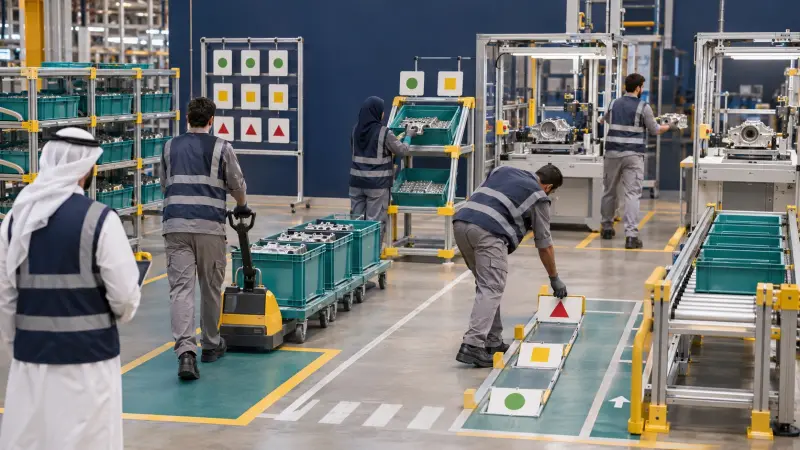
Manufacturing Processes and Process Selection Fundamentals Training Course

Course Details
-
# 2066_251526
-
6 – 10 September 2027 10.Sep.2027
-
Cairo
-
5200 €
Overview
Manufacturing Processes and Process Selection Fundamentals Training Course is a one-week foundation course for manufacturing engineers, production supervisors, process technicians, quality engineers, maintenance engineers, and early-career industrial professionals who leave with a Manufacturing Route Selection File. Participants connect engineering materials, manufacturing process families, production evidence, and selection trade-offs for metal, polymer, and composite components. The course uses manufacturing process selection methods, process capability evidence, and manufacturing quality controls. Agile Leaders Training Center presents manufacturing processes fundamentals through practical route decisions.
Who Should Attend
- Manufacturing functions responsible for defining process routes, work methods, and production requirements
- Production functions responsible for converting drawings and material requirements into repeatable operations
- Process functions responsible for machine settings, tooling choices, and defect prevention
- Quality functions responsible for metrology, capability evidence, inspection plans, and nonconformance analysis
- Maintenance functions responsible for equipment condition, process stability, and production support
- Early-career engineering functions building a working foundation in manufacturing technology
The course assumes participants can read basic engineering drawings or production instructions and leaves production planning, lean management, welding specialization, DFMA, maintenance strategy, and manufacturing finance outside scope.
Departments and Industries
The course supports departments and industries that select, operate, verify, and improve component manufacturing routes.
- Manufacturing engineering, industrial engineering, and technical services
- Production, machining, fabrication, and assembly operations
- Quality assurance, metrology, inspection, and supplier quality
- Automotive, aerospace, machinery, and metal-products manufacturing
- Polymer, packaging, consumer-products, and composite manufacturing
- Energy-equipment, medical-device, and industrial-component operations
Learning Objectives
By the end of this course, participants will be able to:
- Apply material-process relationships to component requirements.
- Compare casting, forming, machining, joining, polymer, and additive routes.
- Use cutting parameters and joining variables to evaluate process windows.
- Analyze capability, metrology, defect, and quality evidence.
- Evaluate safety, cost, energy, waste, and sustainability trade-offs.
- Build a manufacturing route selection file.
Course Agenda
Day 1: Frame the Manufacturing Route
- Engineering Material Property and Process Compatibility Matrix
- Mass-Reducing, Mass-Conserving, Joining, and Finishing Process Map
- Component Geometry, Tolerance, Surface, and Volume Requirement Sheet
- Manufacturing Process Selection Criteria and Screening Method
- Safety Hazard, Resource, Cost, and Sustainability Trade-Off Register
Day 2: Shape Metals and Polymers
- Casting Pattern, Mold, Solidification, and Allowance Decision Map
- Casting Defect Cause-and-Evidence Analysis Sheet
- Bulk-Forming Load, Flow, Temperature, and Lubrication Matrix
- Sheet-Metal Cutting, Bending, Springback, and Formability Checklist
- Polymer Molding and Composite Processing Selection Grid
Day 3: Remove Material and Join Components
- Machining Operation, Tool, Machine, and Workholding Selection Tree
- Cutting Speed, Feed, Depth, Tool-Life, and Finish Calculation Sheet
- Machining Variation, Burr, Wear, and Surface-Defect Diagnostic Map
- Welding and Mechanical Joining Process Compatibility Matrix
- Joint Preparation, Heat Input, Distortion, and Inspection Control Plan
Day 4: Finish, Measure, and Qualify Production
- Heat Treatment and Surface-Finishing Route Selection Table
- Additive Manufacturing Process, Feedstock, Support, and Post-Processing Map
- Measurement Strategy, Datum, Gauge, and Sampling Plan
- Process Capability, Variation, and Acceptance Evidence File
- Quality Control Plan and Manufacturing Defect Escalation Workflow
Day 5: Practice Manufacturing Process Selection
- Suggested Exercise: Screen Casting, Forming, and Machining Routes for a Housing
- Suggested Exercise: Diagnose Forming, Machining, and Joining Defect Evidence
- Suggested Exercise: Compare Polymer, Composite, and Additive Routes for a Bracket
- Suggested Exercise: Balance Quality, Safety, Cost, Waste, and Energy Trade-Offs
- Capstone Exercise: Present a Manufacturing Route Selection File
Practical Exercises
The course uses suggested activities to turn component requirements and manufacturing evidence into route decisions.
- Suggested activity: match materials, geometry, tolerances, volumes, and surface requirements to viable process families.
- Suggested activity: calculate machining parameters and diagnose tool-wear, finish, and dimensional evidence.
- Suggested activity: compare casting, forming, joining, polymer, composite, and additive alternatives for industrial components.
- Suggested activity: assemble a route file with capability, inspection, defect, safety, cost, and sustainability evidence.
FAQs
Who suits manufacturing processes fundamentals training, and what does it assume?
Manufacturing processes fundamentals training suits production, process, quality, maintenance, and early-career engineering functions and assumes participants can interpret basic drawings, material requirements, or work instructions.
How does manufacturing process selection training differ from production planning training?
Manufacturing process selection training chooses how a component is made from material, geometry, tolerance, quality, and process evidence, while production planning training schedules capacity, labor, inventory, and orders.
How is a manufacturing process selected for a component?
A manufacturing process is selected by screening material compatibility, geometry, tolerance, surface finish, production volume, equipment, capability, inspection, safety, cost, energy, waste, and post-processing requirements.
What evidence is used to diagnose manufacturing process defects?
Manufacturing defect diagnosis uses drawings, process settings, material records, measurements, surface observations, tool and equipment condition, inspection results, capability data, and traceable comparisons with the approved process window.
When is additive manufacturing compared with conventional manufacturing processes?
Additive manufacturing is compared when geometry, material, quantity, support needs, post-processing, tolerance, surface, qualification evidence, lead-time constraints, and waste trade-offs could change the preferred route.
Conclusion
Participants take a Manufacturing Route Selection File back to their organization. It links component requirements to material choices, process alternatives, settings, capability, inspection, defect controls, safety, cost, and sustainability evidence. The file changes isolated process preferences into a traceable basis for selecting and reviewing how a component will be made.
Maintenance Training and Engineering Training Courses
Manufacturing Processes Fundamentals Training Course (2066_251526)
Course Details
# 2066_251526
6 – 10 September 2027
Cairo
Fees : 5200 €
Manufacturing Processes and Process Selection Fundamentals Training Course runs in Cairo over 5 days, with 1 upcoming date in Cairo. The course fee is 5,200 €.
All dates in Cairo
| Dates | Price | Actions |
|---|---|---|
| 6 – 10 September 2027 | 5,200 € | Register |
Training in Cairo
Join us in the historic city of Cairo, Egypt, and enrich your knowledge with our industry-leading training courses.
All courses in CairoThis course in other cities
- Abu Dhabi
- Accra
- Addis Ababa
- Amman
- Amsterdam
- Athens
- Baku
- Bali
- Bangkok
- Barcelona
- Berlin
- Cape town
- Casablanca
- Chicago
- Doha
- Dubai
- Frankfurt
- Geneva
- Istanbul
- Jakarta
- Johannesburg
- Kuala Lumpur
- Kuwait
- Lagos
- Langkawi
- Lisbon
- London
- Madrid
- Manama
- Marbella
- Milan
- Montreux
- Munich
- Muscat
- Nairobi
- New York
- Nice
- Paris
- Phuket
- Porto
- Prague
- Rome
- San Diego
- Seoul
- Sharm El-Sheikh
- Singapore
- Tashkent
- Tbilisi
- Tokyo
- Toronto
- Trabzon
- Vienna
- Zanzibar
- Zoom