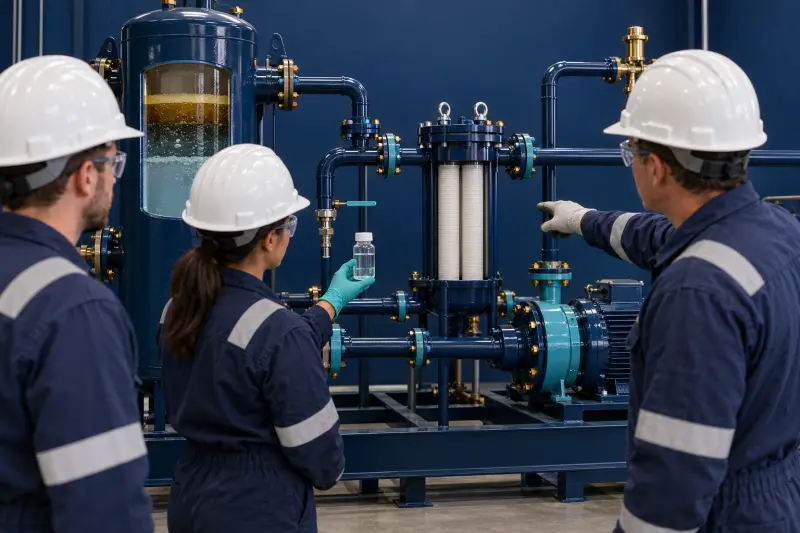
Oilfield Production Chemistry and Chemical Treatment Training Course

Course Details
-
# 2072_251922
-
13 – 17 December 2026 17.Dec.2026
-
Nairobi
-
6000 €
Overview
Oilfield Production Chemistry and Chemical Treatment Training Course is a one-week course for production chemists, petroleum and flow assurance engineers, operations personnel, laboratory specialists, and chemical treatment teams who leave with a Production Chemistry Control Pack. Participants connect representative sampling, fluid chemistry, deposition and corrosion risks, treatment selection, injection performance, and surveillance evidence. Agile Leaders Training Center develops applied oilfield production chemistry practice.
Who Should Attend
- Production chemistry functions responsible for fluid characterization, treatment selection, and performance review
- Flow assurance functions responsible for scale, hydrates, wax, asphaltenes, emulsions, and deposition risks
- Operations functions responsible for chemical injection, sampling, field observations, and response actions
- Laboratory functions responsible for sample integrity, testing, compatibility, residuals, and result quality
- Asset integrity functions responsible for corrosion, microbial risks, produced-water chemistry, and treatment evidence
The course assumes participants can interpret production conditions, laboratory results, and operating records, and it leaves chemical formulation, hazardous laboratory procedures, and site-specific injection authorization outside scope.
Departments and Industries
The course supports departments and industries that manage production-fluid chemistry and chemical treatment.
- Oil and gas production, gathering, processing, and flow assurance teams
- Offshore, onshore, subsea, and mature-field operations
- Production laboratories, chemical services, and technical support groups
- Produced-water treatment, water injection, and asset integrity departments
- Pipeline, terminal, separation, and surface-facility operations
Learning Objectives
By the end of this course, participants will be able to:
- Build a representative sampling and fluid-analysis plan.
- Analyze scale, corrosion, hydrate, wax, asphaltene, and emulsion risks.
- Evaluate produced-water and microbial chemistry evidence.
- Compare chemical-treatment candidates using fit-for-purpose tests.
- Diagnose injection, compatibility, dosage, and monitoring problems.
- Build treatment KPIs and an optimization action record.
Course Agenda
Day 1: Establish Production Chemistry Evidence
- Production System Chemistry Boundary Map
- Representative Fluid Sampling and Preservation Plan
- Brine Ion, Hydrocarbon, Gas, and Solids Data Sheet
- Laboratory Result Quality and Detection-Limit Review
- Chemistry Risk Register and Surveillance Baseline
Day 2: Assess Inorganic and Integrity Risks
- Scale Saturation and Water Compatibility Screen
- Corrosion Mechanism and Fluid Corrosivity Matrix
- Iron, Solids, Residual, and Corrosion Monitoring Trend
- Produced-Water Treatment Chemistry Map
- Microbial Sampling, Biofilm, and Deposit Evidence Guide
Day 3: Assess Flow Assurance Chemistry
- Hydrate Formation and Inhibitor Decision Map
- Wax Appearance and Deposition Risk Screen
- Asphaltene Stability and Precipitation Test Plan
- Emulsion Bottle Test and Demulsifier Selection Matrix
- Foam, Naphthenate, and Mixed-Deposit Diagnostic Guide
Day 4: Select and Monitor Treatment
- Chemical Candidate Qualification and Compatibility Matrix
- Dosage Basis and Injection Location Review
- Storage, Pump, Quill, and Injection-System Checksheet
- Residual, Performance, and Treatment KPI Dashboard
- Treatment Failure Troubleshooting and Optimization Log
Day 5: Practice Production Chemistry Control
- Suggested Exercise: Validate a Fluid Sampling Plan
- Suggested Exercise: Diagnose a Scale and Corrosion Scenario
- Suggested Exercise: Compare Flow Assurance Chemical Options
- Suggested Exercise: Correct an Injection Performance Problem
- Capstone Exercise: Present a Production Chemistry Control Pack
Practical Exercises
The course uses suggested activities based on production-fluid, laboratory, and treatment evidence.
- Suggested activity: identify sampling bias and build a chain from field conditions to interpretable laboratory results.
- Suggested activity: evaluate scale, corrosion, deposition, emulsion, produced-water, and microbial evidence for a production system.
- Suggested activity: compare candidate treatments using compatibility, performance, deployment, monitoring, and risk criteria.
- Suggested activity: diagnose an underperforming injection point and define corrective checks, KPIs, and follow-up sampling.
FAQs
Who suits oilfield production chemistry training, and what does it assume?
Oilfield production chemistry training suits chemistry, petroleum, flow assurance, operations, laboratory, and treatment personnel who interpret production conditions, test results, and operating records.
How does production chemistry differ from petroleum production engineering?
Production chemistry concentrates on fluid reactions, deposits, corrosion, water chemistry, microbes, chemical selection, and treatment performance, while production engineering covers the wider well and production-system performance.
Why is representative sampling important in oilfield production chemistry?
Representative sampling links test results to actual pressure, temperature, phase, location, contamination risk, preservation, timing, and operating conditions, allowing treatment decisions to use defensible evidence.
How is oilfield chemical-treatment performance monitored?
Treatment performance is monitored through injection rate and uptime, chemical residuals, corrosion and scale indicators, water and deposit analysis, process response, failures, sampling quality, and agreed operating KPIs.
Conclusion
Participants take a Production Chemistry Control Pack back to their organization. It combines sampling plans, chemistry screens, treatment qualification tools, injection checks, surveillance trends, KPIs, and troubleshooting records. The pack turns field and laboratory evidence into traceable chemical-treatment decisions and optimization actions.
Oil & Gas Training and Other Technical Courses
Oilfield Production Chemistry Training Course (2072_251922)
Course Details
# 2072_251922
13 – 17 December 2026
Nairobi
Fees : 6000 €
Oilfield Production Chemistry and Chemical Treatment Training Course runs in Nairobi over 5 days, with 1 upcoming date in Nairobi. The course fee is 6,000 €.
All dates in Nairobi
| Dates | Price | Actions |
|---|---|---|
| 13 – 17 December 2026 | 6,000 € | Register |
Training in Nairobi
Experience our top-notch training course programs in the vibrant city of Nairobi, Kenya.
All courses in NairobiThis course in other cities
- Abu Dhabi
- Accra
- Addis Ababa
- Amman
- Amsterdam
- Athens
- Baku
- Bali
- Bangkok
- Barcelona
- Berlin
- Cairo
- Cape town
- Casablanca
- Chicago
- Doha
- Dubai
- Frankfurt
- Geneva
- Istanbul
- Jakarta
- Johannesburg
- Kuala Lumpur
- Kuwait
- Lagos
- Langkawi
- Lisbon
- London
- Madrid
- Manama
- Marbella
- Milan
- Montreux
- Munich
- Muscat
- New York
- Nice
- Paris
- Phuket
- Porto
- Prague
- Rome
- San Diego
- Seoul
- Sharm El-Sheikh
- Singapore
- Tashkent
- Tbilisi
- Tokyo
- Toronto
- Trabzon
- Vienna
- Zanzibar
- Zoom